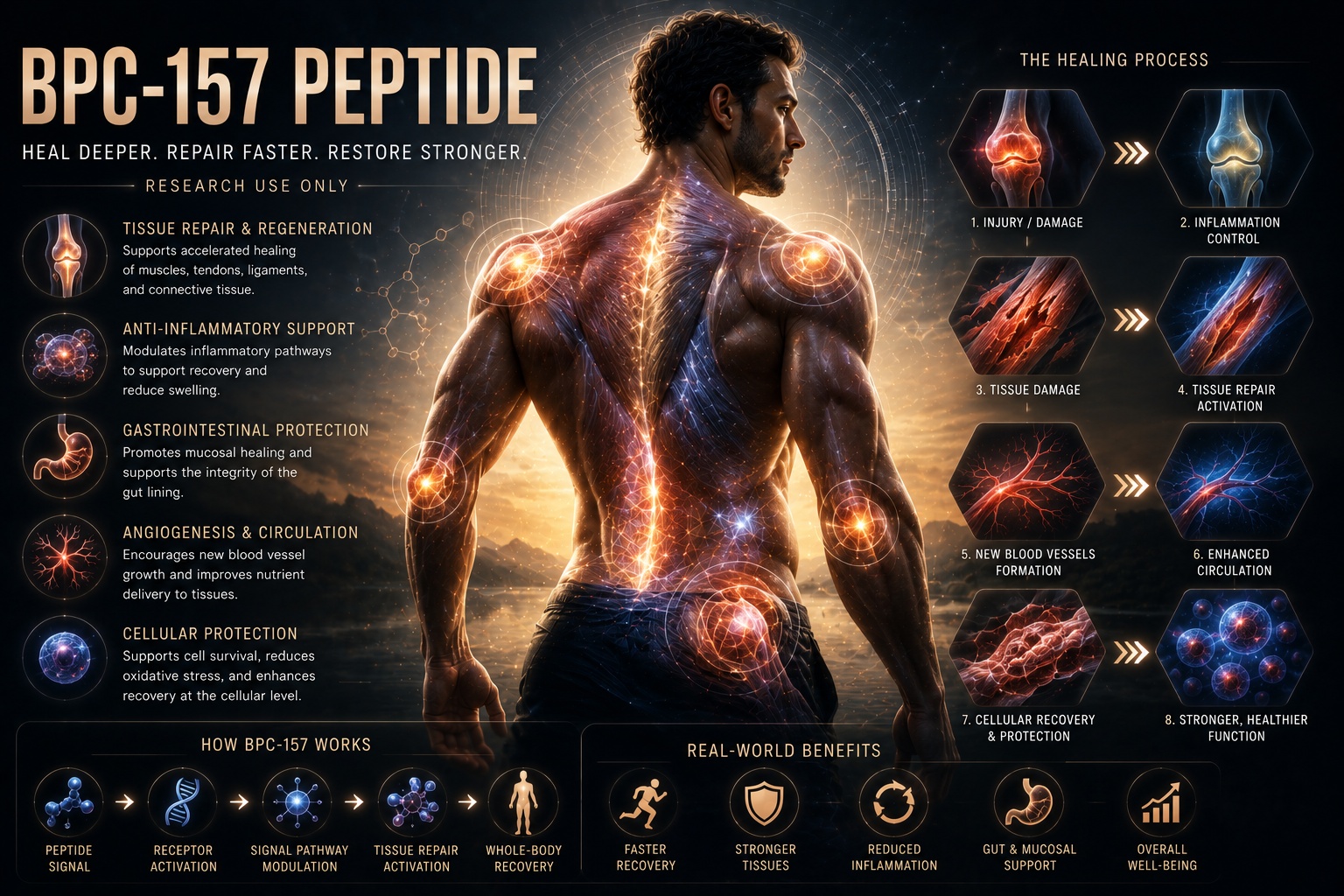
Is BPC-157 Legal? WADA, FDA Status, and What You Need to Know
# BPC-157: Is It Legal?
BPC-157 has become one of the most talked-about peptides in:
* Athletic recovery
* Injury rehabilitation
* Biohacking
* Longevity optimization
* Gut-health support
Many users are drawn to its potential effects involving:
→ Tendon healing
→ Muscle recovery
→ Joint support
→ Gut repair
→ Inflammation regulation
But before considering BPC-157, one major question remains:
→ Is BPC-157 actually legal?
The answer is:
→ Complicated
BPC-157 currently exists within a:
→ Regulatory gray area
It is:
→ Not FDA-approved
→ Prohibited by WADA
→ Restricted by military organizations
yet still widely sold online through:
→ Research peptide vendors
This educational guide explains:
* FDA status of BPC-157
* WADA and anti-doping rules
* Military restrictions
* International legality
* Supplement and prescription regulations
* Drug-testing concerns
* Risks consumers should understand
—
# What Is BPC-157?
BPC-157 stands for:
→ Body Protection Compound-157
and is classified as a:
→ Synthetic pentadecapeptide
derived from:
→ Protective proteins found in gastric juice
—
# Why BPC-157 Became Popular
Research commonly explores its potential role involving:
→ Tendon repair
→ Muscle healing
→ Angiogenesis
→ Gut-lining support
→ Connective-tissue recovery
—
# Why Regulation Became A Concern
As interest in BPC-157 grew within:
→ Sports
→ Recovery clinics
→ Biohacking communities
regulatory agencies began raising concerns involving:
→ Safety
→ Purity
→ Human evidence
→ Performance-enhancement potential
—
# FDA Status: Is BPC-157 Approved?
## FDA Approval Status
BPC-157 is:
→ NOT approved by the U.S. Food and Drug Administration (FDA)
for:
→ Human or veterinary therapeutic use
—
## How The FDA Classifies BPC-157
The FDA currently treats BPC-157 as:
→ An unapproved new drug
meaning it cannot legally be:
→ Prescribed as a medication
→ Marketed as a therapeutic drug
→ Sold as a dietary supplement
—
## FDA Concerns
The FDA has stated that BPC-157:
→ Lacks sufficient human safety and efficacy data
—
## Compounding Restrictions
The FDA has also rejected BPC-157 for:
→ 503B pharmacy compounding
meaning licensed outsourcing facilities cannot legally include it in:
→ Compounded medications
—
## What This Means For Consumers
Although BPC-157 is widely sold online, products are commonly labeled as:
→ “Research use only”
rather than:
→ Approved human-use therapies
—
# Can Supplement Companies Sell BPC-157?
## Dietary Supplement Status
BPC-157 is:
→ Not recognized as a legal dietary ingredient
under U.S. supplement law.
—
## Why This Matters
Companies are not legally allowed to market BPC-157 as:
→ A dietary supplement for human consumption
—
## Common Loophole
Many vendors attempt to avoid regulatory enforcement by labeling BPC-157 as:
→ “Research chemical”
→ “Not for human consumption”
while still indirectly marketing recovery-related benefits.
—
## Product Quality Risks
Because BPC-157 exists outside normal FDA oversight, potential concerns may include:
→ Contamination
→ Incorrect dosing
→ Counterfeit products
→ Poor sterility
—
# WADA Status: Is BPC-157 Banned In Sports?
## WADA Classification
The World Anti-Doping Agency (WADA) added BPC-157 to its:
→ Prohibited List under Section S0
which covers:
→ Non-approved substances
—
## What “S0” Means
Section S0 includes substances that:
→ Are not approved by recognized health authorities for human therapeutic use
—
## Is BPC-157 Banned In Competition?
Yes.
BPC-157 is prohibited:
→ Both in competition and out of competition
for athletes governed by:
→ WADA
→ USADA
→ Olympic federations
→ UFC anti-doping programs
—
## Are Therapeutic Use Exemptions (TUEs) Allowed?
Currently:
→ No Therapeutic Use Exemptions (TUEs) exist for BPC-157
because it has:
→ No approved medical use
—
## What Happens If An Athlete Tests Positive?
Potential consequences may include:
→ Suspension
→ Disqualification
→ Loss of titles or rankings
→ Anti-doping sanctions
—
# Can BPC-157 Be Detected?
## Standard Drug Tests
Most routine workplace drug tests do NOT screen for:
→ Peptides like BPC-157
—
## Advanced Anti-Doping Testing
Professional anti-doping organizations may use:
→ Specialized peptide-detection methods
such as:
→ LC-MS/MS testing
—
## Detection Windows
Exact detection windows remain unclear, but advanced testing may potentially detect:
→ Peptide fragments or biomarkers
for a limited period after administration.
—
# Military Restrictions & Department Of Defense (DoD) Policies
## Department Of Defense Position
The U.S. Department of Defense (DoD), through:
→ Operation Supplement Safety (OPSS)
has identified BPC-157 as:
→ A prohibited substance for service members
—
## Why The Military Restricts It
Potential concerns include:
→ Lack of FDA approval
→ Unknown long-term safety
→ Performance-enhancement concerns
→ Unregulated product quality
—
## What This Means For Service Members
Military personnel using BPC-157 may face:
→ Administrative action
→ Disciplinary consequences
→ Compliance violations
—
# International Legality Of BPC-157
## Canada
BPC-157 is:
→ Not approved by Health Canada
and is generally unavailable through:
→ Licensed medical channels
—
## Australia
BPC-157 is commonly classified as:
→ Prescription-only or restricted-use
and may not be legally imported without authorization.
—
## European Union
Regulations vary between countries, but BPC-157 is generally:
→ Not approved for therapeutic human use
—
# Can You Buy BPC-157 Online?
## Availability
Yes. BPC-157 is widely sold online through:
→ Research peptide vendors
—
## Important Distinction
Buying BPC-157 online does NOT mean it is:
→ FDA-approved or medically authorized
—
## Why Online Sales Continue
Many companies rely on:
→ “Research use only” disclaimers
to reduce regulatory risk.
—
## Risks Of Online Peptide Vendors
Potential concerns commonly include:
→ Fake peptides
→ Incorrect dosing
→ Low purity
→ Contamination
→ Misleading labeling
—
## How To Evaluate Vendors
Potential best practices commonly discussed include:
→ Third-party testing
→ Certificate of Analysis (CoA)
→ Verified purity testing
→ Transparent sourcing information
—
# Legal Alternatives Often Discussed
Some individuals seeking recovery support instead explore legal wellness and nutritional strategies such as:
→ Collagen protein
→ L-glutamine
→ Omega-3 support
→ Structured rehabilitation
→ Sleep and recovery optimization
—
# Important Safety Considerations
Current research involving BPC-157 remains:
→ Limited primarily to preclinical and small-scale evidence
Long-term human safety remains:
→ Unknown
—
## Potential Concerns
Areas still requiring more research include:
→ Chronic exposure effects
→ Angiogenesis-related risks
→ Immune-system interactions
→ Long-term systemic impact
—
# FAQ: Is BPC-157 Legal?
## Is BPC-157 FDA-approved?
No. BPC-157 is not approved by the FDA for:
→ Human therapeutic use
—
## Can doctors prescribe BPC-157?
No. Licensed providers cannot legally prescribe BPC-157 as an approved medication.
—
## Is BPC-157 banned in sports?
Yes. WADA prohibits BPC-157:
→ Both in and out of competition
—
## Is BPC-157 legal for military personnel?
No. The U.S. Department of Defense classifies BPC-157 as:
→ A prohibited substance
—
## Why can BPC-157 still be sold online?
Most vendors sell it under:
→ “Research use only” classifications
rather than:
→ Approved human-use labeling
—
## Can BPC-157 show up on a drug test?
Standard drug tests usually do not screen for BPC-157, but:
→ Specialized anti-doping tests may potentially detect it
—
# Conclusion: What You Need To Know About BPC-157 Legality
Although BPC-157 is widely discussed for:
→ Recovery
→ Gut healing
→ Joint repair
→ Athletic rehabilitation
its legal and regulatory status remains:
→ Highly restricted and uncertain
Currently:
→ It is NOT FDA-approved
→ It is banned by WADA
→ It is prohibited for military personnel
→ It cannot legally be marketed as a dietary supplement
Despite being widely available online, BPC-157 products are generally sold only as:
→ Research-use compounds
with:
→ No guarantees of purity, dosing accuracy, or long-term safety
Potential recovery-focused benefits commonly discussed include:
→ Tendon repair
→ Gut-health support
→ Reduced inflammation
→ Connective-tissue healing
However, despite growing popularity and promising preclinical findings, BPC-157 still remains:
→ Experimental
with:
→ Limited human clinical evidence
→ Ongoing scientific uncertainty
→ Significant regulatory concerns
For now, individuals considering BPC-157 should fully understand:
→ The legal risks
→ Athletic consequences
→ Product-quality concerns
→ Lack of FDA approval
before deciding whether its potential recovery benefits outweigh the regulatory uncertainty.