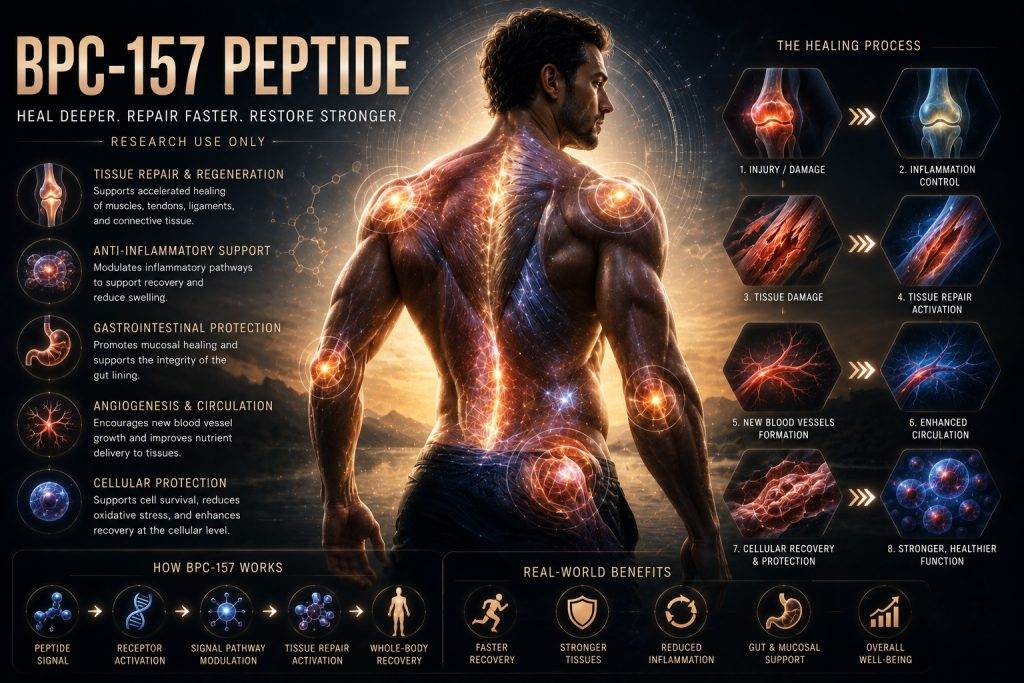
Recovery has become one of the most important aspects of:
• Athletic performance
• Injury rehabilitation
• Longevity optimization
• Wellness-focused training
• Modern peptide therapy
Among the most talked-about regenerative peptides are:
→ TB500
and
→ BPC-157
Both compounds are frequently discussed for:
→ Tissue healing
→ Injury recovery
→ Connective-tissue support
→ Recovery optimization
Yet despite their similarities, these peptides work through:
→ Very different biological mechanisms
TB500 is generally viewed as:
→ A systemic recovery peptide
focused on:
→ Cell migration
→ Angiogenesis
→ Tissue remodeling
Meanwhile, BPC-157 is often associated more strongly with:
→ Tendon, ligament, gut, and localized tissue healing
This educational guide explores:
• What TB500 and BPC-157 are
• How each peptide works
• Recovery and performance benefits
• Differences in healing applications
• Side effects and safety
• Legal and WADA considerations
• Which peptide may fit different recovery goals
What Is TB500?
TB500 is a:
→ Synthetic peptide fragment
derived from:
→ Thymosin Beta-4 (TB4)
More specifically, TB500 represents:
→ The N-acetylated 17–23 fragment (Ac-LKKTETQ)
of the larger TB4 protein.
Why TB500 Became Popular
Researchers became interested in TB4 because of its role in:
→ Cell migration
→ Tissue repair
→ Angiogenesis
→ Recovery signaling
TB500 was developed to isolate many of these:
→ Regenerative properties
into a smaller peptide fragment.
Key Characteristics of TB500
Potential areas commonly discussed include:
→ Muscle recovery
→ Connective-tissue healing
→ Recovery from overtraining
→ Systemic tissue regeneration
What Is BPC-157?
BPC-157 stands for:
→ Body Protection Compound-157
and is classified as a:
→ Gastric-derived pentadecapeptide
meaning it contains:
→ 15 amino acids
Why BPC-157 Became Popular
BPC-157 gained attention because of extensive preclinical research involving:
→ Tendon healing
→ Ligament repair
→ Gastrointestinal protection
→ Neuroprotective signaling
Unlike TB500, BPC-157 is often viewed as:
→ More localized and tissue-specific
particularly involving:
→ Tendons
→ Ligaments
→ GI tissue
Key Characteristics of BPC-157
Potential areas commonly discussed include:
→ Tendon repair
→ Ligament healing
→ Gut-lining support
→ Recovery from overuse injuries
How TB500 Works
TB500’s proposed effects are largely connected to:
→ Actin regulation and cell migration
1. Regulates Actin Dynamics
The LKKTETQ region of TB500 appears to interact with:
→ G-actin
which helps regulate:
→ Cytoskeletal organization and cell movement
Why This Matters
During tissue repair, cells must migrate into damaged tissue.
TB500 may help support:
→ Faster cellular movement and tissue remodeling
2. Supports Angiogenesis
Potential effects may include:
→ Increased blood-vessel formation
which may improve:
→ Nutrient delivery
→ Oxygen transport
→ Healing efficiency
3. Promotes Tissue Remodeling
Potential downstream effects commonly discussed include:
→ Faster soft-tissue recovery
→ Better muscle healing
→ Reduced recovery time
particularly following:
→ High-volume training or injury
How BPC-157 Works
BPC-157 appears to work primarily through:
→ Cytoprotective and vascular-healing pathways
1. VEGF & Angiogenesis Signaling
Research suggests BPC-157 may help regulate:
→ VEGF (vascular endothelial growth factor)
which supports:
→ Blood-vessel formation and tissue repair
2. Nitric Oxide (NO) System Modulation
Potential effects may include:
→ Enhanced nitric-oxide signaling
which may support:
→ Blood flow
→ Nutrient delivery
→ Healing response
3. Tendon & Ligament Remodeling
BPC-157 is especially associated with:
→ Fibroblast activity and collagen remodeling
Potential benefits commonly discussed include:
→ Faster tendon recovery
→ Ligament healing support
→ Reduced connective-tissue downtime
4. Gastrointestinal Protection
Unlike TB500, BPC-157 has extensive preclinical interest involving:
→ Gut-lining protection and GI repair
Potential areas commonly discussed include:
→ Gastric ulcers
→ NSAID-related GI damage
→ Intestinal recovery
TB500 vs BPC-157: Key Differences
Feature TB500 BPC-157
Primary Focus Systemic tissue recovery Localized tissue & gut repair
Main Mechanism Actin regulation & angiogenesis VEGF + NO signaling
Best Known For Muscle & vascular healing Tendons, ligaments, GI repair
Recovery Scope Broad/systemic More localized
GI Protection Minimal evidence Strong preclinical focus
Tendon Support Moderate Strong
Muscle Recovery Strong Moderate
Neuroprotective Interest Limited Emerging interest
Benefits of TB500 For Recovery & Performance
Systemic Tissue Regeneration
Potential benefits commonly discussed include:
→ Broad recovery support across multiple tissue types
Muscle Recovery
Potential effects may include:
→ Reduced recovery time
→ Improved muscle healing
→ Better training consistency
Angiogenesis Support
Potential vascular benefits may help support:
→ Blood flow and tissue perfusion
particularly after:
→ Injury or intense training
Mobility & Soft-Tissue Recovery
TB500 is often discussed for:
→ Shoulder injuries
→ Muscle strains
→ Mobility restoration
→ Recovery from overtraining
Benefits of BPC-157 For Recovery & Performance
Tendon & Ligament Healing
This is the area where BPC-157 receives the:
→ Most attention in preclinical literature
Potential applications commonly discussed include:
→ Tendon tears
→ Ligament injuries
→ Overuse conditions
Gut-Lining Protection
Potential GI benefits may include:
→ Reduced gastric irritation
→ Gut-lining recovery support
→ Cytoprotective effects
Joint & Connective-Tissue Recovery
Potential benefits commonly discussed include:
→ Reduced connective-tissue stress
→ Better rehabilitation support
→ Improved recovery quality
Neuroprotective Interest
Emerging research has explored potential effects involving:
→ Brain-gut axis signaling
→ Nerve repair pathways
though evidence remains early-stage.
Which Peptide Is Better For You?
Choose TB500 If Your Goal Is:
→ Broad systemic recovery
→ Muscle healing
→ Faster recovery between training sessions
→ Vascular and mobility support
Choose BPC-157 If Your Goal Is:
→ Tendon or ligament healing
→ Gut support
→ Localized injury recovery
→ Connective-tissue rehabilitation
Why Some People Combine Them
Some advanced recovery protocols discuss combining:
→ TB500 + BPC-157
because the peptides may target:
→ Different healing pathways simultaneously
Side Effects & Safety Considerations
Although both peptides appear:
→ Relatively well tolerated in preclinical research
human evidence remains limited.
TB500 Side Effects
Potential side effects may include:
→ Injection-site irritation
→ Fatigue
→ Dizziness
→ Blood-pressure fluctuations
BPC-157 Side Effects
Potential side effects may include:
→ Mild nausea
→ Lightheadedness
→ Injection-site irritation
Important Safety Considerations
Potential concerns still requiring more research include:
→ Long-term peptide exposure
→ Immune-system interactions
→ Angiogenesis-related effects
→ Unknown systemic risks
Sourcing Risks
Because these peptides are often sold through:
→ Research chemical suppliers
quality-control concerns may include:
→ Contamination
→ Incorrect dosing
→ Mislabeling
Legal Status & WADA Considerations
FDA Status
Neither TB500 nor BPC-157 is:
→ FDA-approved for therapeutic human use
Research Chemical Classification
Both compounds are commonly sold as:
→ Investigational or research peptides
WADA Status
Both TB500 and BPC-157 are prohibited under:
→ World Anti-Doping Agency (WADA) regulations
meaning competitive athletes may risk:
→ Failed drug testing and sanctions
Important Disclaimer
This content is for educational purposes only and does not constitute medical advice.
TB500 and BPC-157 remain:
→ Investigational peptide compounds
with limited human clinical evidence.
Always consult a qualified healthcare professional before considering:
→ Experimental peptide-related therapies
FAQ: TB500 vs BPC-157
Are TB500 and BPC-157 the same thing?
No. TB500 is a thymosin-beta fragment, while BPC-157 is a gastric-derived pentadecapeptide.
Which peptide is better for tendon injuries?
BPC-157 appears more strongly associated with:
→ Tendon and ligament repair
in current preclinical research.
Which peptide is better for muscle recovery?
TB500 is often viewed as better suited for:
→ Broad muscle and systemic tissue recovery
Does BPC-157 help with gut health?
Yes. BPC-157 has extensive preclinical research involving:
→ Gastrointestinal protection and repair
Can TB500 and BPC-157 be stacked together?
Some protocols combine them because they may target:
→ Different recovery and healing pathways
Conclusion: TB500 vs BPC-157 — Which Recovery Peptide Makes More Sense?
TB500 and BPC-157 are among the most discussed peptides in:
→ Recovery science and regenerative therapy
because both appear to support:
→ Tissue repair and healing pathways
However, their strengths differ significantly.
TB500 appears more focused on:
→ Systemic tissue recovery
through:
→ Actin regulation
→ Cell migration
→ Angiogenesis support
making it attractive for:
→ Muscle recovery
→ Mobility restoration
→ Broad healing support
BPC-157 appears more targeted toward:
→ Tendons
→ Ligaments
→ Gastrointestinal tissue
→ Connective-tissue recovery
through mechanisms involving:
→ VEGF signaling
→ Nitric oxide modulation
→ Cytoprotective activity
Because these peptides target:
→ Different biological systems
some advanced recovery approaches discuss combining them for:
→ Multi-pathway regenerative support
However, despite growing popularity, both compounds remain:
→ Experimental
with:
→ Limited human clinical evidence
→ No FDA approval
→ Ongoing scientific uncertainty
For now, both should be viewed as:
→ Investigational recovery peptides still undergoing scientific evaluation
rather than fully established medical therapies.