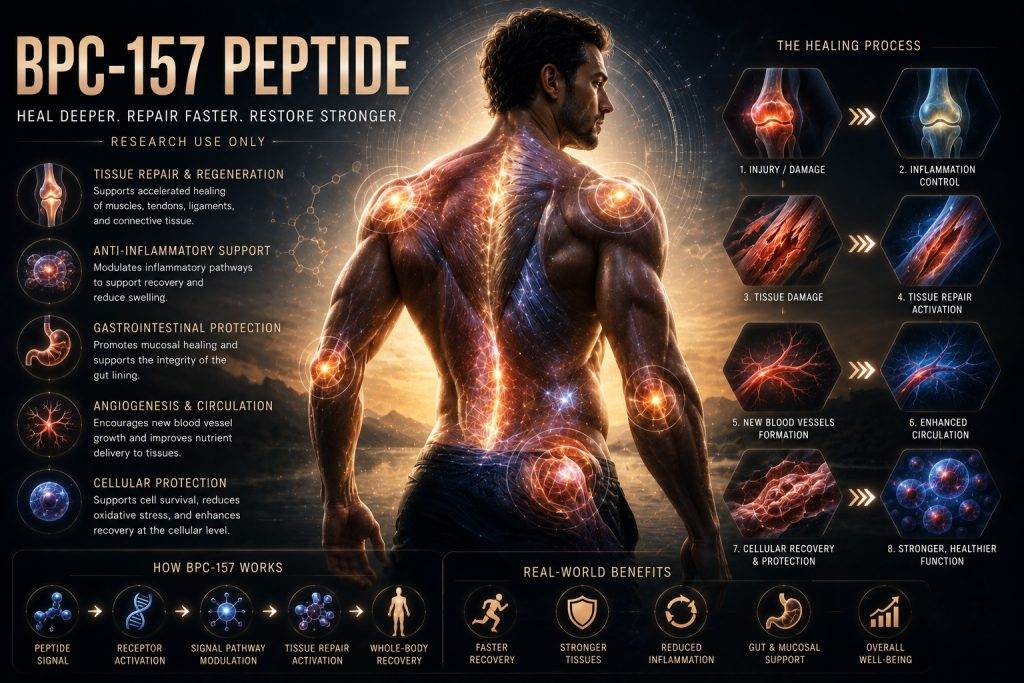
Digestive health plays a central role in:
• Immune function
• Nutrient absorption
• Hormonal regulation
• Inflammation control
• Recovery and performance
• Brain-gut communication
When the gastrointestinal lining becomes damaged or chronically inflamed, issues such as:
→ IBS
→ Leaky gut syndrome
→ Gastritis
→ Ulcers
→ Chronic digestive inflammation
can begin affecting:
→ Energy levels
→ Recovery capacity
→ Mood and cognition
→ Athletic performance
→ Overall health
Unfortunately, many traditional gut-healing strategies focus only on:
→ Symptom management
rather than:
→ Actual tissue repair
This is one reason BPC-157 has become increasingly popular in discussions involving:
→ Digestive repair and gut recovery
Originally derived from a protective protein found in:
→ Human gastric juice
BPC-157 is a synthetic peptide frequently studied for its:
→ Cytoprotective and regenerative effects
particularly involving:
→ Gastrointestinal tissue healing
This educational guide explores:
• What BPC-157 is
• How it works for gut repair
• Research involving IBS, ulcers, and leaky gut
• Oral vs injectable use
• Dosing strategies
• Gut-healing stack ideas
• Side effects and safety considerations
What Is BPC-157?
BPC-157 stands for:
→ Body Protection Compound-157
and is classified as a:
→ Synthetic pentadecapeptide
containing:
→ 15 amino acids
Where BPC-157 Comes From
The peptide was originally derived from:
→ Protective proteins naturally present in gastric juice
which explains why researchers became interested in its potential effects involving:
→ Gastrointestinal protection and tissue healing
Why BPC-157 Is Unique
Unlike many compounds that primarily suppress symptoms, BPC-157 appears to influence:
→ Cellular repair pathways directly
Potential mechanisms commonly discussed include:
→ Angiogenesis support
→ Tissue regeneration
→ Anti-inflammatory signaling
→ Gut barrier integrity support
How BPC-157 Supports Gut Healing
BPC-157 appears to influence several mechanisms involved in:
→ Digestive repair and gastrointestinal recovery
1. Supports Mucosal Barrier Integrity
The mucosal lining protects the digestive tract from:
→ Acid
→ Toxins
→ Pathogens
→ Inflammatory triggers
Potential effects of BPC-157 may include:
→ Faster epithelial regeneration
→ Improved gut-barrier stability
→ Reduced intestinal permeability
Why This Matters
Damage to the gut lining may contribute to:
→ Leaky gut syndrome
→ Chronic inflammation
→ Food sensitivities
→ Poor nutrient absorption
2. Modulates Inflammatory Signaling
Research suggests BPC-157 may help regulate:
→ Pro-inflammatory cytokines
Potential effects may involve:
→ Reduced TNF-α activity
→ Reduced IL-6 signaling
→ Improved inflammatory balance
3. Enhances Gut Microcirculation
BPC-157 appears to influence:
→ Angiogenesis and vascular repair
which may improve:
→ Oxygen delivery
→ Nutrient transport
→ Healing efficiency in damaged GI tissue
4. Supports Enteric Nervous System Function
The enteric nervous system controls:
→ Motility
→ Secretion
→ Digestive signaling
Potential benefits may include:
→ Better motility regulation
→ Reduced digestive dysfunction
→ Improved gut-brain communication
Conditions BPC-157 May Help Support
Leaky Gut Syndrome
Leaky gut involves:
→ Increased intestinal permeability
which may allow:
→ Toxins and inflammatory compounds
to pass into circulation.
Potential BPC-157 effects may include:
→ Tight-junction support
→ Reduced inflammation
→ Improved gut-lining repair
Irritable Bowel Syndrome (IBS)
IBS commonly involves:
→ Gut hypersensitivity
→ Inflammation
→ Abnormal motility
Potential benefits commonly discussed include:
→ Reduced digestive irritation
→ Improved gut signaling
→ Better motility balance
Gastric & Duodenal Ulcers
One of the most researched applications involves:
→ Ulcer healing support
Potential effects may include:
→ Faster mucosal repair
→ Reduced tissue damage
→ Better vascular healing
NSAID-Induced Gut Damage
Long-term NSAID use may contribute to:
→ Gastric erosion
→ Intestinal irritation
→ Poor gut integrity
Potential BPC-157 effects may include:
→ Mucosal protection
→ Reduced ulcer formation
→ Improved epithelial repair
Inflammatory Bowel Disease (IBD)
Emerging research has explored BPC-157 in connection with:
→ Crohn’s disease
→ Ulcerative colitis
→ Colitis-related inflammation
Potential benefits may include:
→ Reduced oxidative stress
→ Improved mucosal appearance
→ Better tissue regeneration
Oral vs Injectable BPC-157 For Gut Healing
One reason BPC-157 became especially interesting for digestive health is that:
→ Oral administration may still remain biologically active
despite the harsh gastric environment.
Oral BPC-157
Often Discussed For:
→ IBS
→ Gastritis
→ Ulcers
→ Leaky gut
→ General digestive inflammation
Potential Advantages
→ Convenient administration
→ Direct GI exposure
→ No injections required
Common Oral Dosage Range
Typical discussions commonly involve:
→ 250–500 mcg
1–2 times daily
often taken:
→ On an empty stomach
Injectable BPC-157
Often Discussed For:
→ Severe inflammation
→ Systemic recovery
→ Post-surgical support
→ Multi-system recovery protocols
Common Injectable Dosage Range
Typical protocols commonly involve:
→ 250–500 mcg daily
administered via:
→ Subcutaneous injection
Suggested Gut-Healing Protocols
Mild–Moderate Gut Dysfunction
Potential protocol discussions commonly include:
→ Oral BPC-157: 250–500 mcg daily
→ 4-week duration
often paired with:
→ Gut-supportive nutrition and recovery strategies
More Severe GI Support
Potential protocols sometimes discussed include:
→ Oral + injectable BPC-157 combined
for:
→ 4–6 weeks
alongside:
→ Anti-inflammatory nutrition
→ Stress reduction
→ Sleep optimization
Supplements Often Combined With BPC-157
Probiotics
Potential benefits may include:
→ Microbiome support and digestive balance
Collagen Protein
Often used to help support:
→ Structural repair of connective tissue and gut lining
L-Glutamine
Frequently discussed for:
→ Enterocyte fuel and gut-lining support
Digestive Enzymes
Potential support may include:
→ Improved digestion and nutrient absorption
Omega-3 Fatty Acids
Potential benefits may include:
→ Inflammation regulation and gut support
BPC-157 vs Traditional Gut-Healing Strategies
Strategy Main Focus
Probiotics Microbiome balance
Glutamine Enterocyte support
Collagen Structural support
PPIs Acid suppression
BPC-157 Active tissue repair & regeneration
Why BPC-157 Stands Out
Unlike many traditional approaches, BPC-157 appears more directly involved in:
→ Tissue regeneration pathways
rather than only:
→ Symptom reduction
Potential Side Effects & Safety Considerations
Although current research suggests BPC-157 appears:
→ Relatively well tolerated
human clinical evidence remains limited.
Potential Side Effects
Potential issues may include:
→ Mild nausea
→ Headaches
→ Dizziness
→ Fatigue
→ Injection-site irritation
Product Quality Concerns
Because BPC-157 is often sold through:
→ Research chemical suppliers
potential concerns may include:
→ Contamination
→ Incorrect dosing
→ Mislabeling
Long-Term Human Data Is Limited
Despite promising preclinical findings:
→ Long-term human safety remains unclear
Potential concerns still requiring research include:
→ Chronic exposure effects
→ Immune-system interactions
→ Angiogenesis-related risks
Important Medical Considerations
Individuals with:
→ Crohn’s disease
→ Ulcerative colitis
→ Chronic GI disorders
should consult a qualified healthcare professional before considering:
→ Experimental peptide therapies
Legal Status Of BPC-157
FDA Status
BPC-157 is:
→ Not FDA-approved
for:
→ Gut healing
→ IBS treatment
→ Ulcer repair
→ Performance enhancement
Research Classification
BPC-157 is commonly sold as:
→ An investigational or research peptide
WADA Status
BPC-157 is prohibited under:
→ World Anti-Doping Agency (WADA) regulations
making it banned in:
→ Competitive sports
FAQ: BPC-157 For Gut Healing
Can BPC-157 help with leaky gut?
Research suggests it may help support:
→ Gut-barrier integrity and mucosal repair
Is oral BPC-157 effective?
Yes. Oral administration is commonly discussed for:
→ GI-specific healing support
because the peptide appears stable within the digestive environment.
How long does gut healing take?
Many discussions commonly mention:
→ Initial symptom improvements within 1–2 weeks
while deeper tissue repair may require:
→ 4–6 weeks or longer
Can BPC-157 help IBS symptoms?
Potential benefits may include support involving:
→ Motility regulation
→ Inflammation reduction
→ Gut-brain signaling
Is BPC-157 approved for medical use?
No. It remains an:
→ Experimental investigational peptide
with limited human research.
Conclusion: Can BPC-157 Support Digestive Healing?
BPC-157 has become one of the most discussed peptides in:
→ Digestive-health and gut-repair research
because of its potential ability to support:
→ Mucosal healing
→ Angiogenesis
→ Inflammation regulation
→ Gut-barrier integrity
Unlike many traditional gut-health supplements that primarily offer:
→ Nutritional or microbiome support
BPC-157 appears more directly involved in:
→ Tissue-repair pathways
which may make it especially attractive for individuals struggling with:
→ Chronic gut dysfunction
→ IBS
→ Leaky gut
→ Gastritis
→ Ulcer-related inflammation
Potential advantages commonly discussed include:
→ Oral bioactivity
→ Cytoprotective effects
→ Anti-inflammatory support
→ Improved vascular healing
However, despite strong preclinical findings, BPC-157 still remains:
→ Experimental
with:
→ Limited human clinical data
→ No FDA approval
→ Ongoing scientific uncertainty
For now, BPC-157 should be viewed as:
→ A promising investigational gut-healing peptide
rather than a fully established clinical treatment for digestive disease.