How Long Does BPC-157 Stay in Your System? Half-Life, Clearance, and Detection Explained
If you’re using BPC-157 for:
• Injury recovery
• Gut healing
• Joint repair
• Performance recovery
• Post-surgical rehabilitation
you may wonder:
→ How long does BPC-157 actually stay in the body?
Understanding:
→ Half-life
→ Clearance time
→ Detection windows
→ Residual healing effects
can be important for:
→ Recovery planning
→ Peptide cycling
→ Stacking strategies
→ Competitive athletics and drug testing
Unlike stimulants or anabolic compounds, BPC-157 does not create an immediate:
→ “On/off” effect
Instead, it works by initiating:
→ Cellular repair and regenerative signaling pathways
which means its healing effects may continue long after the peptide itself has cleared circulation.
This educational guide explores:
• What BPC-157 is
• How it works in the body
• Estimated half-life and clearance time
• Oral vs injectable duration
• Drug-testing implications
• Cycling and stacking strategies
• Frequently asked questions
________________________________________
What Is BPC-157?
BPC-157 stands for:
→ Body Protection Compound-157
and is classified as a:
→ Synthetic pentadecapeptide
containing:
→ 15 amino acids
________________________________________
Where BPC-157 Comes From
The peptide was originally derived from:
→ Protective proteins found in gastric juice
and is commonly researched for its potential role involving:
→ Tissue repair
→ Gut healing
→ Angiogenesis
→ Inflammation regulation
→ Connective-tissue recovery
________________________________________
Why BPC-157 Is Different
Unlike hormonal compounds, BPC-157 appears to be:
→ Non-hormonal
→ Non-steroidal
→ Non-suppressive to endocrine function
Its research focus centers more heavily on:
→ Regenerative healing pathways
rather than:
→ Hormonal anabolic activity
________________________________________
How BPC-157 Works In The Body
1. Angiogenesis Support
BPC-157 appears to influence:
→ VEGF signaling and vascular repair
Potential effects may include:
→ Improved blood flow
→ Faster oxygen delivery
→ Enhanced tissue regeneration
________________________________________
2. Fibroblast Activation & Collagen Synthesis
Potential mechanisms commonly discussed include:
→ Fibroblast migration
→ Collagen type-I synthesis
→ Connective-tissue remodeling
which may help support:
→ Tendon and ligament healing
________________________________________
3. Gut-Lining Protection
Because BPC-157 originates from gastric proteins, it is also heavily researched for:
→ Mucosal repair
→ Ulcer healing
→ GI protection
________________________________________
4. Neuroprotective Signaling
Research also commonly explores:
→ Nerve repair
→ Dopamine modulation
→ Neuroinflammatory regulation
________________________________________
Why Understanding Half-Life Matters
Understanding BPC-157’s duration helps users better plan:
→ Recovery cycles
→ Dosing frequency
→ Athletic timelines
→ Stacking protocols
It’s also important to distinguish between:
→ Bloodstream presence
and:
→ Biological healing effects
because tissue-repair signaling may continue long after the peptide clears circulation.
________________________________________
What Is BPC-157’s Half-Life?
The exact human half-life of BPC-157 has not been formally established through:
→ Large-scale clinical pharmacokinetic studies
However, available preclinical data and anecdotal reports suggest BPC-157 appears to:
→ Absorb rapidly
→ Clear relatively quickly
→ Continue producing downstream healing effects after clearance
________________________________________
Estimated Half-Life Ranges
Form Estimated Half-Life Notes
Injectable SubQ ~4–6 hours Fast absorption and moderate systemic duration
Injectable IM ~6–8 hours Slightly slower release and prolonged activity
Oral Capsules ~2–4 hours Faster systemic clearance but local GI exposure
________________________________________
Important Distinction
Even though the peptide itself may clear relatively quickly:
→ Tissue repair and healing cascades may continue for days or weeks
after administration ends.
________________________________________
Factors That Influence Clearance Time
1. Dosage & Frequency
Higher and more frequent dosing protocols may prolong:
→ Tissue-level biological activity
________________________________________
2. Delivery Method
Injectable forms generally provide:
→ Higher systemic exposure
while oral forms primarily focus on:
→ Local GI effects
________________________________________
3. Injury Severity
More damaged tissue may lead to:
→ Longer biological activity at the target site
because BPC-157 appears more active in:
→ Inflamed or injured tissue
________________________________________
4. Metabolic Rate
Clearance may vary depending on:
→ Age
→ Liver function
→ Kidney function
→ Hydration status
→ Overall metabolic rate
________________________________________
5. Peptide Quality
Poor-quality peptides may degrade faster due to:
→ Improper storage
→ Contamination
→ Inaccurate formulation
________________________________________
Injectable vs Oral Clearance
Injectable BPC-157
Subcutaneous (SubQ) and intramuscular (IM) injections provide:
→ Systemic absorption
Potential characteristics commonly discussed include:
→ Longer circulation time
→ Wider tissue distribution
→ Stronger musculoskeletal recovery support
________________________________________
Oral BPC-157
Oral forms are more commonly discussed for:
→ Gut healing and GI repair
Potential characteristics may include:
→ Faster systemic clearance
→ Strong local digestive exposure
→ Reduced systemic bioavailability
________________________________________
Which Clears Faster?
Generally:
→ Oral BPC-157 clears faster systemically
while injectable forms may remain biologically active slightly longer because of:
→ Broader tissue distribution
________________________________________
How Long Do Effects Last After Stopping?
One of the most unique aspects of BPC-157 is that:
→ Healing effects often outlast bloodstream presence
________________________________________
Why This Happens
BPC-157 appears to trigger:
→ Angiogenesis
→ Collagen remodeling
→ Cellular repair signaling
which may continue even after:
→ The peptide is no longer detectable
________________________________________
Estimated Residual Healing Effects
Usage Pattern Peptide Clearance Residual Healing Effects
Single dose 12–24 hours 1–2 days
2-week cycle 24–48 hours Up to 1 week
4–6 week cycle 24–48 hours 2–4+ weeks
________________________________________
Can BPC-157 Be Detected In Drug Tests?
WADA Status
BPC-157 is prohibited under:
→ World Anti-Doping Agency (WADA) regulations
under:
→ Section S0 (Non-Approved Substances)
making it banned:
→ In and out of competition
for drug-tested athletes.
________________________________________
Is It Included In Standard Drug Tests?
Most routine workplace or athletic drug tests do NOT screen for:
→ Peptides like BPC-157
Standard panels usually focus on:
→ Narcotics
→ THC
→ Stimulants
→ Steroids
→ Benzodiazepines
________________________________________
Advanced Testing Requirements
Detecting BPC-157 would generally require:
→ Specialized LC-MS/MS peptide testing
which is usually reserved for:
→ Elite anti-doping programs
________________________________________
Estimated Detection Window
If specifically tested for, estimated detection windows may range between:
→ 24–72 hours post-dose
depending on:
→ Dose size
→ Injection method
→ Metabolic rate
→ Testing sensitivity
________________________________________
Implications For Cycling & Stacking
Common BPC-157 Cycle Lengths
Goal Typical Duration
Mild injuries 2–4 weeks
Moderate recovery 4–6 weeks
Severe/post-surgical recovery 6–8+ weeks
________________________________________
Why Cycling Matters
Cycling allows the body to:
→ Continue healing naturally
without relying on continuous peptide exposure.
________________________________________
Common Stacking Strategies
BPC-157 + TB500
Potential goals commonly discussed include:
→ Tendon repair
→ Ligament recovery
→ Systemic tissue healing
________________________________________
BPC-157 + CJC-1295 / Ipamorelin
Potential goals may include:
→ Recovery enhancement
→ Sleep optimization
→ GH-support pathways
________________________________________
BPC-157 + MK-677
Potential goals commonly discussed include:
→ Recovery support
→ Lean-mass retention
→ Collagen synthesis support
________________________________________
How Long Should You Wait Between Cycles?
Many users commonly discuss taking:
→ 1–2 week breaks
between cycles to:
→ Evaluate healing progress and recovery response
________________________________________
FAQ: BPC-157 Half-Life & Detection
How long does BPC-157 stay in your body?
The peptide itself may clear within:
→ 24–48 hours
though healing effects may continue much longer.
________________________________________
What is BPC-157’s half-life?
Estimated half-life discussions commonly range between:
→ 4–8 hours depending on delivery method
________________________________________
Does BPC-157 build up in the body?
No. BPC-157 does not appear to accumulate like:
→ Fat-soluble hormones or steroids
________________________________________
Can BPC-157 be detected on a drug test?
Not typically on standard panels, though:
→ Advanced anti-doping tests may potentially detect it
for a short period after use.
________________________________________
Why do effects continue after stopping?
BPC-157 appears to trigger:
→ Tissue-healing cascades
that continue even after:
→ The peptide itself clears circulation
________________________________________
Important Disclaimer
This content is provided for educational purposes only and does not constitute medical advice.
BPC-157 remains an:
→ Investigational peptide compound
with:
→ Limited human clinical evidence
→ No FDA approval
→ Ongoing scientific uncertainty
Always consult a qualified healthcare professional before considering:
→ Experimental peptide-related therapies
especially if you participate in:
→ Drug-tested sports or professional athletic competition
________________________________________
Conclusion: Understanding BPC-157 Half-Life & Clearance
Although BPC-157 itself appears to clear from the bloodstream relatively quickly, its regenerative effects may continue for:
→ Days or even weeks
because of its potential ability to stimulate:
→ Angiogenesis
→ Collagen synthesis
→ Tissue remodeling
→ Cellular repair pathways
Estimated half-life discussions commonly suggest:
→ 4–8 hours depending on delivery method
while total clearance may occur within:
→ 24–48 hours
Potential recovery-focused advantages commonly discussed include:
→ Faster tissue repair
→ Reduced inflammation
→ Improved recovery timelines
→ Enhanced connective-tissue healing
However, despite growing popularity and promising preclinical research, BPC-157 still remains:
→ Experimental
with:
→ Limited human clinical evidence
→ No FDA approval
→ Ongoing scientific uncertainty
For now, BPC-157 should be viewed as:
→ A promising investigational recovery peptide still undergoing scientific evaluation
rather than a fully established medical therapy for healing or performance enhancement.
RESEARCH & EDUCATION
BPC-157 for Gut Healing: How This Peptide Supports IBS, Leaky Gut, and Digestive Repair
Laboratory research products from HiTech Peptides. Not intended for human or veterinary use.
READ THE ILLUSTRATION
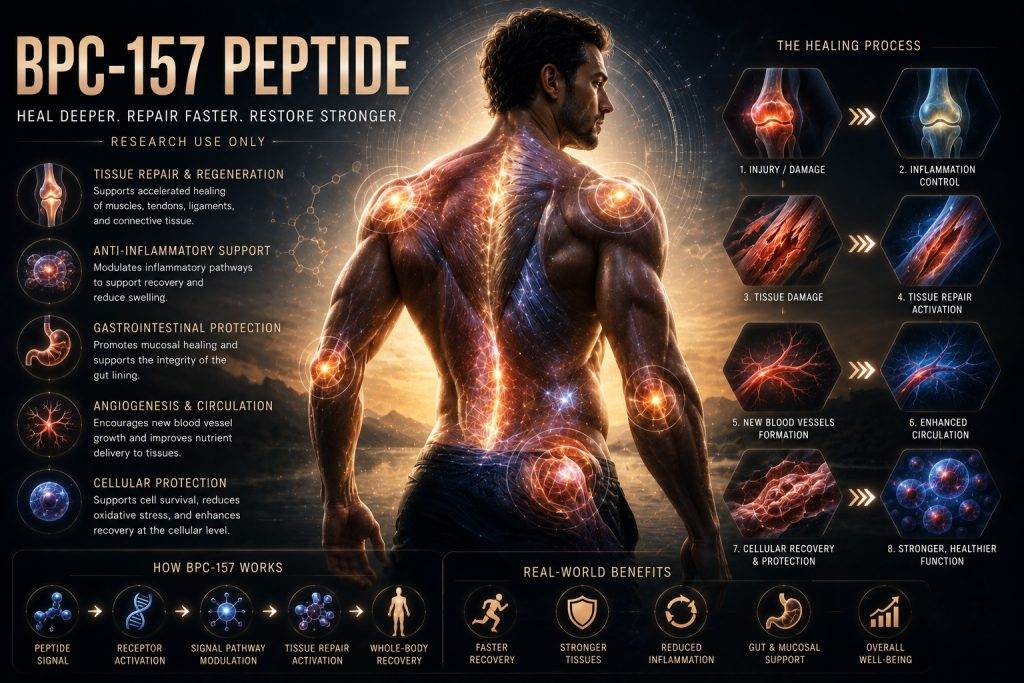
BPC-157 illustration, in readable text
Transcription of the original artwork, including its claims and labels. Research use only.
Tissue repair & regeneration
Supports accelerated healing of muscles, tendons, ligaments, and connective tissue.
Anti-inflammatory support
Modulates inflammatory pathways to support recovery and reduce swelling.
Gastrointestinal protection
Promotes mucosal healing and supports the integrity of the gut lining.
Angiogenesis & circulation
Encourages new blood vessel growth and improves nutrient delivery to tissues.
Cellular protection
Supports cell survival, reduces oxidative stress, and enhances recovery at the cellular level.
The healing process
- Injury / damage
- Inflammation control
- Tissue damage
- Tissue repair activation
- New blood vessels formation
- Enhanced circulation
- Cellular recovery & protection
- Stronger, healthier function
How BPC-157 works
- Peptide signal
- Receptor activation
- Signal pathway modulation
- Tissue repair activation
- Whole-body recovery
Real-world benefits listed in the artwork
- Faster recovery
- Stronger tissues
- Reduced inflammation
- Gut & mucosal support
- Overall well-being
Artwork heading: “BPC-157 Peptide.” Tagline: “Heal deeper. Repair faster. Restore stronger.”
View original illustration