If you’re struggling with:
• Chronic injuries
• Gut inflammation
• Slow recovery from training
• Joint pain
• Tendon or ligament damage
BPC-157 may be one of the most talked-about recovery peptides worth exploring.
Originally derived from:
→ A protective protein found in human gastric juice
BPC-157 has become increasingly popular because of its potential ability to support:
→ Tissue repair
→ Gut healing
→ Inflammation reduction
→ Joint and tendon recovery
→ Regenerative healing pathways
Unlike painkillers or anti-inflammatory drugs that mainly:
→ Mask symptoms
BPC-157 appears to work more directly on:
→ Cellular repair and tissue regeneration
This educational guide explores:
• What BPC-157 is
• How it works
• Potential recovery benefits
• Dosage protocols
• Stacking strategies
• Side effects and safety
• Legal and WADA considerations
—
What Is BPC-157?
BPC-157 stands for:
→ Body Protection Compound-157
and is classified as a:
→ Synthetic pentadecapeptide
containing:
→ 15 amino acids
—
Where BPC-157 Comes From
The peptide was originally derived from:
→ A protective protein naturally found in gastric juice
which explains why researchers initially focused on its effects involving:
→ Gut protection and epithelial repair
—
Why BPC-157 Became Popular
Over time, research began exploring its potential effects involving:
→ Tendon repair
→ Ligament healing
→ Muscle recovery
→ Angiogenesis
→ Nerve regeneration
→ Connective-tissue support
—
What Makes BPC-157 Unique
Unlike anabolic steroids or hormonal therapies, BPC-157 appears to be:
→ Non-hormonal
→ Non-steroidal
→ Non-suppressive to endocrine function
Its research focus centers more heavily on:
→ Regenerative healing pathways
rather than:
→ Hormonal muscle-building mechanisms
—
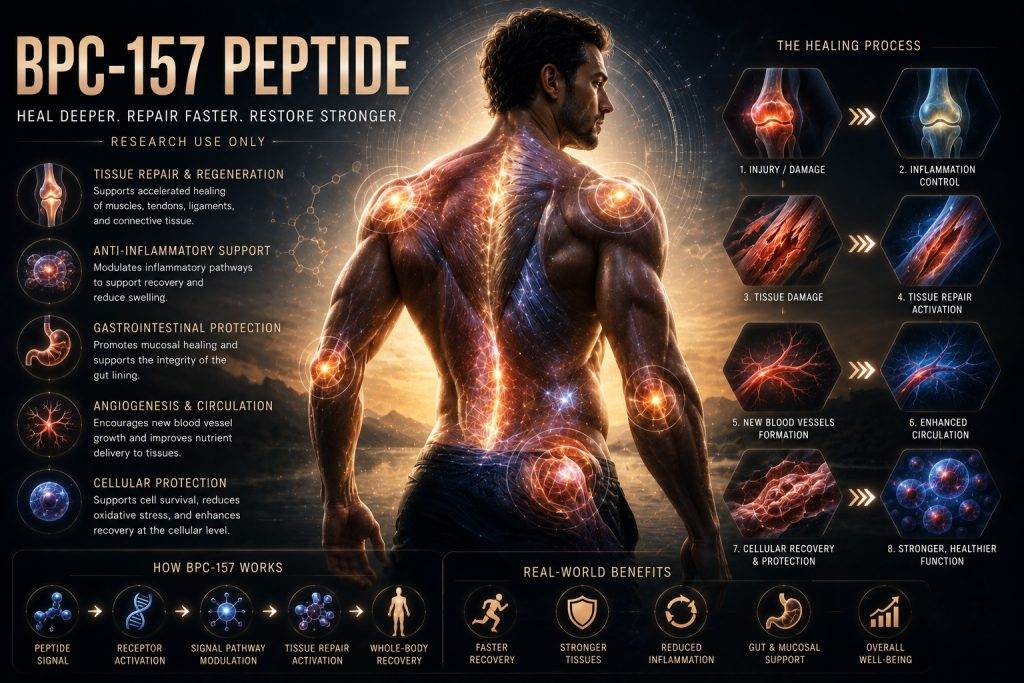
How BPC-157 Works
BPC-157 appears to influence multiple systems involved in:
→ Tissue repair and recovery
—
1. Promotes Angiogenesis
BPC-157 appears to support:
→ VEGF signaling and angiogenesis
which may help stimulate:
→ New blood-vessel formation
Why This Matters
Improved circulation may help support:
→ Faster nutrient delivery
→ Better oxygenation
→ Enhanced tissue regeneration
especially in tissues that heal slowly such as:
→ Tendons
→ Ligaments
→ Cartilage
—
2. Enhances Fibroblast & Collagen Activity
Fibroblasts are critical for:
→ Collagen production and connective-tissue remodeling
Potential effects may include:
→ Faster collagen synthesis
→ Improved tendon integrity
→ Better tissue organization
—
3. Reduces Inflammation & Oxidative Stress
Potential mechanisms commonly discussed include:
→ Nitric-oxide modulation
→ Cytokine regulation
→ Reduced inflammatory signaling
which may help support:
→ Reduced pain and swelling
—
4. Protects The Gut & Digestive System
Because BPC-157 originates from gastric proteins, research also heavily explores its effects involving:
→ Gut-lining protection
→ Ulcer healing
→ GI inflammation support
Potential applications commonly discussed include:
→ IBS
→ Leaky gut
→ NSAID-related gastric damage
—
5. Neuroprotective & Nerve-Regeneration Support
Emerging research also explores possible effects involving:
→ Nerve regeneration
→ Neuroinflammation modulation
→ Dopamine and serotonin regulation
—
Benefits Of BPC-157
Joint & Ligament Healing
Potential benefits commonly discussed include:
→ Faster tendon healing
→ Improved ligament repair
→ Better connective-tissue resilience
Potential applications may include:
→ Rotator-cuff injuries
→ Achilles tendonitis
→ Elbow tendon pain
→ Knee instability
—
Muscle Recovery & Regeneration
Potential effects may include:
→ Reduced soreness
→ Faster recovery from training
→ Muscle strain repair
→ Improved tissue oxygenation
—
Gut Healing & Ulcer Protection
Potential gut-related benefits may include:
→ Reduced gastric irritation
→ Improved mucosal repair
→ Better gut-barrier integrity
—
Improved Blood Flow & Tissue Oxygenation
Through angiogenesis support, BPC-157 may help improve:
→ Circulation to injured tissue
which may support:
→ Faster healing and nutrient delivery
—
Reduced Systemic Inflammation
Potential anti-inflammatory benefits commonly discussed include:
→ Reduced joint irritation
→ Better recovery from overtraining
→ Reduced inflammatory stress
—
Neuroprotective Support
Emerging research commonly explores possible benefits involving:
→ Nerve healing
→ Brain inflammation support
→ Recovery from neural stress
—
BPC-157 Dosage Guidelines
Common Injectable Dosage Range
Typical recovery discussions commonly involve:
→ 250–500 mcg daily
—
Split-Dose Protocols
Some protocols discuss:
→ 250 mcg twice daily
for more consistent peptide exposure.
—
Injection Method
Subcutaneous (SubQ) injections are most commonly discussed for:
→ Tendon
→ Muscle
→ Joint recovery
Localized injections near injured tissue are often preferred for:
→ Targeted healing support
—
Oral BPC-157
Oral versions are more commonly discussed for:
→ Gut-health support
rather than:
→ Musculoskeletal recovery
—
Typical Cycle Length
Most recovery cycles commonly range between:
→ 2–6 weeks
depending on:
→ Injury severity and recovery goals
—
Stacking BPC-157 With Other Peptides
BPC-157 + TB-500
One of the most common recovery stacks discussed for:
→ Tendon repair
→ Ligament healing
→ Systemic tissue recovery
Potential reasons include:
→ Localized healing + systemic regeneration support
—
BPC-157 + Ipamorelin
Potential goals commonly discussed include:
→ Growth-hormone support
→ Faster tissue repair
→ Enhanced recovery
—
BPC-157 + MK-677
Potential benefits commonly discussed include:
→ GH/IGF-1 support
→ Better sleep quality
→ Lean-mass retention during recovery
—
BPC-157 + Gut-Support Supplements
Potential additions commonly include:
→ L-glutamine
→ Collagen peptides
→ Probiotics
→ Anti-inflammatory nutrition
—
Side Effects & Safety Profile
Current research suggests BPC-157 appears:
→ Relatively well tolerated
though long-term human clinical evidence remains limited.
—
Potential Side Effects
Potential issues may include:
→ Mild headaches
→ Fatigue
→ Dizziness
→ Injection-site irritation
→ Mild nausea
—
Hormonal Effects
Unlike anabolic compounds, BPC-157 does not appear to significantly:
→ Suppress testosterone
→ Alter estrogen
→ Affect cortisol production
—
Product Quality Concerns
Because BPC-157 is often sold through:
→ Research peptide suppliers
potential concerns may include:
→ Contamination
→ Incorrect dosing
→ Poor sterility
—
Legal Status & Testing Concerns
FDA Status
BPC-157 is:
→ Not FDA-approved for therapeutic human use
and is commonly sold as:
→ A research-use peptide
—
WADA Status
BPC-157 is prohibited under:
→ World Anti-Doping Agency (WADA) regulations
making it banned in:
→ Drug-tested sports and athletic competition
—
Detection Concerns
Advanced anti-doping testing may potentially detect:
→ Peptide-related biomarkers and peptide fragments
—
Important Disclaimer
This content is provided for educational purposes only and does not constitute medical advice.
BPC-157 remains an:
→ Investigational peptide compound
with:
→ Limited human clinical evidence
→ No FDA approval
→ Ongoing scientific uncertainty
Always consult a qualified healthcare professional before considering:
→ Experimental peptide-related therapies
especially if you participate in:
→ Drug-tested sports or professional athletic competition
—
FAQ: BPC-157
Can BPC-157 be taken orally?
Yes. Oral forms are commonly discussed for:
→ Gut-health and digestive support
though injections are generally preferred for:
→ Tendon and muscle recovery
—
How quickly does BPC-157 work?
Some users commonly report improvements within:
→ 7–14 days
though full tissue repair may require:
→ Several weeks depending on injury severity
—
Can BPC-157 help chronic injuries?
Potential research commonly explores:
→ Chronic tendon and connective-tissue recovery
particularly in injuries resistant to traditional rehab.
—
Should BPC-157 be stacked with TB-500?
Many recovery protocols commonly combine them because they may target:
→ Complementary tissue-healing pathways
—
Is BPC-157 safe for women?
Because BPC-157 is non-hormonal, it is commonly discussed for use by:
→ Both men and women
without androgenic side effects.
—
Conclusion: Is BPC-157 Worth Exploring For Recovery?
BPC-157 has become one of the most discussed recovery peptides because of its potential ability to support:
→ Tendon repair
→ Muscle regeneration
→ Gut healing
→ Angiogenesis
→ Connective-tissue recovery
→ Systemic inflammation reduction
Potential advantages commonly discussed include:
→ Faster recovery
→ Improved mobility
→ Better connective-tissue healing
→ Reduced inflammation
→ Enhanced recovery from chronic injuries
Unlike purely anabolic compounds, BPC-157 appears more focused on:
→ Regenerative healing and recovery pathways
which is why it continues to attract attention within:
→ Athletic recovery
→ Rehabilitation
→ Longevity optimization
→ Performance-focused wellness communities
However, despite promising preclinical findings and growing popularity, BPC-157 still remains:
→ Experimental
with:
→ Limited long-term human clinical evidence
→ No FDA approval
→ Ongoing scientific uncertainty
For now, BPC-157 should be viewed as:
→ A promising investigational recovery peptide still undergoing scientific evaluation
rather than a fully established medical treatment for healing or performance enhancement.