Hair loss and thinning affect both men and women, often driven by genetics, inflammation, stress, aging, hormonal changes, or poor scalp health. While treatments like minoxidil and finasteride remain widely used, many people seek alternatives that support hair growth without directly altering hormones.
One compound gaining major attention in regenerative medicine and hair restoration is GHK-Cu — a naturally occurring copper peptide known for its healing and tissue-repair properties.
Originally discovered in human plasma during the 1970s, GHK-Cu has been extensively studied for:
→ Wound healing
→ Collagen synthesis
→ Tissue regeneration
→ Anti-inflammatory effects
→ Scalp and follicle health
More recently, researchers have focused on its ability to:
→ Stimulate hair follicles
→ Improve scalp circulation
→ Protect follicles from oxidative damage
→ Support thicker, healthier hair growth
—
What Is GHK-Cu?
GHK-Cu stands for:
→ Glycyl-L-histidyl-L-lysine copper complex
It is a naturally occurring tripeptide bound to copper ions and found throughout the body in:
→ Blood plasma
→ Saliva
→ Urine
GHK-Cu levels naturally decline with age, which may contribute to:
→ Slower tissue repair
→ Reduced skin elasticity
→ Poorer scalp health
→ Hair thinning and aging
—
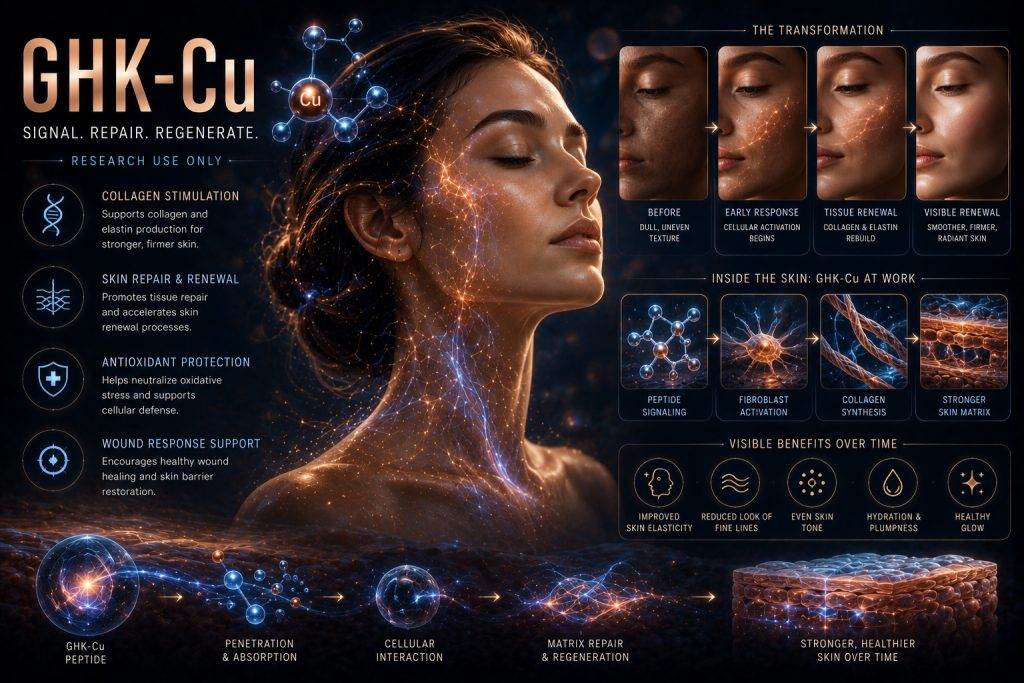
Core Functions of GHK-Cu
Unlike compounds that target only one pathway, GHK-Cu acts as a broad regenerative signaling molecule.
Its major biological functions include:
→ Collagen and elastin synthesis
→ Wound healing and tissue repair
→ Anti-inflammatory signaling
→ Antioxidant defense
→ Gene expression modulation
These properties are what make GHK-Cu so promising for both:
→ Skin rejuvenation
→ Hair restoration protocols
—
How GHK-Cu Works for Hair Growth
GHK-Cu supports hair growth through multiple regenerative mechanisms rather than hormonal manipulation.
—
→ Stimulates Hair Follicle Activity
GHK-Cu helps:
→ Reactivate dormant follicles
→ Extend the anagen (growth) phase
→ Increase follicle size
→ Support thicker hair strands
This is particularly valuable for early-to-moderate thinning where follicles still exist but have become weakened or inactive.
—
→ Improves Collagen and Elastin Production
Healthy follicles depend on a strong extracellular matrix.
GHK-Cu supports:
→ Collagen production
→ Elastin synthesis
→ Structural scalp integrity
→ Better follicle anchoring
This may reduce breakage and improve overall hair density.
—
→ Enhances Blood Flow and Nutrient Delivery
GHK-Cu promotes:
→ Angiogenesis (new capillary formation)
→ Improved scalp circulation
→ Better oxygen and nutrient delivery to follicles
Improved blood supply helps create a healthier environment for follicle regeneration.
—
→ Reduces Scalp Inflammation
Inflammation contributes heavily to:
→ Follicle miniaturization
→ Irritation
→ Hair shedding
GHK-Cu helps reduce:
→ Pro-inflammatory cytokines
→ Oxidative stress
→ Local scalp irritation
—
→ Provides Antioxidant Protection
Oxidative damage accelerates follicle aging and scalp deterioration.
GHK-Cu increases antioxidant defenses by helping neutralize:
→ Free radicals
→ Environmental stressors
→ UV-related scalp damage
—
→ Modulates Gene Expression
One of GHK-Cu’s most unique features is its influence on thousands of genes involved in:
→ Tissue repair
→ Regeneration
→ Growth signaling
→ Aging regulation
This broad-spectrum regenerative activity is a major reason it’s viewed as a next-generation hair restoration compound.
—
Main Benefits of GHK-Cu for Hair Growth
—
→ Stimulates New Hair Growth
GHK-Cu may help:
→ Reactivate weakened follicles
→ Improve follicle activity
→ Promote visible regrowth in thinning areas
—
→ Thickens Existing Hair
Potential cosmetic improvements include:
→ Thicker hair shafts
→ Better density
→ Fuller appearance
→ Reduced breakage
—
→ Improves Scalp Health
GHK-Cu creates a healthier scalp environment through:
→ Better circulation
→ Reduced irritation
→ Improved tissue repair
→ Lower inflammation
—
→ Protects Against Hair Aging
By reducing oxidative stress and supporting regenerative signaling, GHK-Cu may help slow:
→ Follicle aging
→ Hair weakening
→ Environmental damage
—
→ Supports Hair Pigmentation
Copper plays a key role in melanin production.
GHK-Cu may help support:
→ Healthier pigmentation
→ More vibrant-looking hair
→ Preservation of natural color
—
→ Works Well With Other Hair Treatments
GHK-Cu is often combined with:
→ Minoxidil
→ Finasteride
→ Microneedling
→ PRP therapy
Because it works through different pathways than traditional pharmaceutical treatments.
—
GHK-Cu Dosage and Application Guide
GHK-Cu is most commonly used topically for hair restoration.
—
→ Typical Concentrations
Most scalp serums contain:
→ 0.5%–2% GHK-Cu
Lower concentrations are generally used for maintenance, while higher concentrations are often included in active restoration protocols.
—
→ How to Apply
Standard application method:
→ Apply directly to thinning areas
→ Use on a clean, dry scalp
→ Massage gently into the scalp
→ Do not rinse immediately
—
→ Frequency
Typical usage:
→ Once daily
→ Sometimes twice daily depending on protocol
Consistency is important because hair follicles require ongoing support over time.
—
→ Timeline for Results
Most users notice:
→ Scalp improvements within 4–8 weeks
→ Thickness and density improvements within 3–6 months
Hair restoration is gradual and requires patience.
—
→ Patch Testing
Before full application:
→ Perform a small patch test first
Especially if sensitive to:
→ Copper
→ Peptides
→ Active scalp ingredients
—
Side Effects and Safety
GHK-Cu generally has a favorable safety profile because it naturally exists in the body.
—
→ Common Side Effects
Possible mild reactions include:
→ Redness
→ Itching
→ Dryness
→ Mild irritation
—
→ Temporary Shedding
Some users experience:
→ Temporary shedding during early use
This may occur as follicles transition into new growth cycles.
—
→ Copper Toxicity Concerns
The amount of copper absorbed from topical GHK-Cu is extremely low.
When used correctly:
→ Systemic copper overload is not considered a realistic concern
—
→ Who Should Avoid It
Caution is advised for:
→ Individuals with copper allergies
→ Severe skin sensitivities
→ Active scalp infections
→ Pregnant or breastfeeding individuals without physician guidance
—
GHK-Cu vs Minoxidil and Finasteride
| Feature | GHK-Cu | Minoxidil | Finasteride |
| ——————- | ——————————- | ——————– | —————————- |
| Mechanism | Regenerative peptide | Vasodilator | DHT blocker |
| Hormonal Effects | None | None | Hormonal |
| Main Benefit | Scalp and follicle regeneration | Increased blood flow | Prevents DHT miniaturization |
| Common Side Effects | Mild irritation | Shedding, dryness | Sexual and hormonal effects |
| Best For | Sensitive or non-hormonal users | General thinning | DHT-driven hair loss |
—
Best GHK-Cu Stacking Strategies
—
→ GHK-Cu + Minoxidil
Potential synergy:
→ Improved circulation from minoxidil
→ Better regenerative support from GHK-Cu
—
→ GHK-Cu + Finasteride
Useful for androgenic alopecia by combining:
→ DHT reduction
→ Follicle regeneration
—
→ GHK-Cu + Microneedling
Microneedling may improve:
→ Product penetration
→ Blood flow
→ Follicle stimulation
Often used 1–2x weekly alongside topical GHK-Cu.
—
→ GHK-Cu + PRP Therapy
PRP provides growth factors while GHK-Cu supports:
→ Tissue repair
→ Collagen synthesis
→ Regenerative signaling
—
Legal Status of GHK-Cu
GHK-Cu is generally regulated as a cosmetic ingredient when sold in topical products.
Current status:
→ Available over the counter in many countries
→ Not FDA-approved as a drug for hair loss
→ Commonly marketed for skincare and scalp health
Injectable or compounded versions may exist in specialized clinics but often fall into research or off-label categories.
—
Final Thoughts: Does GHK-Cu Help Hair Growth?
GHK-Cu has emerged as one of the most promising non-hormonal compounds for hair restoration because it targets multiple biological pathways simultaneously.
Potential advantages include:
→ Better scalp health
→ Improved circulation
→ Reduced inflammation
→ Stronger follicles
→ Thicker hair appearance
→ Regenerative support without hormonal disruption
While it may not completely reverse advanced baldness, it appears especially useful for:
→ Early-to-moderate thinning
→ Follicle preservation
→ Long-term scalp support
→ Combination therapy protocols
As research continues to expand, GHK-Cu is increasingly viewed as a cornerstone compound in regenerative hair restoration strategies.