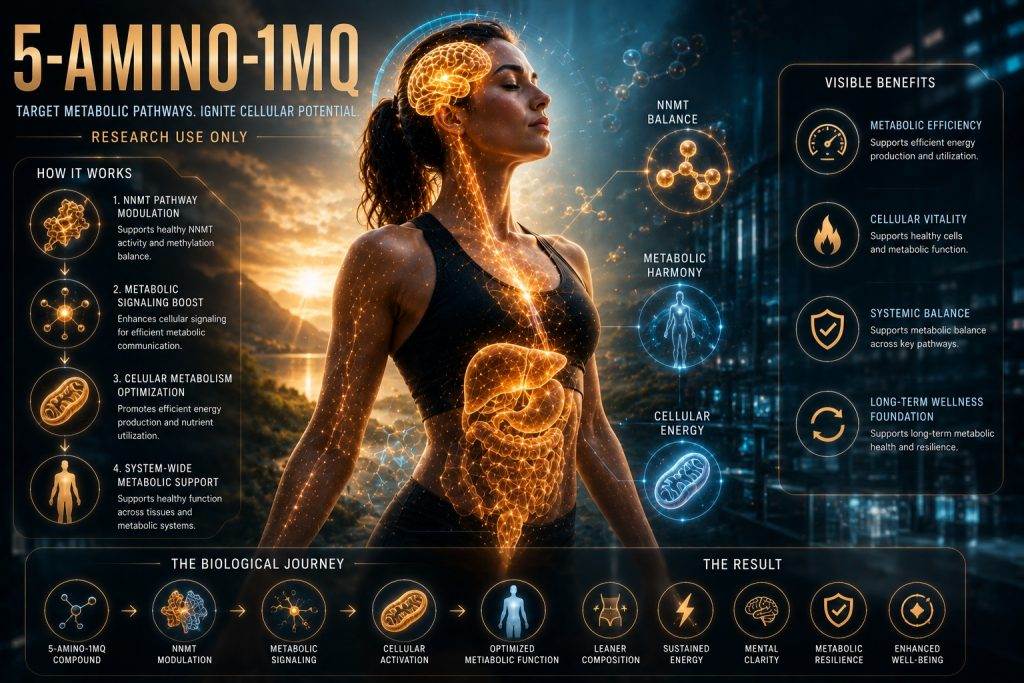
5-Amino-1-methylquinolinium, more commonly known as 5-Amino-1MQ, has emerged as one of the most talked-about compounds in the fields of metabolic optimization, body recomposition, and longevity science. Originally investigated for its potential role in addressing obesity, insulin resistance, and age-related metabolic decline, this innovative compound has attracted attention for its unique ability to influence fat metabolism at the cellular level.
Unlike traditional fat-loss products that depend on stimulants, appetite suppression, or thermogenic effects, 5-Amino-1MQ targets a specific metabolic enzyme involved in energy regulation and fat storage. This distinct mechanism has made it increasingly popular among athletes, fitness enthusiasts, and individuals seeking advanced strategies for improving body composition and metabolic health.
In this guide, we’ll explore:
What 5-Amino-1MQ is
How its mechanism of action works
The role of NNMT inhibition
How it supports NAD+ production
Potential benefits for fat loss and performance
Stacking strategies
Cycle recommendations
Research and current evidence
Legal and regulatory considerations
What Is 5-Amino-1MQ?
5-Amino-1MQ is a small-molecule compound that functions as an inhibitor of nicotinamide N-methyltransferase (NNMT), an enzyme involved in regulating metabolism, energy balance, and fat storage.
Unlike injectable peptides such as:
BPC-157
AOD-9604
CJC-1295
Ipamorelin
5-Amino-1MQ is an orally active small molecule, making it easier to incorporate into daily wellness and performance protocols.
Researchers originally explored NNMT inhibition as a potential treatment strategy for:
Obesity
Metabolic syndrome
Insulin resistance
Age-related metabolic decline
Potential benefits associated with 5-Amino-1MQ include:
Enhanced fat metabolism
Increased cellular energy
Improved metabolic efficiency
Better insulin sensitivity
Support for healthy aging pathways
Its growing popularity stems largely from its influence on NAD+ metabolism and mitochondrial function.
Understanding the Mechanism of Action
The effectiveness of 5-Amino-1MQ is rooted in a series of interconnected biological processes that influence energy production, fat metabolism, and cellular health.
1. NNMT Inhibition
The primary action of 5-Amino-1MQ is the inhibition of NNMT.
NNMT is present in several tissues, including:
Adipose tissue
Liver tissue
Skeletal muscle
Under normal conditions, NNMT converts nicotinamide (vitamin B3) into 1-methylnicotinamide.
When NNMT activity becomes elevated:
NAD+ availability decreases
Energy production becomes less efficient
Fat-storage pathways become more active
Metabolic efficiency declines
By inhibiting NNMT, 5-Amino-1MQ helps preserve nicotinamide for NAD+ production rather than allowing it to be diverted into alternative metabolic pathways.
Potential outcomes include:
Greater metabolic flexibility
Improved fat oxidation
Enhanced energy utilization
Better body-composition support
2. Increased NAD+ Availability
One of the most important downstream effects of NNMT inhibition is increased NAD+ availability.
NAD+ plays a critical role in:
Cellular energy production
Mitochondrial function
DNA repair
Stress adaptation
Metabolic regulation
Higher NAD+ levels may contribute to:
Greater energy production
Improved recovery
Better metabolic resilience
Enhanced cellular maintenance
Because NAD+ naturally declines with age, preserving NAD+ levels has become a major focus within longevity and performance research.
3. Activation of Sirtuin Pathways
Another important effect of increased NAD+ availability is enhanced activity of sirtuins, particularly SIRT1.
SIRT1 influences:
Fat metabolism
Mitochondrial function
Glucose regulation
Cellular stress resistance
Longevity-associated pathways
Potential outcomes include:
Increased fat oxidation
Improved insulin sensitivity
Reduced metabolic inflammation
Better preservation of lean tissue
For athletes and active individuals, these effects may support both body composition and performance goals.
4. Increased Basal Metabolic Rate
Basal metabolic rate (BMR) represents the number of calories burned while the body is at rest.
By improving mitochondrial efficiency and energy utilization, 5-Amino-1MQ may support increased daily energy expenditure.
Potential benefits include:
Greater calorie burn throughout the day
Enhanced fat-loss efficiency
Better support during cutting phases
Improved metabolic health
Unlike stimulant-based fat burners, this effect occurs through metabolic optimization rather than nervous-system stimulation.
5. Enhanced Mitochondrial Performance
Mitochondria serve as the energy-producing centers of the cell.
By supporting NAD+ levels and activating SIRT1 pathways, 5-Amino-1MQ may contribute to:
Increased ATP production
Improved endurance
Faster recovery
Better training capacity
Reduced oxidative stress
Potential performance benefits include:
More consistent energy levels
Improved exercise tolerance
Enhanced recovery between sessions
Greater resilience during calorie deficits
Why This Mechanism Matters
The metabolic effects of 5-Amino-1MQ align closely with goals commonly pursued by athletes, bodybuilders, and individuals focused on body recomposition.
Potential advantages include:
Fat Loss Without Excessive Muscle Loss
Traditional aggressive dieting can increase the risk of muscle loss.
Potential benefits of 5-Amino-1MQ include:
Increased fat oxidation
Improved metabolic efficiency
Better preservation of lean tissue
Enhanced nutrient utilization
Improved Training Performance
Enhanced mitochondrial function may contribute to:
Greater workout intensity
Better endurance
Increased training volume
Improved work capacity
Faster Recovery
Improved energy production and cellular efficiency may support:
Faster recovery between workouts
Reduced fatigue
Better tissue repair
Enhanced adaptation to training
Better Metabolic Resilience
Unlike stimulant-heavy approaches, 5-Amino-1MQ focuses on improving metabolic function at the cellular level.
Potential benefits include:
More stable energy levels
Reduced dependence on stimulants
Improved metabolic flexibility
Better long-term sustainability
Stacking 5-Amino-1MQ
Because it operates through unique metabolic pathways, 5-Amino-1MQ is frequently combined with complementary compounds.
Fat-Loss Focused Stacks
AOD-9604
Potential benefits include:
Increased fat oxidation
Enhanced lipolysis
Improved body composition
Cardarine (GW-501516)
Potential benefits include:
Improved endurance
Enhanced fatty-acid utilization
Better aerobic performance
CJC-1295 + Ipamorelin
Potential benefits include:
Growth hormone support
Improved recovery
Enhanced fat metabolism
Recovery-Focused Stacks
BPC-157
Potential benefits include:
Tendon support
Soft-tissue recovery
Joint health
TB-500
Potential benefits include:
Systemic recovery support
Improved mobility
Enhanced tissue repair
Creatine Monohydrate
Potential benefits include:
Strength preservation
Recovery support
Improved training performance
Mitochondrial and Energy Support
Potential additions include:
NAD+ precursor compounds
L-Carnitine
Omega-3 fatty acids
Krill oil
These combinations may further support energy production and recovery.
Cycling Strategies
Most users incorporate 5-Amino-1MQ into structured cycles.
Common Cycle Length
Many protocols utilize:
4–6 weeks on
2–4 weeks off
This approach may help maintain effectiveness while reducing metabolic adaptation.
Dosing Considerations
Common practices include:
Dividing daily doses into multiple administrations
Maintaining consistent blood levels
Coordinating dosing with training and nutrition plans
Users often begin cycles at the start of:
Cutting phases
Recomposition programs
Metabolic reset periods
Coordinating With Other Compounds
Fat-Loss Phases
Potential stack combinations include:
5-Amino-1MQ
AOD-9604
CJC-1295 + Ipamorelin
Recovery Phases
Potential stack combinations include:
5-Amino-1MQ
BPC-157
TB-500
Endurance Blocks
Potential stack combinations include:
5-Amino-1MQ
Cardarine (GW-501516)
The optimal approach depends on individual goals and training demands.
Research and Current Evidence
Research on 5-Amino-1MQ remains largely preclinical.
Current evidence suggests:
NNMT inhibition may increase energy expenditure
NAD+ preservation may improve mitochondrial function
SIRT1 activation may enhance fat oxidation
Metabolic efficiency may improve through multiple pathways
However, important limitations remain:
Limited human clinical data
Incomplete long-term safety information
Ongoing research regarding optimal dosing
Need for additional studies in athletic populations
While the biological rationale is compelling, more human research is necessary to fully establish efficacy and safety.
Legal Status
United States
5-Amino-1MQ is:
Not FDA-approved
Considered an investigational compound
Commonly sold for research purposes only
It is not approved as:
A medication
A dietary supplement
Competitive Athletics
Competitive athletes should exercise caution.
The World Anti-Doping Agency prohibits non-approved substances under its S0 category.
Because 5-Amino-1MQ is not an approved therapeutic substance, athletes subject to anti-doping regulations should carefully review applicable rules before considering its use.
Conclusion
5-Amino-1MQ represents a unique approach to metabolic enhancement by targeting the NNMT–NAD+–SIRT1 pathway.
Potential benefits include:
Enhanced fat metabolism
Increased cellular energy production
Improved mitochondrial efficiency
Better metabolic flexibility
Lean-mass preservation support
Improved body-composition outcomes
Its primary mechanisms involve:
NNMT inhibition
NAD+ preservation
SIRT1 activation
Enhanced mitochondrial function
Increased energy expenditure
When incorporated into a structured training, nutrition, and recovery program, 5-Amino-1MQ may offer meaningful support for fat loss, metabolic health, and performance optimization.
However, because human research remains limited and the compound is not FDA-approved, individuals should approach its use cautiously and seek guidance from qualified healthcare professionals when appropriate.