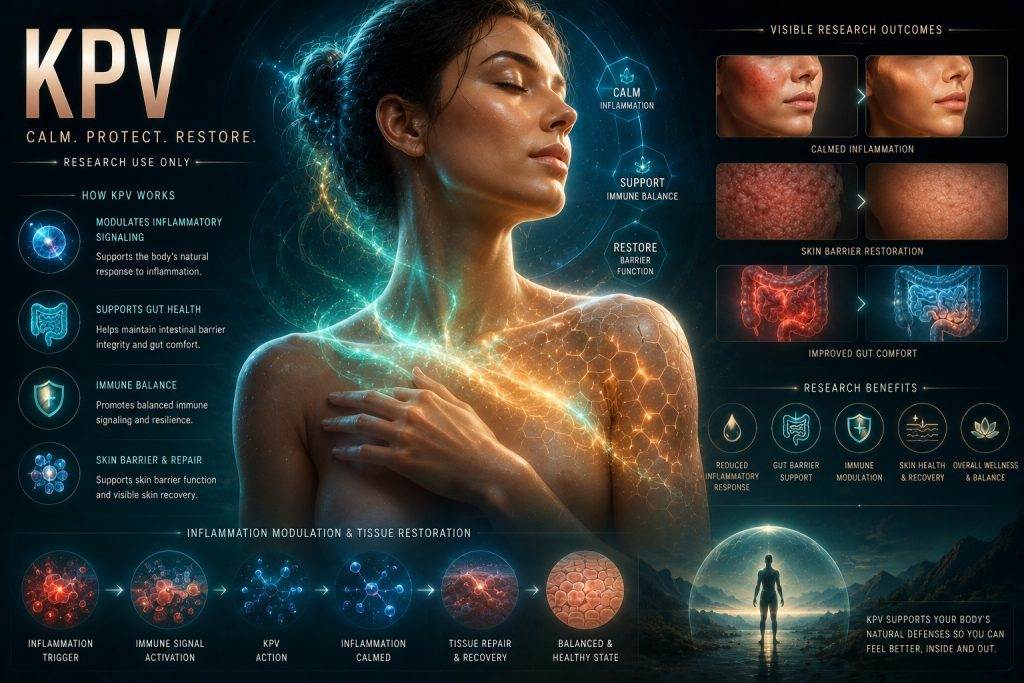
Inflammation plays a central role in recovery, performance, digestive health, skin repair, and overall wellness. While acute inflammation is a necessary part of healing, chronic inflammation can contribute to tissue damage, impaired recovery, gut dysfunction, and a wide range of health concerns. One peptide that has generated increasing interest in inflammation research is KPV.
KPV is a small tripeptide derived from alpha-melanocyte-stimulating hormone (α-MSH). Despite consisting of only three amino acids, KPV has demonstrated significant anti-inflammatory activity in numerous preclinical studies. Unlike many conventional anti-inflammatory medications that broadly suppress immune function, KPV appears to help regulate immune responses while preserving normal immune activity.
In this guide, we’ll explore:
What KPV is
How it works
Its anti-inflammatory mechanisms
Potential benefits for gut health
Skin repair and wound-healing applications
Recovery and systemic inflammation support
Research protocols and dosing considerations
Safety profile and side effects
Comparisons with other peptides
Legal and regulatory status
What Is KPV Peptide?
KPV is a tripeptide composed of three amino acids:
Lysine (K)
Proline (P)
Valine (V)
It originates from the C-terminal portion of α-MSH (alpha-melanocyte-stimulating hormone), a naturally occurring peptide involved in regulating:
Immune responses
Inflammation
Pigmentation
Energy balance
Cellular protection
Although α-MSH performs numerous functions throughout the body, researchers discovered that the KPV fragment retains much of the parent molecule’s anti-inflammatory activity while eliminating many of its broader hormonal effects.
Key Characteristics of KPV
Small and highly bioactive structure
Derived from α-MSH
Strong anti-inflammatory activity
Multiple administration routes under investigation
Potential applications in gut, skin, and immune health
Because of its simplicity and stability, KPV has become one of the most promising peptides being investigated for inflammatory disorders and tissue recovery.
How KPV Works
KPV functions by influencing several pathways involved in inflammation and immune regulation.
Unlike medications that completely suppress immune activity, KPV appears to help restore balance within inflammatory pathways.
Melanocortin Receptor Activity
One of KPV’s primary mechanisms involves interaction with melanocortin receptors, particularly:
MC1R
MC3R
These receptors are present on:
Immune cells
Skin tissues
Gastrointestinal tissues
Various inflammatory pathways
Activation of these receptors may help reduce the production of inflammatory signaling molecules.
Potential effects include:
Reduced immune overactivation
Lower inflammatory burden
Improved tissue healing
NF-κB Suppression
One of the most studied aspects of KPV is its ability to influence the NF-κB pathway.
NF-κB acts as a master regulator of inflammation and controls the production of numerous inflammatory mediators.
KPV may help reduce:
TNF-α
IL-1β
IL-6
Other pro-inflammatory cytokines
Potential benefits include:
Reduced inflammatory signaling
Improved recovery
Protection against chronic inflammatory stress
Gut Barrier Protection
Research suggests KPV may help strengthen epithelial barriers within the digestive tract.
Potential benefits include:
Improved intestinal integrity
Reduced permeability
Better barrier function
Lower inflammatory activity within gut tissues
Because intestinal barrier dysfunction is associated with numerous inflammatory conditions, this mechanism has generated considerable interest in gastrointestinal research.
Antimicrobial Activity
Some studies suggest KPV may possess mild antimicrobial properties.
Potential effects include:
Reduced pathogen-related inflammation
Improved tissue recovery
Enhanced barrier protection
While this remains an emerging area of research, it may contribute to KPV’s broader healing profile.
Benefits of KPV Peptide
Gut Health Support
One of the most extensively studied applications of KPV involves gastrointestinal inflammation.
Potential benefits include:
Improved intestinal barrier function
Reduced inflammatory responses
Support for digestive tissue repair
Lower inflammatory stress within the gut
Research has explored KPV in models of:
Colitis
Inflammatory bowel disease
Gut barrier dysfunction
Intestinal inflammation
Because gut health influences systemic inflammation throughout the body, these effects may extend beyond digestive wellness alone.
Skin Repair and Wound Healing
KPV has also attracted significant attention for skin health applications.
Potential benefits include:
Faster wound closure
Reduced redness
Lower irritation
Improved tissue remodeling
Enhanced recovery from inflammatory skin conditions
Research has investigated its potential role in:
Eczema
Psoriasis
Dermatitis
Skin barrier dysfunction
Topical administration remains one of the most commonly explored methods for these applications.