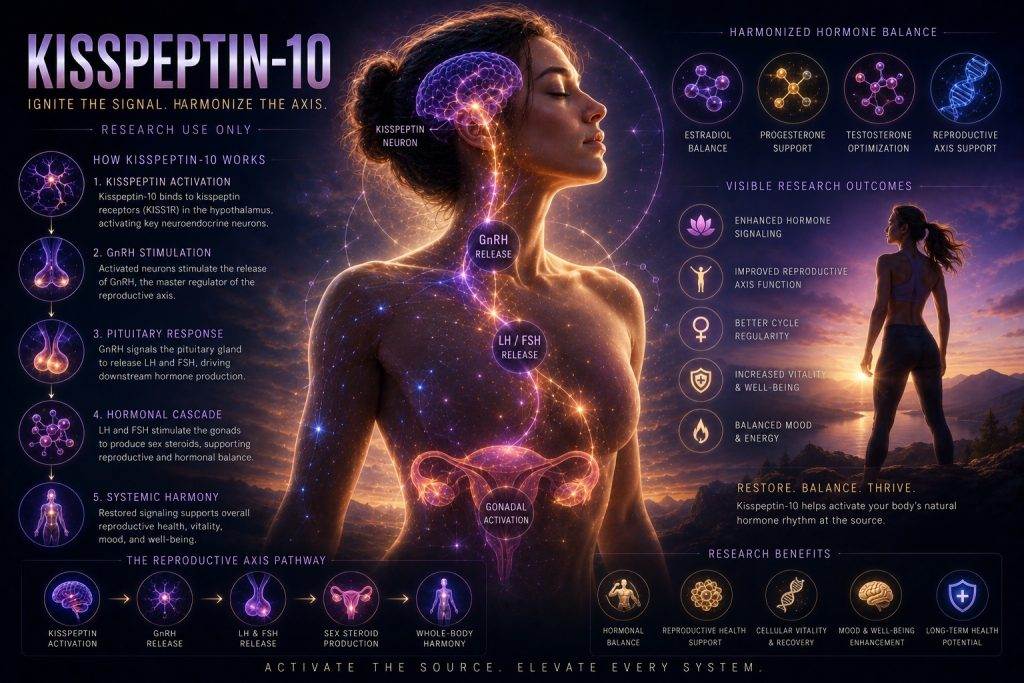
The human reproductive system relies on a delicate network of hormones that must function in perfect coordination to support fertility, puberty, reproductive health, and overall hormonal balance. Among the most important discoveries in modern reproductive endocrinology is Kisspeptin, a naturally occurring neuropeptide that serves as one of the primary regulators of the reproductive hormone axis.
Over the last two decades, Kisspeptin has transformed scientists’ understanding of fertility, puberty, menstrual regulation, and hormonal signaling. Once known primarily for its role in suppressing cancer metastasis, Kisspeptin is now recognized as a master controller of reproductive function in both men and women.
As researchers continue to investigate its mechanisms, Kisspeptin is emerging as a promising target for the treatment of infertility, hormonal disorders, and reproductive dysfunction.
In this guide, we’ll explore:
What Kisspeptin is
How it regulates hormones
Its role in fertility and reproductive health
Factors that influence Kisspeptin levels
Research developments
Potential therapeutic applications
Benefits for men’s and women’s health
Future implications in reproductive medicine
What Is Kisspeptin?
Kisspeptin is a naturally occurring neuropeptide encoded by the KISS1 gene. It is produced primarily within the hypothalamus, a region of the brain responsible for regulating numerous hormonal processes.
Originally identified because of its ability to suppress cancer metastasis, researchers later discovered that Kisspeptin plays a critical role in reproductive hormone regulation.
Kisspeptin exerts its effects by binding to the KISS1 receptor (KISS1R), previously known as GPR54.
Activation of this receptor stimulates the release of:
Gonadotropin-Releasing Hormone (GnRH)
GnRH then signals the pituitary gland to release:
Luteinizing Hormone (LH)
Follicle-Stimulating Hormone (FSH)
These hormones regulate:
Puberty
Fertility
Ovulation
Testosterone production
Menstrual cycles
Reproductive function
Because of its central role in initiating reproductive hormone signaling, Kisspeptin is often referred to as one of the body’s primary reproductive regulators.
The Role of Kisspeptin in Hormonal Regulation
The primary function of Kisspeptin is to regulate the hypothalamic-pituitary-gonadal (HPG) axis.
This system governs the production of reproductive hormones throughout the body.
Step 1: Kisspeptin Activation
Kisspeptin neurons stimulate the release of GnRH from the hypothalamus.
Step 2: GnRH Signaling
GnRH travels to the pituitary gland and promotes the release of:
LH
FSH
Step 3: Gonadal Response
These hormones act on:
In Women
Ovarian follicles
Estrogen production
Ovulation
Progesterone synthesis
In Men
Testosterone production
Sperm development
Testicular function
Without adequate Kisspeptin signaling, normal reproductive hormone production becomes impaired.
Kisspeptin as the Master Regulator of Reproduction
One reason Kisspeptin has attracted so much scientific attention is because it serves as a critical link between the brain and reproductive organs.
Its activity helps determine:
Puberty onset
Fertility status
Menstrual regularity
Hormonal balance
Sexual maturation
Research has demonstrated that individuals with defects in Kisspeptin signaling often experience:
Delayed puberty
Infertility
Reproductive hormone deficiencies
Hypogonadism
This highlights its importance as a central coordinator of reproductive health.
Kisspeptin and Female Reproductive Health
Menstrual Cycle Regulation
Kisspeptin levels naturally fluctuate throughout the menstrual cycle.
During the follicular phase:
Estrogen levels rise
Kisspeptin activity increases
As ovulation approaches:
Kisspeptin stimulates GnRH release
LH surges occur
Ovulation is triggered
Following ovulation:
Progesterone production increases
Reproductive hormone balance is maintained
These cyclical changes help ensure proper menstrual function and fertility.
Fertility and Ovulation
Kisspeptin plays an essential role in:
Egg maturation
Follicle development
Ovulation
Hormonal coordination
Disruptions in Kisspeptin signaling may contribute to:
Irregular menstrual cycles
Anovulation
Fertility challenges
Researchers continue to investigate how Kisspeptin-based therapies may improve fertility outcomes.
Potential Applications in PCOS
Polycystic Ovary Syndrome is one of the most common endocrine disorders affecting women.
Common symptoms include:
Irregular cycles
Elevated androgen levels
Ovulatory dysfunction
Infertility
Research suggests that abnormalities in Kisspeptin signaling may contribute to hormonal disturbances associated with PCOS.
Potential therapeutic benefits under investigation include:
Improved ovulation
Better menstrual regulation
Enhanced reproductive hormone balance
Further studies are needed, but the early findings are promising.
Kisspeptin and Male Reproductive Health
Kisspeptin is equally important for male reproductive function.
Testosterone Production
By stimulating LH release, Kisspeptin indirectly supports testosterone production within the testes.
Healthy testosterone levels are important for:
Libido
Energy levels
Muscle maintenance
Mood regulation
Reproductive function
Reduced Kisspeptin activity may contribute to low testosterone levels and related symptoms.
Sperm Production
FSH plays a critical role in spermatogenesis.
Because Kisspeptin regulates FSH release, it also supports:
Sperm development
Sperm maturation
Fertility
Disruptions in this pathway may contribute to male infertility.
Sexual Health and Function
Emerging research suggests Kisspeptin may influence:
Sexual desire
Arousal
Emotional processing
Reproductive behavior
While more research is needed, these findings suggest that Kisspeptin may affect both physical and psychological aspects of sexual health.
Factors That Influence Kisspeptin Levels
Kisspeptin production is highly responsive to both internal and external signals.
Sex Hormones
Estrogen and testosterone significantly influence Kisspeptin activity.
Higher hormone levels may:
Stimulate Kisspeptin production
Enhance reproductive signaling
Lower levels may suppress reproductive hormone activity.
Body Weight and Energy Availability
Metabolic status plays an important role in reproductive function.
Signals from hormones such as:
Leptin
Ghrelin
help communicate energy availability to the brain.
When energy stores are insufficient:
Kisspeptin activity may decline
Fertility may be reduced
Hormone production may decrease
This explains why severe dieting, eating disorders, and chronic undernutrition can disrupt reproductive health.
Stress
Chronic stress may negatively affect:
GnRH secretion
Kisspeptin signaling
Fertility
Hormonal balance
Long-term activation of stress pathways can interfere with reproductive hormone production.
Current Research and Emerging Applications
Interest in Kisspeptin has expanded significantly in recent years.
Researchers are investigating its potential role in:
Fertility treatments
Hormonal disorders
Delayed puberty
Hypogonadism
Reproductive dysfunction
Several studies have explored the use of Kisspeptin to stimulate reproductive hormone release in individuals experiencing fertility challenges.
Early findings suggest that Kisspeptin may provide a more physiologic method of activating reproductive pathways compared with some traditional therapies.
Kisspeptin as a Potential Treatment Target
Infertility
Because Kisspeptin sits at the very top of the reproductive hormone cascade, it has become a promising target for fertility interventions.
Potential applications include:
Ovulation support
Fertility enhancement
Hormonal restoration
Reproductive axis activation
Research remains ongoing.
Assisted Reproductive Technology (ART)
Scientists are investigating whether Kisspeptin may improve outcomes in:
In Vitro Fertilization (IVF)
Controlled ovarian stimulation
Egg maturation protocols
Potential benefits include:
More physiologic hormone signaling
Reduced risk of ovarian overstimulation
This remains one of the most exciting areas of reproductive medicine research.
Hypogonadotropic Hypogonadism
Researchers have also explored Kisspeptin therapy for:
Hypogonadotropic Hypogonadism
Potential benefits include:
Increased LH production
Increased FSH production
Improved reproductive hormone signaling
Restoration of fertility
Further clinical trials are ongoing.
Future Prospects
The future of Kisspeptin research appears highly promising.
Potential areas of future development include:
Fertility treatments
Hormonal optimization
Puberty disorders
Reproductive medicine
Men’s health
Women’s health
As researchers continue to uncover the full scope of Kisspeptin’s functions, its importance within endocrinology and reproductive medicine is likely to grow substantially.
Conclusion
Kisspeptin has emerged as one of the most important discoveries in modern reproductive endocrinology.
By regulating the release of GnRH and controlling the hypothalamic-pituitary-gonadal axis, Kisspeptin influences:
Puberty
Fertility
Ovulation
Testosterone production
Menstrual cycles
Reproductive health
Its impact extends across both male and female physiology, making it a critical component of hormonal balance and reproductive function.
As research continues to expand, Kisspeptin may eventually become a cornerstone of future fertility treatments and reproductive medicine strategies.
For now, it remains one of the most exciting and rapidly developing areas of hormone research, offering valuable insights into how the body regulates some of its most essential biological functions.