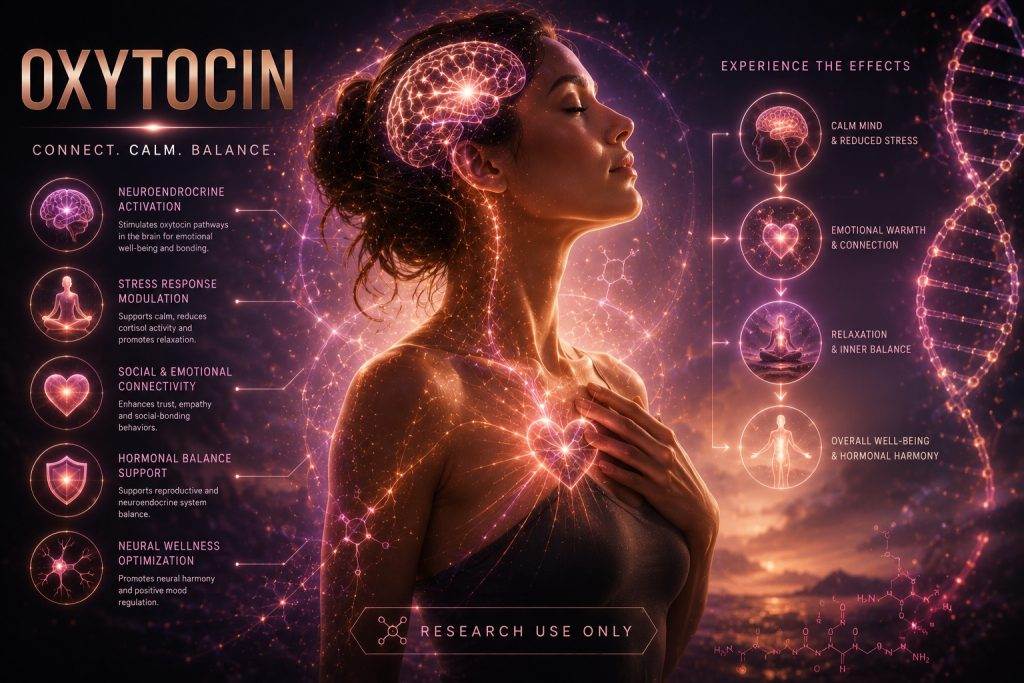
Few peptides have captured public attention quite like Oxytocin. Commonly referred to as the “love hormone” or “bonding peptide,” Oxytocin is widely recognized for its role in social connection, trust, and emotional attachment. However, its influence extends far beyond relationships and emotional well-being.
Oxytocin is a naturally occurring peptide hormone produced in the hypothalamus and released through the posterior pituitary gland. It functions as both a hormone and a neuropeptide, allowing it to affect multiple systems throughout the body simultaneously.
Researchers continue to investigate Oxytocin because of its potential impact on:
Social behavior
Emotional regulation
Stress resilience
Recovery
Metabolic health
Cardiovascular function
Cognitive performance
Although it is best known for its involvement in childbirth and breastfeeding, Oxytocin may play a much broader role in human health and performance.
In this guide, we’ll cover:
What Oxytocin is
How it works
Potential benefits
Research dosing protocols
Side effects and safety
Comparisons to other peptides
Legal status
Current scientific research
What Is Oxytocin?
Oxytocin is a naturally occurring peptide hormone composed of nine amino acids.
It is produced primarily in the hypothalamus and stored within the posterior pituitary gland before being released into circulation.
Oxytocin plays critical roles in:
Childbirth
Lactation
Pair bonding
Social attachment
Emotional regulation
Stress management
Because it functions both as a hormone and a neurotransmitter, Oxytocin influences both physical and psychological processes.
Researchers often describe Oxytocin as a communication molecule because it helps coordinate interactions between the brain, nervous system, and various organs throughout the body.
How Oxytocin Works
One of the reasons Oxytocin is so fascinating is its dual mechanism of action.
It functions both:
Systemically through the bloodstream
Directly within the brain
This allows Oxytocin to influence a wide range of biological and behavioral functions.
Hormonal Effects
When released into circulation, Oxytocin binds to receptors located in tissues throughout the body.
Some of its most well-known actions include:
Uterine Contractions
Oxytocin stimulates smooth muscle contraction during labor.
This effect makes it one of the most commonly used medications in obstetric medicine.
Milk Ejection
During breastfeeding, Oxytocin promotes milk letdown by stimulating contractions within mammary tissue.
These functions represent some of the clearest examples of peptide hormones directly influencing physiology.
Neurological Effects
Within the brain, Oxytocin acts as a neuropeptide.
It influences brain regions involved in:
Emotion
Trust
Social recognition
Bonding
Stress regulation
Oxytocin receptors are found in areas such as:
Amygdala
Hippocampus
Prefrontal cortex
These regions help regulate how humans process emotions and social interactions.
Stress Regulation
One of the most researched effects of Oxytocin involves its relationship with the stress response.
Potential effects include:
Reduced cortisol release
Improved emotional resilience
Reduced anxiety responses
Enhanced relaxation
By influencing the hypothalamic-pituitary-adrenal (HPA) axis, Oxytocin may help buffer the effects of chronic stress.
Metabolic and Cardiovascular Effects
Emerging research suggests Oxytocin may also influence:
Blood glucose regulation
Insulin sensitivity
Appetite control
Blood pressure
Cardiovascular health
Although these findings remain under investigation, they suggest Oxytocin may play a broader role in whole-body health than previously recognized.
Potential Benefits of Oxytocin
Social Bonding and Emotional Connection
Oxytocin is most famous for its role in human bonding.
Potential benefits include:
Increased trust
Enhanced empathy
Stronger social connection
Improved emotional recognition
Research has demonstrated that Oxytocin influences how individuals perceive and respond to social cues.
These effects contribute to:
Romantic attachment
Parental bonding
Social cohesion
Stress Resilience
One of Oxytocin’s most promising applications involves stress management.
Potential benefits include:
Reduced cortisol levels
Improved stress tolerance
Enhanced emotional regulation
Greater resilience under pressure
Many researchers believe these effects may contribute significantly to overall mental well-being.
Mood Support
Oxytocin continues to be studied for its influence on mood-related pathways.
Potential benefits include:
Improved emotional balance
Reduced anxiety
Enhanced feelings of well-being
Better emotional processing
Because Oxytocin affects several neurotransmitter systems, it remains an active area of psychiatric research.
Recovery and Healing
Research suggests Oxytocin may influence recovery processes throughout the body.
Potential benefits include:
Reduced inflammation
Improved recovery
Better sleep quality
Enhanced relaxation
By encouraging parasympathetic nervous system activity, Oxytocin may help shift the body into a recovery-focused state.
Metabolic Health
Emerging evidence suggests Oxytocin may contribute to:
Improved insulin sensitivity
Better glucose regulation
Appetite control
Energy balance
Although research remains ongoing, these findings have generated interest in metabolic medicine.
Cardiovascular Support
Potential cardiovascular benefits currently under investigation include:
Improved vascular function
Reduced blood pressure
Better circulatory health
Additional research is needed to fully understand these effects.
Oxytocin Dosage in Research
Because Oxytocin is an approved medication and an active area of research, dosing varies significantly depending on the intended application.
Intranasal Administration
Most behavioral and psychological studies utilize intranasal Oxytocin.
Common research protocols include:
Acute Studies
24 IU per session
Occasionally 40 IU
Used for:
Social cognition
Stress response
Emotional processing
Multi-Week Research
Protocols often include:
24 IU twice daily
Duration:
Several weeks to several months
These studies investigate mood, social functioning, and psychiatric outcomes.
Clinical Obstetric Use
Oxytocin is widely used in hospital settings for:
Labor induction
Labor augmentation
Postpartum hemorrhage management
Administration occurs through carefully controlled intravenous infusion under continuous medical supervision.
Obstetric dosing protocols are highly individualized and not comparable to research-based intranasal use.
Side Effects of Oxytocin
Oxytocin is generally considered well tolerated when used appropriately.
Potential side effects vary depending on route of administration and dosage.
Common Intranasal Side Effects
Potential effects include:
Headaches
Nasal irritation
Mild fatigue
Drowsiness
Dizziness
Nausea
Most reported reactions are mild and temporary.
Emotional Effects
Because Oxytocin influences emotional processing, some individuals may experience:
Mood changes
Emotional sensitivity
Irritability
Altered social perception
Responses can vary considerably between individuals.
Cardiovascular Effects
Potential effects include:
Temporary blood pressure changes
Mild heart-rate fluctuations
These effects are generally minor in healthy individuals.
Obstetric Risks
When administered intravenously during labor, Oxytocin carries additional risks.
Potential complications include:
Excessive uterine contractions
Fetal distress
Low sodium levels
Hypotension
Water retention
For this reason, obstetric use requires hospital monitoring.
Oxytocin Compared to Other Peptides
Oxytocin vs Selank
Selank primarily focuses on:
Anxiety reduction
Mood stabilization
Cognitive balance
Oxytocin primarily focuses on:
Bonding
Social connection
Trust
Emotional regulation
Oxytocin vs Semax
Semax is generally associated with:
Cognitive performance
Focus
Neuroprotection
Learning
Oxytocin is more closely linked to:
Social behavior
Emotional processing
Stress resilience
Oxytocin vs Vasopressin
Vasopressin regulates:
Fluid balance
Blood pressure
Water retention
Oxytocin primarily supports:
Bonding
Relaxation
Emotional regulation
Although structurally similar, their functions differ substantially.
Oxytocin vs BPC-157
BPC-157 is typically associated with:
Tissue repair
Recovery
Gut health
Oxytocin focuses more on:
Emotional resilience
Social health
Stress reduction
Together they represent different aspects of recovery and well-being.
Legal Status
Oxytocin occupies a unique position because it is both a naturally occurring hormone and an approved prescription medication.
Approved Medical Uses
Oxytocin is approved for:
Labor induction
Labor augmentation
Postpartum hemorrhage management
These uses occur under physician supervision.
Research Applications
Potential uses involving:
Mood
Social behavior
Anxiety
Metabolic health
remain investigational.
Intranasal Oxytocin has not received regulatory approval for these purposes.
Supplement Status
Oxytocin:
Is not approved as a dietary supplement
Cannot legally be marketed as a supplement
Remains restricted to medical and research settings
Conclusion
Oxytocin is far more than a simple “love hormone.”
As both a hormone and neuropeptide, it influences numerous systems involved in:
Social bonding
Emotional regulation
Stress resilience
Recovery
Metabolic health
Cardiovascular function
Its ability to connect emotional well-being with physiological regulation makes it one of the most fascinating peptides currently being studied.
Potential benefits include:
Improved trust and social connection
Enhanced stress management
Better emotional resilience
Recovery support
Emerging metabolic benefits
While its medical role in childbirth is well established, ongoing research continues to explore how Oxytocin may influence mental health, performance, recovery, and overall wellness.
As scientific understanding expands, Oxytocin remains one of the most promising examples of how a single peptide can bridge the gap between physical health and emotional well-being.
Oxytocin FAQ
What is Oxytocin?
Oxytocin is a naturally occurring peptide hormone produced in the hypothalamus and released from the posterior pituitary gland. It regulates childbirth, lactation, bonding, stress responses, and social behavior.
Why is Oxytocin called the “love hormone”?
Oxytocin is associated with trust, bonding, attachment, and emotional connection, leading to its popular nickname as the “love hormone.”
Can Oxytocin reduce stress?
Research suggests Oxytocin may reduce cortisol levels and improve emotional resilience, helping individuals better manage stress.
What are the most common side effects?
Potential side effects include:
Headaches
Nasal irritation
Drowsiness
Mild dizziness
Temporary nausea
Is Oxytocin legal?
Yes. Oxytocin is an approved prescription medication for specific medical uses, particularly in obstetrics. However, most behavioral and performance-related uses remain investigational and are not approved by regulatory agencies.