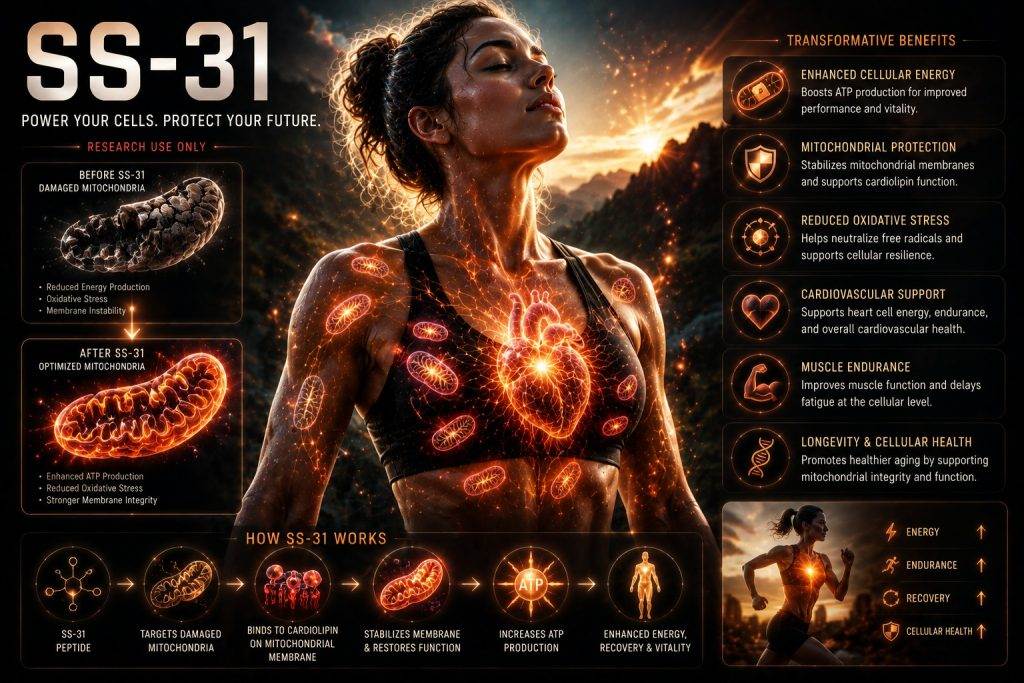
Mitochondria are often called the powerhouses of the cell because they generate the energy required for virtually every biological process. As we age, mitochondrial efficiency declines, contributing to reduced energy production, slower recovery, increased oxidative stress, and a greater risk of age-related dysfunction.
This is where SS-31 (Elamipretide) has attracted significant attention. Unlike many peptides that act on hormone receptors or growth pathways, SS-31 was specifically engineered to target mitochondria directly. By improving mitochondrial function and protecting cellular energy production, SS-31 has become one of the most promising investigational compounds in longevity, recovery, and metabolic health research.
In this guide, we’ll cover:
What SS-31 is
How SS-31 works
Benefits for energy, recovery, and longevity
Dosage and administration
Side effects and safety
SS-31 vs other mitochondrial peptides
Stacking strategies
Legal status
What Is SS-31?
SS-31, also known as Elamipretide, is a synthetic tetrapeptide with the amino acid sequence:
D-Arg
Dmt
Lys
Phe-NH2
Unlike traditional peptides that work by binding to cell-surface receptors, SS-31 was specifically designed to penetrate cells and accumulate within mitochondria. Its primary target is cardiolipin, a phospholipid found exclusively within the inner mitochondrial membrane that plays a critical role in energy production.
By binding directly to cardiolipin, SS-31 helps maintain mitochondrial structure and optimize the efficiency of cellular energy production.
Key characteristics include:
Mitochondria-targeted peptide
Cardiolipin stabilization
ATP production support
Oxidative stress reduction
Non-hormonal mechanism
Unlike peptides such as MOTS-c or Humanin, SS-31 was specifically engineered as a therapeutic mitochondrial compound.
How SS-31 Works
The unique value of SS-31 lies in its ability to work directly inside mitochondria.
Cardiolipin Binding
Cardiolipin is essential for:
Mitochondrial structure
Electron transport chain function
ATP production
As mitochondria age, cardiolipin becomes damaged and less effective.
SS-31 binds to cardiolipin and helps stabilize the inner mitochondrial membrane, preserving mitochondrial integrity.
Improved Electron Transport Chain Efficiency
The Electron Transport Chain (ETC) is responsible for producing ATP, the body’s primary energy currency.
SS-31 helps:
Improve ETC efficiency
Reduce electron leakage
Increase ATP production
Improve cellular energy availability
This may result in greater energy production at the cellular level.
Reduced Oxidative Stress
Mitochondrial dysfunction often leads to excessive production of reactive oxygen species (ROS).
Excessive ROS contributes to:
DNA damage
Protein damage
Cellular aging
Chronic inflammation
By stabilizing mitochondrial function, SS-31 helps reduce oxidative stress at its source.
Enhanced Cellular Bioenergetics
Potential benefits include:
Higher ATP output
Better energy utilization
Increased resilience under stress
Improved cellular efficiency
These effects are particularly relevant in tissues with high energy demands such as:
Brain
Heart
Skeletal muscle
Nervous system
Benefits of SS-31
Mitochondrial Protection
One of SS-31’s primary applications is preserving mitochondrial health.
Potential benefits include:
Improved mitochondrial integrity
Reduced mitochondrial dysfunction
Protection against age-related decline
Increased Cellular Energy
By improving ATP production, SS-31 may support:
Improved vitality
Better recovery
Reduced fatigue
Enhanced physical performance
Many researchers consider ATP production one of the most important mechanisms behind SS-31’s effects.
Reduced Oxidative Damage
Potential benefits include:
Lower oxidative stress
Reduced inflammation
Improved cellular resilience
Support for healthy aging
Neuroprotection
The brain is highly dependent on mitochondrial function.
Research suggests SS-31 may support:
Cognitive function
Memory
Neural resilience
Protection against mitochondrial-related decline
Recovery and Endurance Support
Potential performance benefits include:
Improved oxygen utilization
Better recovery between workouts
Reduced exercise-induced fatigue
Enhanced endurance capacity
These effects have contributed to growing interest among athletes and longevity enthusiasts.
Anti-Aging Potential
Because mitochondrial dysfunction is considered a hallmark of aging, SS-31 has become a major focus of longevity research.
Potential benefits include:
Improved cellular health
Better metabolic efficiency
Reduced age-related decline
Increased physiological resilience
SS-31 Dosage and Administration
SS-31 is primarily administered through injection.
Administration Methods
Most research protocols utilize:
Subcutaneous injection
Intravenous administration (clinical studies)
Oral administration is generally not used because of peptide degradation within the digestive system.
Research Dosing
Human studies have generally used:
Single-digit milligram doses per day
Daily administration
Continuous dosing schedules
Because SS-31 remains investigational, no standardized medical dosing guidelines currently exist.
Duration of Use
Research protocols commonly range from:
Several weeks
Multiple months
Long-term human data remains limited and continues to be investigated.
Side Effects and Safety
Current research suggests SS-31 has a favorable safety profile.
Common Side Effects
Reported side effects include:
Injection-site irritation
Mild redness
Temporary discomfort
These are generally the most commonly reported adverse events.
Less Common Side Effects
Occasionally reported effects include:
Mild headache
Temporary fatigue
Mild nausea
Gastrointestinal discomfort
These symptoms are generally mild and transient.
Long-Term Safety
Current findings suggest:
No major toxicity signals
Favorable tolerability
No hormonal suppression
However, comprehensive long-term human data is still limited.
SS-31 vs Other Mitochondrial Peptides
SS-31 vs MOTS-c
MOTS-c primarily improves:
Metabolic flexibility
AMPK activation
Fuel utilization
SS-31 primarily improves:
Mitochondrial membrane stability
ATP production
Oxidative stress control
Many researchers view them as complementary rather than competitive.
SS-31 vs Humanin
Humanin focuses primarily on:
Cytoprotection
Anti-apoptotic signaling
Neuroprotection
SS-31 focuses more directly on:
Bioenergetics
Mitochondrial efficiency
ATP production
SS-31 vs BPC-157
BPC-157 supports:
Tissue repair
Angiogenesis
Recovery
SS-31 supports:
Cellular energy production
Mitochondrial function
Together they may target different aspects of recovery.
Popular SS-31 Stacks
Researchers often combine SS-31 with compounds that support mitochondrial function and recovery.
Potential combinations include:
SS-31 + NAD+ Precursors
Examples:
NR
NMN
Potential benefits:
Improved mitochondrial cofactor availability
Enhanced energy metabolism
SS-31 + CoQ10
Potential benefits:
Electron transport support
Additional mitochondrial protection
SS-31 + Creatine
Potential benefits:
ATP buffering
Improved performance
Enhanced recovery
SS-31 + MOTS-c
Potential benefits:
Enhanced metabolic flexibility
Improved endurance
Greater cellular resilience