Tendon injuries, muscle tears, and chronic joint pain can become some of the most frustrating obstacles for:
• Athletes
• Lifters
• Runners
• Combat athletes
• Active individuals
Traditional recovery approaches often focus primarily on:
→ Symptom management
through methods such as:
→ Rest
→ Ice
→ NSAIDs
→ Physical therapy
While these approaches can help, recovery may still feel:
→ Slow and incomplete
This is one reason BPC-157 has become increasingly discussed within:
→ Recovery and regenerative-performance communities
Originally derived from:
→ Protective proteins found in gastric juice
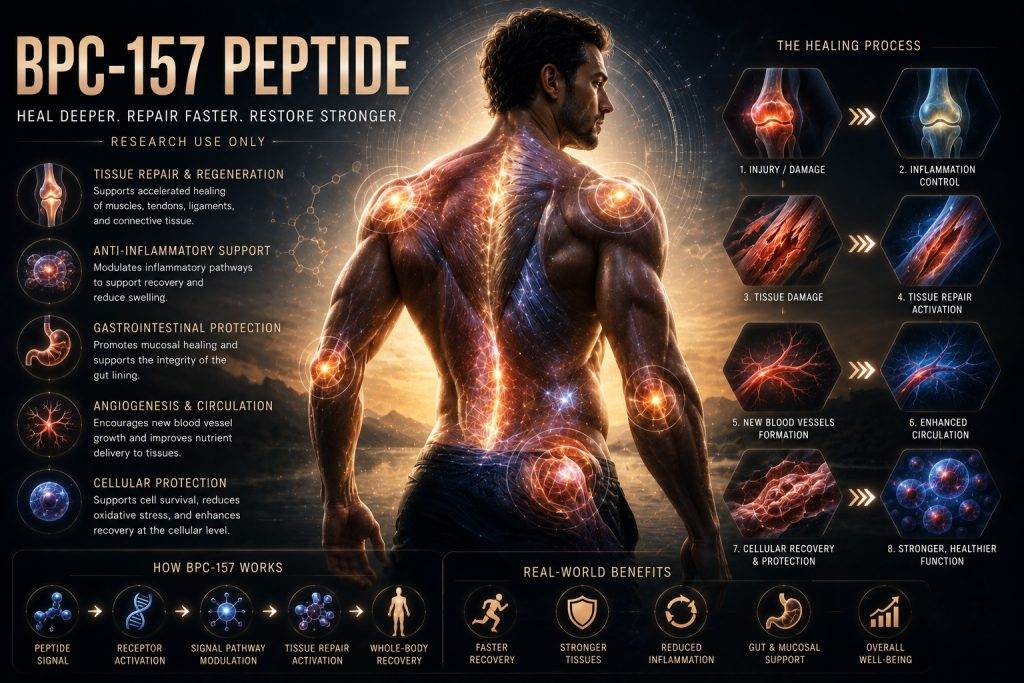
BPC-157 is a synthetic peptide frequently researched for its potential role in:
→ Tendon repair
→ Muscle healing
→ Connective-tissue regeneration
→ Angiogenesis
→ Inflammation modulation
This educational guide explores:
• What BPC-157 is
• How it works
• Tendon and muscle recovery research
• Dosage and injection strategies
• Stacking approaches
• Side effects and safety
• Legal and regulatory considerations
—
What Is BPC-157 & How Does It Work?
BPC-157 stands for:
→ Body Protection Compound-157
and is classified as a:
→ Synthetic pentadecapeptide
containing:
→ 15 amino acids
—
Where BPC-157 Comes From
The peptide was originally derived from:
→ A protective protein sequence found in gastric juice
which explains why researchers initially explored its effects involving:
→ Gut protection and epithelial repair
—
Why BPC-157 Became Popular
Over time, research began exploring BPC-157’s potential effects involving:
→ Soft-tissue regeneration
→ Angiogenesis
→ Tendon healing
→ Muscle recovery
→ Connective-tissue repair
—
Mechanisms of Action
Potential mechanisms commonly discussed include:
→ VEGF (vascular endothelial growth factor) signaling
→ Angiogenesis support
→ Fibroblast activation
→ Collagen synthesis
→ Nitric-oxide modulation
→ Inflammatory pathway regulation
—
Why Angiogenesis Matters
Angiogenesis refers to:
→ The formation of new blood vessels
Potential benefits may include:
→ Better nutrient delivery
→ Improved oxygenation
→ Faster tissue repair
→ Enhanced waste removal from damaged tissue
—
Why BPC-157 Is Different From Hormonal Peptides
Unlike anabolic agents or GH-based compounds, BPC-157 does not appear to significantly:
→ Alter testosterone
→ Elevate IGF-1
→ Cause anabolic hypertrophy
Instead, its research focus centers more heavily on:
→ Tissue healing and recovery pathways
—
Tissue Targets Commonly Discussed
Potential applications commonly explored include:
→ Tendon injuries
→ Ligament damage
→ Muscle tears and strains
→ Cartilage degeneration
→ Joint recovery
→ Nerve repair support
→ Post-surgical rehabilitation
—
Benefits of BPC-157 For Tendon & Muscle Recovery
1. Tendon & Ligament Healing
Tendons and ligaments generally heal slowly because they receive:
→ Limited blood flow
Potential BPC-157 effects may include:
→ Faster collagen remodeling
→ Improved fibroblast migration
→ Better tissue organization
→ Increased tensile strength during recovery
Why This Matters For Athletes
Potential recovery applications commonly discussed include:
→ Achilles injuries
→ Patellar tendonitis
→ Rotator-cuff recovery
→ Elbow tendon irritation
→ Chronic overuse injuries
—
2. Muscle Regeneration & Repair
BPC-157 has been explored for its potential ability to support:
→ Muscle regeneration and recovery
Potential benefits may include:
→ Reduced inflammation after training
→ Faster recovery from strains and tears
→ Reduced oxidative stress
→ Improved tissue healing
DOMS & Overtraining Recovery
Some recovery protocols discuss BPC-157 for:
→ Delayed-onset muscle soreness (DOMS)
and:
→ High-volume training recovery
—
3. Joint & Connective-Tissue Protection
Emerging research has explored whether BPC-157 may help support:
→ Cartilage integrity and connective-tissue resilience
Potential benefits commonly discussed include:
→ Better joint mobility
→ Reduced inflammatory stress
→ Long-term connective-tissue support
—
4. Nerve Recovery & Pain Modulation
Although less studied than tendon repair, research has also explored:
→ Neuroprotective signaling and nerve-regeneration pathways
Potential areas commonly discussed include:
→ Neuropathy
→ Nerve irritation
→ Pain-signaling modulation
—
BPC-157 Dosage For Tendon & Muscle Healing
Common Dosage Range
Typical recovery discussions commonly involve:
→ 250–500 mcg daily
—
Split-Dose Protocols
Some protocols discuss:
→ 250 mcg twice daily
to maintain more consistent peptide exposure.
—
Typical Cycle Length
Common recovery cycles generally range between:
→ 2–6 weeks
depending on:
→ Injury severity
→ Tissue involved
→ Recovery response
—
Injection Protocols
Common Administration Methods
→ Subcutaneous injection
→ Intramuscular injection near injury site
Why Localized Injections Are Popular
Localized injections are often discussed because they may help provide:
→ More targeted tissue exposure near the injured area
Systemic Administration
Subcutaneous abdominal injections are also commonly used for:
→ Generalized recovery support
—
Oral vs Injectable BPC-157
Oral BPC-157
Potentially more useful for:
→ Gut-health support
→ Gastric protection
→ GI recovery applications
—
Injectable BPC-157
Generally viewed as:
→ More effective for tendon, muscle, and joint repair
because injectable administration may offer:
→ Better systemic and tissue exposure
—
Stacking BPC-157 With Other Recovery Compounds
BPC-157 + TB500
One of the most common recovery stacks discussed for:
→ Tendon, ligament, and muscle recovery
Potential reasons include:
→ Collagen synthesis support + systemic tissue remodeling
—
BPC-157 + CJC-1295 / Ipamorelin
Potential goals commonly discussed include:
→ GH support
→ Better sleep quality
→ Enhanced systemic recovery
—
Advanced Recovery Stacks
Some advanced protocols discuss combining:
→ BPC-157
→ TB500
→ GH secretagogues
for:
→ Multi-pathway recovery support
—
Supplement Support Often Discussed
Potential additions commonly include:
→ Omega-3 support
→ Collagen protein
→ Magnesium and sleep support
→ Electrolyte hydration support
—
Side Effects & Safety Considerations
Current research suggests BPC-157 appears:
→ Relatively well tolerated
though long-term human clinical evidence remains limited.
—
Potential Side Effects
Potential issues may include:
→ Mild nausea
→ Headaches
→ Dizziness
→ Injection-site irritation
—
Long-Term Safety Questions
Potential concerns still requiring more research include:
→ Chronic exposure effects
→ Angiogenesis-related risks
→ Immune-system interactions
—
Why Product Quality Matters
Because BPC-157 is often sold through:
→ Research peptide suppliers
quality concerns may include:
→ Contamination
→ Incorrect dosing
→ Sterility issues
—
Legal Status of BPC-157
United States
BPC-157 is:
→ Not FDA-approved for therapeutic human use
and is commonly sold as:
→ A research-use peptide
—
International Status
Regulations vary significantly between countries involving:
→ Prescription status
→ Importation
→ Research legality
—
WADA Status
BPC-157 is prohibited under:
→ World Anti-Doping Agency (WADA) regulations
making it banned in:
→ Competitive sports
—
Important Disclaimer
This content is provided for educational purposes only and does not constitute medical advice.
BPC-157 remains an:
→ Investigational peptide compound
with:
→ Limited human clinical evidence
→ No FDA approval
→ Ongoing scientific uncertainty
Always consult a qualified healthcare professional before considering:
→ Experimental peptide-related therapies
—
FAQ: BPC-157 For Tendon & Muscle Healing
How long should you run BPC-157?
Many protocols commonly discuss:
→ 2–6 week cycles
depending on the injury and recovery response.
—
Is BPC-157 better injected near the injury?
Many recovery protocols prefer:
→ Localized administration near the injury site
for more targeted tissue exposure.
—
Can BPC-157 help tendon injuries?
Research commonly explores BPC-157 for:
→ Tendon and ligament recovery support
particularly involving collagen remodeling and angiogenesis.
—
Is oral BPC-157 effective?
Oral versions are more commonly discussed for:
→ Gut-health support
while injectable forms are generally preferred for:
→ Muscle, tendon, and connective-tissue recovery
—
Is BPC-157 legal?
BPC-157 is not FDA-approved for therapeutic use and is prohibited in drug-tested sports under WADA regulations.
—
Final Thoughts: Is BPC-157 Worth Exploring For Healing?
BPC-157 has become one of the most discussed recovery peptides because of its potential ability to support:
→ Tendon repair
→ Muscle regeneration
→ Angiogenesis
→ Collagen synthesis
→ Connective-tissue healing
Potential advantages commonly discussed include:
→ Faster recovery
→ Reduced inflammation
→ Improved tissue resilience
→ Better joint support
→ Recovery from chronic overuse injuries
Unlike purely anabolic compounds, BPC-157 appears more focused on:
→ Regenerative healing pathways
which is why it continues to attract attention within:
→ Athletic recovery and rehabilitation communities
However, despite promising preclinical findings, BPC-157 still remains:
→ Experimental
with:
→ Limited long-term human clinical evidence
→ No FDA approval
→ Ongoing scientific uncertainty
For now, it should be viewed as:
→ A promising investigational recovery peptide still undergoing scientific evaluation
rather than a fully established medical therapy for tendon and muscle healing.