L-Carnitine: A Key Nutrient for Energy Production and Fat Metabolism
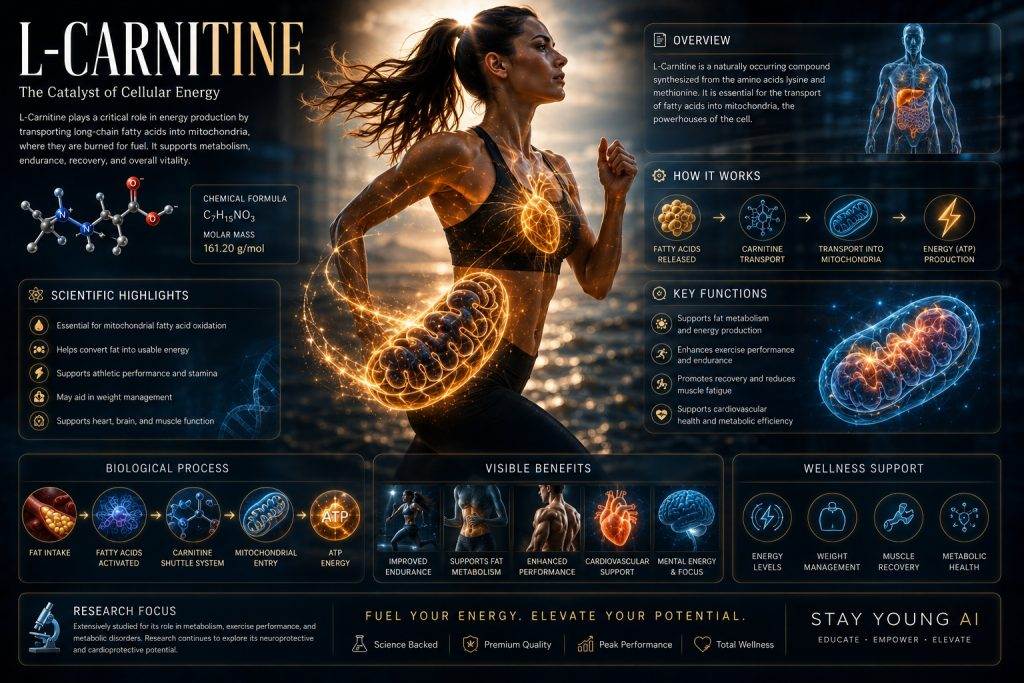
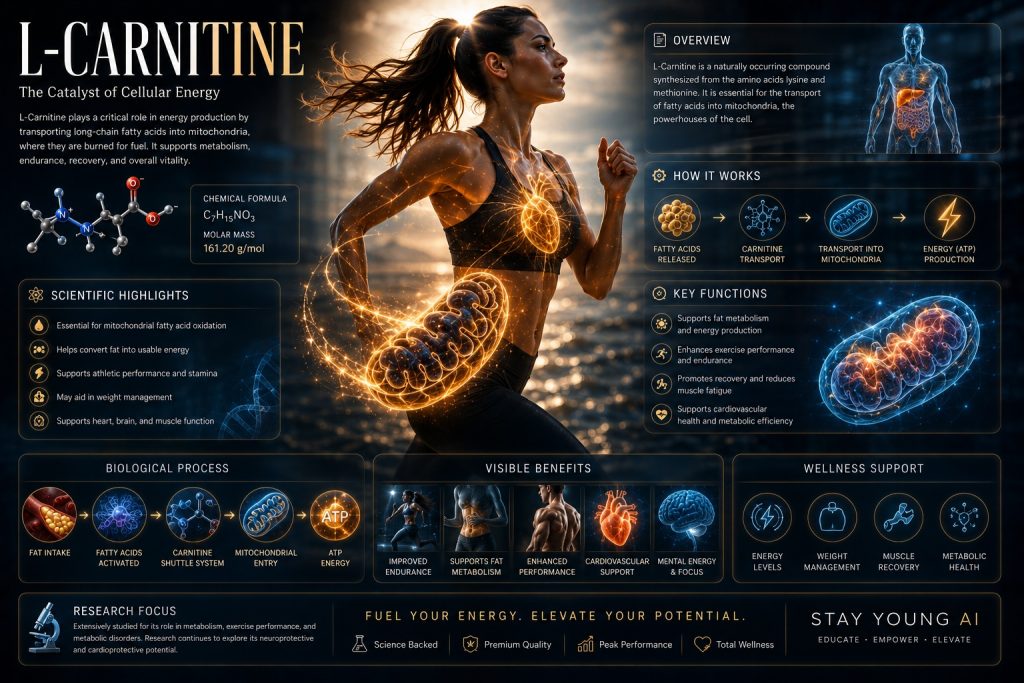
L-Carnitine is a naturally occurring compound that plays an essential role in how the body converts fat into usable energy. Found in nearly every cell, L-Carnitine helps transport long-chain fatty acids into the mitochondria—the “powerhouses” of cells—where they can be broken down to produce energy.
Because of its central role in energy metabolism, L-Carnitine has become a popular subject of research in sports nutrition, metabolic health, cardiovascular wellness, and healthy aging. Scientists continue to investigate how supporting optimal L-Carnitine levels may influence physical performance, recovery, and overall cellular function.
This article explores what L-Carnitine is, how it works, and what current scientific research suggests about its potential benefits.
What Is L-Carnitine?
L-Carnitine is a naturally occurring amino acid derivative synthesized in the body from the amino acids lysine and methionine.
It is produced primarily in the liver and kidneys and then transported to tissues with high energy demands, including:
- Skeletal muscles
- Heart muscle
- Brain
- Liver
Although the body produces L-Carnitine naturally, it can also be obtained through dietary sources such as red meat, fish, poultry, and dairy products.
Its primary function is to support the transport of fatty acids into mitochondria for energy production.
How Does L-Carnitine Work?
Fatty Acid Transport
L-Carnitine’s primary role is transporting long-chain fatty acids into mitochondria.
Once inside the mitochondria, these fatty acids undergo beta-oxidation, a process that converts fat into adenosine triphosphate (ATP), the body’s primary energy source.
This process is essential for maintaining energy production, particularly during prolonged physical activity.
Supporting Mitochondrial Function
Mitochondria generate energy for virtually every cell in the body.
Researchers continue to investigate whether adequate L-Carnitine availability may help support:
- Efficient energy production
- Cellular metabolism
- Mitochondrial health
- Physical endurance
Cellular Energy Production
By assisting in fat utilization, L-Carnitine helps cells efficiently produce ATP, supporting normal physiological functions throughout the body.
Potential Benefits of L-Carnitine
1. Energy Production
Because L-Carnitine helps transport fatty acids into mitochondria, it plays an important role in maintaining normal cellular energy production.
Researchers continue to study its potential effects on energy metabolism and physical performance.
2. Fat Metabolism
One of the best-known functions of L-Carnitine is its involvement in fat metabolism.
Scientific research continues to explore whether optimizing L-Carnitine levels may support:
- Fat utilization
- Metabolic efficiency
- Healthy body composition
- Exercise performance
3. Exercise Performance
Researchers have investigated L-Carnitine’s potential role in supporting:
- Endurance
- Exercise recovery
- Muscle function
- Physical performance
Although findings vary, L-Carnitine remains a widely studied nutrient in sports nutrition.
4. Muscle Recovery
Physical activity places significant demands on muscle tissue.
Researchers continue to explore whether L-Carnitine may support normal recovery processes by promoting efficient energy production and reducing exercise-related muscle stress.
5. Cardiovascular Health
The heart relies heavily on fatty acids as a source of energy.
Because of this, researchers have studied L-Carnitine for its potential role in supporting normal heart function and overall cardiovascular health.
Additional clinical research is ongoing.
6. Healthy Aging
As mitochondrial function naturally changes with age, researchers continue to investigate whether supporting cellular energy production through compounds such as L-Carnitine may contribute to healthy aging and improved metabolic resilience.
Types of L-Carnitine
Several forms of L-Carnitine are used in research and nutritional applications.
L-Carnitine
The standard form commonly studied for energy metabolism and fat utilization.
Acetyl-L-Carnitine (ALCAR)
Often investigated for its potential role in brain health, cognitive function, and nervous system support due to its ability to cross the blood-brain barrier.
L-Carnitine L-Tartrate
Frequently studied in sports nutrition for its potential role in exercise recovery and muscle performance.
Propionyl-L-Carnitine
Primarily researched for cardiovascular health and circulation.
Each form has distinct properties and continues to be studied for different physiological applications.
Current Research
Scientific investigations involving L-Carnitine continue to explore its potential role in:
- Cellular energy production
- Fat metabolism
- Exercise performance
- Muscle recovery
- Cardiovascular health
- Brain health
- Healthy aging
While research has produced encouraging findings in several areas, responses may vary depending on an individual’s nutritional status, health conditions, and study population.
Safety and Considerations
L-Carnitine has been extensively studied and is generally considered well tolerated when used appropriately.
Important considerations include:
- Individual needs may vary.
- Certain medical conditions may require professional guidance before supplementation.
- Researchers continue to evaluate optimal dosing strategies for various health applications.
Anyone considering L-Carnitine supplementation should consult a qualified healthcare professional.
Frequently Asked Questions
What is L-Carnitine?
L-Carnitine is a naturally occurring amino acid derivative that transports long-chain fatty acids into mitochondria, where they are converted into energy.
What is L-Carnitine used for?
Researchers and healthcare professionals study L-Carnitine for its potential role in energy production, fat metabolism, exercise performance, muscle recovery, cardiovascular health, and healthy aging.
Does L-Carnitine burn fat?
L-Carnitine does not directly burn fat. Instead, it plays an essential role in transporting fatty acids into mitochondria, where they can be used as fuel during normal energy metabolism.
Is L-Carnitine a peptide?
No. L-Carnitine is not a peptide. It is a naturally occurring amino acid derivative involved in cellular energy production.
Is L-Carnitine naturally produced by the body?
Yes. The body synthesizes L-Carnitine from the amino acids lysine and methionine, and it can also be obtained from dietary sources.
Final Thoughts
L-Carnitine is a vital nutrient involved in cellular energy production and fat metabolism. By transporting fatty acids into mitochondria, it supports one of the body’s most important metabolic processes and has become a major focus of research in sports nutrition, cardiovascular health, and healthy aging.
While scientific studies continue to explore its full range of benefits, L-Carnitine remains one of the most well-established compounds for supporting normal energy metabolism and mitochondrial function. As with any nutritional supplement, its use should be guided by individual needs and professional medical advice.
Disclaimer
This article is provided for educational and informational purposes only. This content is not intended to diagnose, treat, cure, or prevent any disease and should not be considered medical advice. Always consult a qualified healthcare professional regarding health-related decisions before beginning any new supplement or wellness program.