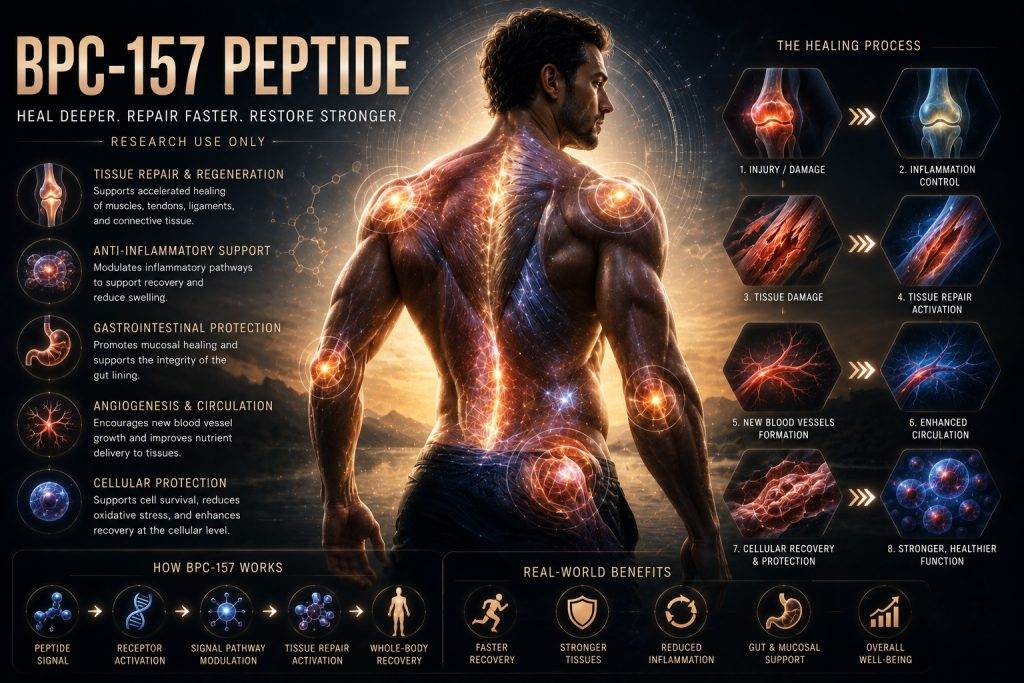
BPC-157 has quickly become one of the most discussed peptides for:
* Injury recovery
* Gut healing
* Joint support
* Tendon repair
* Inflammation management
Originally derived from:
→ A protective protein found in gastric juice
BPC-157 has gained popularity within:
→ Athletic recovery
→ Biohacking
→ Longevity optimization
→ Regenerative wellness communities
As interest in BPC-157 continues growing, so do the available delivery methods.
Today, BPC-157 is commonly sold as:
→ Injectable peptides
→ Oral liquid solutions
→ Capsule-based supplements
However, each form differs significantly in:
→ Bioavailability
→ Absorption
→ Systemic effects
→ Research support
→ Overall effectiveness
This educational guide compares:
* Injectable BPC-157
* Oral liquid BPC-157
* BPC-157 capsules
* Bioavailability differences
* Injury-recovery applications
* Gut-healing effectiveness
* Risks and sourcing concerns
* Which form appears most effective
—
What Is BPC-157?
BPC-157 stands for:
→ Body Protection Compound-157
and is classified as a:
→ Synthetic pentadecapeptide
containing:
→ 15 amino acids
—
Where BPC-157 Comes From
The peptide was originally derived from:
→ Protective proteins found in the human stomach
which explains why research initially focused heavily on:
→ Gastrointestinal healing and mucosal repair
—
Why BPC-157 Became Popular
Over time, research began exploring potential applications involving:
→ Tendon repair
→ Muscle recovery
→ Ligament healing
→ Angiogenesis
→ Joint support
→ Gut-barrier repair
—
What Makes BPC-157 Unique
Unlike many peptides that degrade rapidly in stomach acid, BPC-157 appears relatively:
→ Stable within gastric environments
which is one reason oral forms have become increasingly popular.
—
How BPC-157 Works
Potential mechanisms commonly discussed include:
→ VEGF signaling
→ Angiogenesis support
→ Fibroblast activation
→ Collagen synthesis
→ Nitric-oxide modulation
→ Inflammation regulation
—
Why These Mechanisms Matter
Potential effects may include:
→ Faster tissue repair
→ Improved blood flow
→ Better oxygen delivery
→ Reduced inflammatory stress
→ Enhanced connective-tissue healing
—
BPC-157 Delivery Forms Explained
The three most common BPC-157 delivery methods include:
| Form | Main Purpose |
| ———– | ———————————– |
| Injectable | Systemic recovery & injury healing |
| Oral Liquid | Gut-health support |
| Capsules | Convenience-focused supplementation |
Each form comes with:
→ Different strengths and limitations
—
Injectable BPC-157
Injectable BPC-157 is generally considered:
→ The gold-standard form
for users seeking:
→ Maximum therapeutic and recovery effects
—
How Injectable BPC-157 Is Used
Potential administration methods commonly discussed include:
→ Subcutaneous (SubQ) injection
→ Intramuscular (IM) injection near injury sites
—
Typical Dosage Range
Most recovery discussions commonly involve:
→ 250–500 mcg daily
sometimes split into:
→ Twice-daily dosing protocols
—
Why Injectable BPC-157 Is Popular
Potential advantages commonly discussed include:
→ Highest bioavailability
→ Strong systemic distribution
→ Localized tissue healing support
→ Most research-backed delivery method
—
Common Applications
Injectable BPC-157 is frequently discussed for:
→ Tendon injuries
→ Ligament recovery
→ Muscle strains
→ Joint inflammation
→ Post-surgical rehabilitation
—
Pros of Injectable BPC-157
Potential advantages may include:
→ Excellent absorption
→ More predictable effects
→ Strong tissue penetration
→ Better systemic recovery support
—
Cons of Injectable BPC-157
Potential drawbacks may include:
→ Requires injections
→ Higher cost
→ Refrigeration and mixing requirements
→ Sterile technique needed
—
Oral Liquid BPC-157
Oral liquid BPC-157 is commonly marketed for:
→ Gut-health and digestive support
and is typically delivered as:
→ Sublingual drops or oral liquid solutions
—
Why Oral BPC-157 Exists
Because BPC-157 appears relatively stable in gastric environments, researchers began exploring whether oral forms may support:
→ Localized digestive healing
—
Typical Oral Dosage Range
Potential protocols commonly involve:
→ 500–1,000 mcg daily
depending on:
→ Product concentration and intended use
—
Common Applications
Oral liquid BPC-157 is often discussed for:
→ IBS
→ Gastritis
→ Leaky gut
→ Ulcer support
→ Digestive inflammation
—
Sublingual vs Swallowed Use
Sublingual Use
Potentially offers:
→ Limited bloodstream absorption
through:
→ Oral mucosal tissue
—
Swallowed Oral Use
More commonly discussed for:
→ Localized GI exposure and gut healing
—
Pros of Oral Liquid BPC-157
Potential advantages may include:
→ No injections required
→ Easier administration
→ Good digestive targeting
→ Convenient travel use
—
Cons of Oral Liquid BPC-157
Potential drawbacks may include:
→ Lower systemic bioavailability
→ Less evidence for injury recovery
→ Variable absorption
—
BPC-157 Capsules & Pills
Capsule-based BPC-157 products are increasingly marketed as:
→ Convenient supplement-style alternatives
—
Why Capsules Became Popular
Potential reasons include:
→ Ease of use
→ Familiar supplement format
→ No injections or droppers required
—
Typical Capsule Dosages
Most products commonly range between:
→ 250–1,000 mcg per serving
—
Potential Uses Commonly Marketed
Capsules are often promoted for:
→ Gut support
→ General recovery
→ Inflammation management
→ Joint-health support
—
Major Concerns With Capsules
Potential issues may include:
→ Very low bioavailability
→ Peptide breakdown in digestion
→ Inconsistent dosing
→ Poor product quality
—
Why Capsule Effectiveness Is Questioned
Most published BPC-157 research was conducted using:
→ Injectable forms
while capsule versions have:
→ Very limited direct clinical support
—
Pros of BPC-157 Capsules
Potential advantages may include:
→ Convenience
→ Portability
→ Easy daily compliance
—
Cons of BPC-157 Capsules
Potential drawbacks may include:
→ Weak absorption
→ Less predictable effects
→ Questionable product quality in some brands
—
Injectable vs Oral vs Capsules Comparison
| Form | Best For | Bioavailability | Main Advantage | Main Limitation |
| ———– | ————— | ————— | ————————– | ————————- |
| Injectable | Injury recovery | ★★★★★ | Strongest systemic effects | Requires injections |
| Oral Liquid | Gut healing | ★★☆☆☆ | Digestive targeting | Lower systemic absorption |
| Capsules | Convenience | ★☆☆☆☆ | Easy to use | Weak efficacy |
—
Which Form Of BPC-157 Appears Most Effective?
Best For Injury Recovery
Injectable BPC-157
Injectable forms appear most effective for:
→ Tendon repair
→ Ligament healing
→ Muscle recovery
→ Joint inflammation
because they provide:
→ Strong systemic exposure and localized delivery
—
Best For Gut Healing
Oral Liquid BPC-157
Oral forms may be more appropriate for:
→ Gastric repair
→ IBS support
→ Leaky gut protocols
because they provide:
→ Direct GI exposure
—
Least Effective Form
Capsules
Capsules are generally viewed as:
→ The least reliable form
because of:
→ Poor absorption and limited research support
—
Risks, Quality & Sourcing Concerns
FDA Status
BPC-157 is:
→ Not FDA-approved for therapeutic human use
and is commonly sold as:
→ A research-use peptide
—
WADA Status
BPC-157 is prohibited under:
→ World Anti-Doping Agency (WADA) regulations
making it banned for:
→ Drug-tested athletes
—
Quality Risks
Because BPC-157 is largely unregulated, potential concerns may include:
→ Incorrect dosing
→ Contamination
→ Under-dosed products
→ Fake peptide products
—
What To Look For
Potential best practices commonly discussed include:
→ Third-party testing
→ Certificate of Analysis (CoA)
→ Transparent sourcing
→ Verified peptide purity
—
Side Effects & Safety Considerations
Current research suggests BPC-157 appears:
→ Relatively well tolerated
though long-term human clinical evidence remains limited.
—
Potential Side Effects
Potential issues may include:
→ Mild nausea
→ Headaches
→ Fatigue
→ Injection-site irritation
→ Dizziness
—
Long-Term Unknowns
Areas still requiring more research include:
→ Chronic exposure effects
→ Angiogenesis-related risks
→ Immune-system interactions
—
FAQ: Best Forms Of BPC-157
Which form of BPC-157 is best for tendon healing?
Injectable BPC-157 is generally viewed as the most effective form for:
→ Tendon and connective-tissue recovery
—
Can oral BPC-157 help gut issues?
Yes. Oral liquid BPC-157 is commonly discussed for:
→ IBS
→ Gastritis
→ Ulcer support
→ Leaky gut protocols
—
Do BPC-157 capsules work?
Capsules may offer mild digestive support, but they generally appear:
→ Much less effective than injectable forms
—
Why is injectable BPC-157 more effective?
Injectable administration provides:
→ Higher bioavailability and stronger systemic exposure
which may better support:
→ Tissue repair and recovery
—
Is BPC-157 legal?
BPC-157 is not FDA-approved for therapeutic use and is prohibited in:
→ Drug-tested sports under WADA regulations
—
Conclusion: Which Form Of BPC-157 Makes The Most Sense?
Although injectable, oral, and capsule forms of BPC-157 are all marketed for recovery and healing support, they differ significantly in:
→ Bioavailability
→ Effectiveness
→ Scientific backing
→ Intended applications
Injectable BPC-157 appears most effective for:
→ Tendon injuries
→ Muscle recovery
→ Joint healing
→ Systemic tissue repair
because it provides:
→ Strong systemic exposure and localized delivery
Oral liquid BPC-157 may be more useful for:
→ Gut-healing and digestive-health protocols
because of its:
→ Relative gastric stability and localized GI exposure
Capsules remain the most convenient form, but they generally appear:
→ The least reliable and least studied option
Potential advantages commonly discussed across all forms include:
→ Faster recovery
→ Reduced inflammation
→ Improved connective-tissue healing
→ Better gut-health support
However, despite growing popularity and promising preclinical findings, BPC-157 still remains:
→ Experimental
with:
→ Limited human clinical evidence
→ No FDA approval
→ Ongoing scientific uncertainty
For now, choosing the best form of BPC-157 depends heavily on:
→ Your recovery goals
→ Desired convenience
→ Risk tolerance
→ Intended application.