Tendon and ligament injuries can be some of the most frustrating conditions for:
• Athletes
• Lifters
• Runners
• Active individuals
• Post-surgical rehab patients
Unlike muscle tissue, tendons and ligaments typically receive:
→ Poor blood flow
which means recovery can often feel:
→ Slow, incomplete, and prone to reinjury
Traditional treatment approaches usually involve:
→ Rest
→ Physical therapy
→ Anti-inflammatory medications
→ Corticosteroid injections
But many people recovering from chronic injuries eventually begin searching for:
→ Regenerative recovery strategies
This is one reason BPC-157 has become increasingly discussed within:
→ Athletic recovery
→ Sports rehabilitation
→ Longevity optimization
→ Biohacking communities
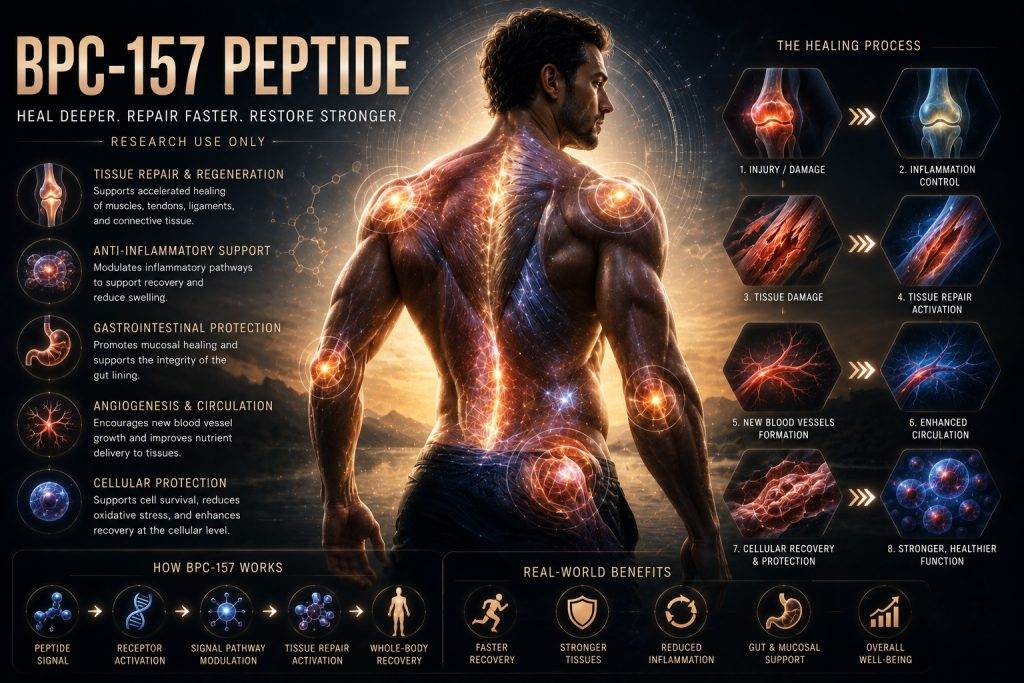
BPC-157 is commonly researched for its potential role involving:
→ Tendon repair
→ Ligament healing
→ Collagen remodeling
→ Angiogenesis
→ Connective-tissue regeneration
This educational guide explores:
• What BPC-157 is
• How it works for tendon and ligament repair
• Current scientific evidence
• Real-world recovery discussions
• Dosing and administration
• Stacking strategies
• Side effects and safety considerations
—
What Is BPC-157?
BPC-157 stands for:
→ Body Protection Compound-157
and is classified as a:
→ Synthetic pentadecapeptide
containing:
→ 15 amino acids
—
Where BPC-157 Comes From
The peptide was originally derived from:
→ Protective proteins found in gastric juice
which explains why early research initially focused heavily on:
→ Gastrointestinal protection and tissue repair
—
Why BPC-157 Became Popular For Recovery
Over time, research began exploring potential effects involving:
→ Tendon healing
→ Ligament regeneration
→ Muscle repair
→ Joint support
→ Angiogenesis
→ Nerve healing
—
How BPC-157 Works For Tendon & Ligament Healing
BPC-157 appears to work through multiple regenerative pathways involved in:
→ Connective-tissue recovery
—
1. Angiogenesis Support
One of the most discussed mechanisms involves:
→ VEGF signaling and angiogenesis
which helps stimulate:
→ New blood-vessel formation
Why This Matters For Tendons
Tendons and ligaments typically heal slowly because they receive:
→ Limited circulation
Improved blood flow may help support:
→ Faster nutrient delivery
→ Better oxygenation
→ Enhanced tissue repair
—
2. Fibroblast Activation & Collagen Remodeling
Fibroblasts are essential for:
→ Tendon and ligament regeneration
Potential BPC-157 effects commonly discussed include:
→ Increased collagen synthesis
→ Better collagen organization
→ Improved tissue integrity
—
3. Nitric-Oxide & Inflammation Regulation
Potential mechanisms commonly discussed include:
→ Nitric-oxide modulation
→ Reduced inflammatory signaling
→ Reduced oxidative stress
which may help support:
→ Reduced swelling and pain
—
4. Growth-Factor Regulation
Research commonly explores possible interactions involving:
→ VEGF
→ FGF
→ Tissue-remodeling pathways
which may influence:
→ Structural recovery and healing speed
—
Scientific Research On BPC-157 & Soft-Tissue Repair
Achilles Tendon Research
Animal studies commonly explored BPC-157 involving:
→ Partially transected Achilles tendons
Potential findings commonly discussed include:
→ Faster tendon healing
→ Improved structural integrity
→ Better collagen organization
—
Ligament Injury Research
Research has also explored BPC-157 involving:
→ Medial collateral ligament (MCL) injuries
Potential findings may include:
→ Improved tensile strength
→ Better vascularization
→ Faster healing timelines
—
Tendon-To-Bone Reattachment
Emerging studies have explored BPC-157 involving:
→ Tendon-to-bone healing models
Potential findings commonly discussed include:
→ Better connective-tissue integration
→ Improved fibroblast activity
→ Enhanced collagen remodeling
—
Corticosteroid-Damaged Tendons
Research has also explored whether BPC-157 may help support:
→ Recovery from corticosteroid-induced tendon degeneration
—
Important Limitation
Despite promising preclinical findings:
→ Large-scale human clinical trials remain limited
meaning many current recovery discussions still rely heavily on:
→ Animal data and anecdotal reports
—
Real-World Recovery Discussions
Within recovery and rehabilitation communities, users commonly discuss BPC-157 for:
→ Chronic tendonitis
→ Rotator-cuff injuries
→ ACL and MCL rehabilitation
→ Achilles tendon recovery
→ Elbow and forearm overuse injuries
—
Commonly Reported Benefits
Potential anecdotal benefits commonly discussed include:
→ Faster recovery timelines
→ Reduced joint pain
→ Improved mobility
→ Better training tolerance
→ Enhanced rehabilitation progress
—
Why Physical Therapy Still Matters
Even within peptide-focused recovery discussions, many protocols still emphasize:
→ Progressive rehabilitation and tissue loading
because peptides alone do not replace:
→ Proper movement mechanics and rehab progression
—
How To Use BPC-157 For Tendon & Ligament Repair
Common Injectable Protocols
Most tendon and ligament recovery discussions commonly involve:
→ 200–500 mcg daily
—
Typical Administration Methods
Potential methods commonly discussed include:
→ Subcutaneous (SubQ) injection
→ Intramuscular (IM) injection near injury site
—
Typical Cycle Length
Most recovery cycles commonly range between:
→ 2–6 weeks
depending on:
→ Injury severity and recovery goals
—
Split-Dose Protocols
Some protocols discuss:
→ 250 mcg twice daily
for more consistent peptide exposure.
—
Oral BPC-157
Oral forms are more commonly discussed for:
→ Gut-health support
though some users still report general recovery benefits involving:
→ Joint and connective-tissue support
—
Best Recovery Stacks With BPC-157
BPC-157 + TB-500
One of the most common recovery stacks discussed for:
→ Tendon, ligament, and connective-tissue healing
Potential goals may include:
→ Faster tissue remodeling
→ Better mobility
→ Reduced fibrosis
—
BPC-157 + CJC-1295 + Ipamorelin
Potential goals commonly discussed include:
→ GH-support pathways
→ Increased IGF-1
→ Collagen synthesis support
→ Recovery optimization
—
BPC-157 + MK-677
Potential recovery-focused goals may include:
→ Lean-mass retention
→ Recovery enhancement
→ Connective-tissue resilience
—
Supportive Recovery Supplements
Potential additions commonly discussed include:
→ Collagen peptides
→ Vitamin C
→ L-glutamine
→ Probiotics
→ Omega-3 support
—
Side Effects & Safety Considerations
Current research suggests BPC-157 appears:
→ Relatively well tolerated
though long-term human evidence remains limited.
—
Potential Side Effects
Potential issues may include:
→ Headaches
→ Dizziness
→ Fatigue
→ Injection-site irritation
→ Mild nausea
—
Long-Term Unknowns
Areas still requiring more research include:
→ Chronic angiogenesis stimulation
→ Long-term immune-system interactions
→ Extended human exposure
—
Product Quality Concerns
Because BPC-157 is often sold through:
→ Research peptide suppliers
potential concerns may include:
→ Contamination
→ Incorrect dosing
→ Poor sterility
—
Important Legal & Regulatory Considerations
FDA Status
BPC-157 is:
→ Not FDA-approved for therapeutic human use
and is commonly sold as:
→ A research-use peptide
—
WADA Status
BPC-157 is prohibited under:
→ World Anti-Doping Agency (WADA) regulations
making it banned in:
→ Drug-tested sports
—
FAQ: BPC-157 For Tendon & Ligament Healing
Does BPC-157 actually work for tendon repair?
Animal research and anecdotal reports commonly suggest potential support involving:
→ Tendon regeneration and collagen remodeling
though human clinical evidence remains limited.
—
Is BPC-157 better than TB-500?
They appear to target:
→ Different but complementary healing pathways
which is why many recovery protocols commonly combine them.
—
How long does tendon recovery take with BPC-157?
Many users commonly discuss noticeable improvements within:
→ 2–6 weeks
depending on:
→ Injury severity and rehabilitation consistency
—
Should BPC-157 be injected near the injury?
Many protocols commonly prefer:
→ Localized SubQ injections near injured tissue
for targeted recovery support.
—
Can oral BPC-157 help tendon healing?
Oral forms are more commonly discussed for:
→ Gut-health support
though some users report generalized connective-tissue benefits.
—
Important Disclaimer
This content is provided for educational purposes only and does not constitute medical advice.
BPC-157 remains an:
→ Investigational peptide compound
with:
→ Limited human clinical evidence
→ No FDA approval
→ Ongoing scientific uncertainty
Always consult a qualified healthcare professional before considering:
→ Experimental peptide-related therapies
especially if you have:
→ Chronic disease
→ Cardiovascular conditions
→ Autoimmune disorders
→ Cancer history
—
Conclusion: Does BPC-157 Really Work For Tendon & Ligament Repair?
BPC-157 has become one of the most discussed recovery peptides because of its potential ability to support:
→ Tendon repair
→ Ligament healing
→ Angiogenesis
→ Collagen synthesis
→ Connective-tissue regeneration
Potential advantages commonly discussed include:
→ Faster recovery
→ Reduced inflammation
→ Better mobility
→ Improved structural healing
→ Recovery from chronic overuse injuries
Unlike purely anabolic compounds, BPC-157 appears more focused on:
→ Regenerative healing pathways
which is why it continues attracting interest within:
→ Sports rehabilitation
→ Athletic recovery
→ Longevity optimization
→ Performance-focused wellness communities
However, despite promising preclinical findings and widespread anecdotal use, BPC-157 still remains:
→ Experimental
with:
→ Limited human clinical evidence
→ No FDA approval
→ Ongoing scientific uncertainty
For now, BPC-157 should be viewed as:
→ A promising investigational connective-tissue recovery peptide still undergoing scientific evaluation
rather than a fully established medical therapy for tendon or ligament injuries.