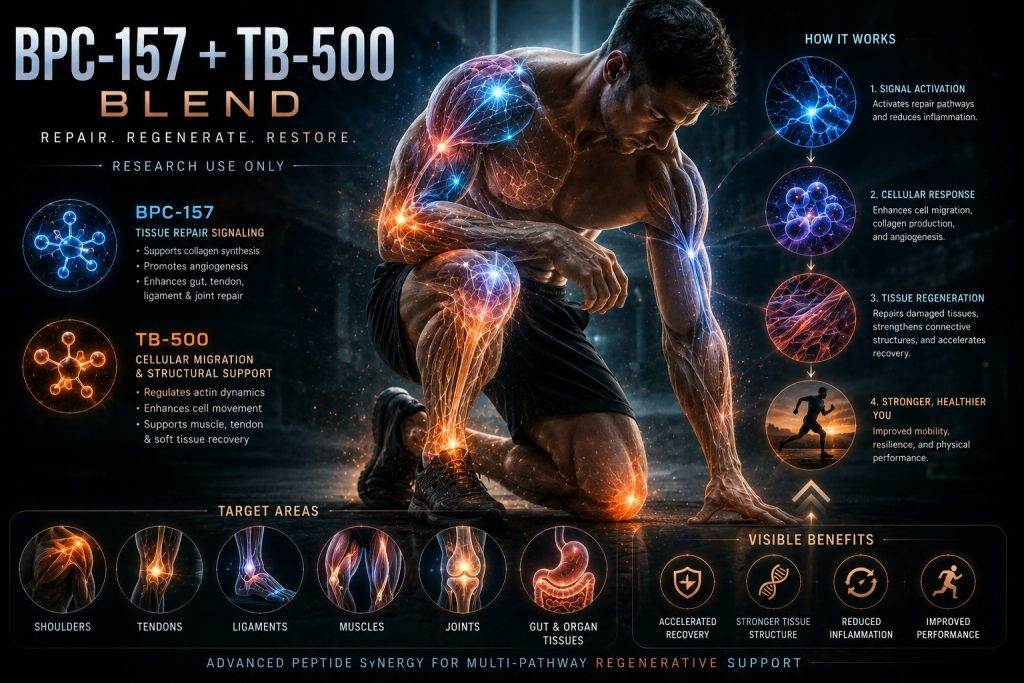
Peptides have become increasingly popular within:
Athletic recovery
Muscle growth
Injury rehabilitation
Hormonal optimization
Biohacking and longevity communities
Among the most frequently compared compounds are:
→ BPC-157
→ MK-677 (Ibutamoren)
→ CJC-1295
→ TB-500
Although these compounds are often grouped together, they work through:
→ Very different biological pathways
Some focus primarily on:
→ Tissue repair and recovery
while others target:
→ Growth hormone (GH) and IGF-1 signaling
Understanding these differences is essential because the:
→ Best peptide depends entirely on your goals
This educational guide explores:
What each compound is
How they work
Recovery and healing benefits
Muscle-growth and fat-loss potential
Side effects and safety
Stacking strategies
Which peptide may fit different performance goals
BPC-157 Overview & How It Works
BPC-157:
→ Body Protection Compound-157
is a:
→ Synthetic pentadecapeptide
derived from:
→ Protective proteins found in gastric juice
What Makes BPC-157 Different
Unlike hormonal peptides, BPC-157 primarily focuses on:
→ Tissue regeneration and inflammation control
rather than:
→ Growth hormone stimulation
Key Mechanisms of BPC-157
Potential mechanisms commonly discussed include:
→ Angiogenesis support
→ Fibroblast activation
→ Collagen synthesis
→ Nitric-oxide modulation
→ Anti-inflammatory signaling
Why Athletes Use BPC-157
Potential applications commonly discussed include:
→ Tendon healing
→ Ligament repair
→ Muscle recovery
→ Gut healing
→ Nerve recovery support
Delivery Methods
BPC-157 is commonly discussed as:
→ Subcutaneous injection
though oral use is also frequently explored for:
→ GI-related applications
MK-677 (Ibutamoren) Overview & How It Works
MK-677:
→ Also known as Ibutamoren
is classified as a:
→ Growth-hormone secretagogue
rather than a peptide.
How MK-677 Works
MK-677 mimics the hormone:
→ Ghrelin
by binding to:
→ GHS-R1a receptors
which stimulates the pituitary gland to increase:
→ Growth hormone (GH)
→ IGF-1 levels
Potential Effects Commonly Discussed
Potential benefits may include:
→ Muscle growth support
→ Improved sleep quality
→ Better recovery
→ Enhanced appetite
→ Long-term body recomposition support
Why MK-677 Became Popular
Unlike injectable GH therapies, MK-677 is:
→ Orally active
with a:
→ Long half-life (~24 hours)
allowing:
→ Once-daily dosing
Common Applications
Potential uses commonly discussed include:
→ Lean-mass retention
→ Recovery support
→ Hormonal optimization
→ Age-related GH decline support
CJC-1295 Overview & How It Works
CJC-1295 is a:
→ Synthetic growth hormone–releasing hormone (GHRH) analog
designed to stimulate:
→ Natural pulsatile GH release
Two Forms of CJC-1295
CJC-1295 With DAC
→ Long half-life (~8 days)
→ Weekly dosing
CJC-1295 Without DAC
→ Short half-life (~30 minutes)
→ More physiological GH pulses
→ Preferred in many athletic protocols
Key Mechanisms
Potential effects commonly discussed include:
→ Increased GH secretion
→ Elevated IGF-1 over time
→ Better sleep quality
→ Fat-loss support
→ Improved recovery
Common Stacking Combinations
CJC-1295 is frequently discussed alongside:
→ MK-677
→ GHRP-2
→ BPC-157
→ TB-500
Why Athletes Use It
Potential goals may include:
→ Recovery enhancement
→ Sleep optimization
→ Hormonal support
→ Body recomposition
TB-500 Overview & How It Works
TB-500 is the synthetic version of:
→ Thymosin Beta-4 (TB4)
a naturally occurring peptide heavily involved in:
→ Tissue repair and cellular migration
How TB-500 Works
Potential mechanisms commonly discussed include:
→ Actin regulation
→ Angiogenesis support
→ Cellular migration
→ Reduced inflammatory signaling
Why This Matters
These mechanisms may help support:
→ Faster soft-tissue recovery
→ Muscle healing
→ Mobility restoration
→ Connective-tissue repair
Common Applications
Potential uses commonly discussed include:
→ Muscle strains
→ Tendon injuries
→ Joint pain
→ Overtraining recovery
→ Mobility restoration
Common Dosing Discussions
Protocols often discuss:
→ 2–5 mg weekly
during:
→ Loading phases lasting 4–6 weeks
Benefits Comparison: BPC-157 vs MK-677 vs CJC-1295 vs TB-500
BPC-157 Benefits
Potential benefits commonly discussed include:
→ Tendon-to-bone healing
→ Gut repair support
→ Reduced inflammation
→ Nerve recovery support
→ Angiogenesis and collagen synthesis
MK-677 Benefits
Potential effects may include:
→ Increased GH & IGF-1
→ Lean-mass retention
→ Better sleep quality
→ Appetite stimulation
→ Long-term recovery support
CJC-1295 Benefits
Potential benefits commonly discussed include:
→ Pulsatile GH release
→ Fat-loss support
→ Improved recovery
→ Better sleep and circadian support
→ Hormonal optimization
TB-500 Benefits
Potential effects may include:
→ Faster muscle healing
→ Better mobility
→ Soft-tissue recovery
→ Reduced inflammation
→ Enhanced tissue oxygenation
Which Peptide Is Best For Different Goals?
Best For Injury Recovery
Best Combination:
→ BPC-157 + TB-500
Potential reasons include:
→ Local tissue repair + systemic healing support
Best For Muscle Growth & Hormonal Support
Best Combination:
→ MK-677 + CJC-1295
Potential reasons include:
→ GH and IGF-1 support pathways
Best For Gut Healing
Best Choice:
→ BPC-157
Potential reasons include:
→ GI stability and mucosal repair support
Best For Sleep & Recovery
Best Choice:
→ CJC-1295 or MK-677
Potential reasons include:
→ Growth-hormone and sleep-support effects
Best All-Around Recovery Stack
Common Discussion:
→ BPC-157 + CJC-1295
Potential goals may include:
→ Tissue healing + systemic recovery support
Side Effects Comparison
BPC-157 Side Effects
Potential issues may include:
→ Mild injection-site irritation
→ Rare headaches
→ Mild nausea
Potential safety profile:
→ Very low toxicity and no hormonal suppression
MK-677 Side Effects
Potential side effects may include:
→ Increased appetite
→ Water retention
→ Fatigue
→ Elevated fasting glucose
→ Mild insulin resistance risk
CJC-1295 Side Effects
Potential issues may include:
→ Mild water retention
→ Headaches
→ Joint tightness
→ Injection irritation
TB-500 Side Effects
Potential side effects may include:
→ Mild fatigue
→ Injection-site redness
→ Temporary dizziness
Side Effects Summary Table
Side Effect BPC-157 MK-677 CJC-1295 TB-500
Appetite Increase ❌ ✅ ❌ ❌
Water Retention ❌ ✅ ✅ ❌
Hormonal Suppression ❌ ❌ ❌ ❌
Injection Irritation ✅ ❌ ✅ ✅
Blood Sugar Impact ❌ ✅ ❌ ❌
Stacking Strategies
BPC-157 + TB-500
Potential goals commonly discussed include:
→ Comprehensive injury recovery and tissue healing
MK-677 + CJC-1295
Potential goals may include:
→ GH optimization
→ Sleep enhancement
→ Lean-mass retention
Full Recovery Stack
Some advanced protocols commonly discuss combining:
→ BPC-157
→ TB-500
→ CJC-1295
→ MK-677
for:
→ Multi-pathway recovery and performance support
Legal Status & WADA Considerations
FDA Status
None of these compounds are:
→ FDA-approved for general therapeutic human use
Research Classification
All four compounds are commonly sold as:
→ Research-use or investigational compounds
WADA Status
BPC-157, MK-677, CJC-1295, and TB-500 are all prohibited under:
→ World Anti-Doping Agency (WADA) regulations
making them banned for:
→ Drug-tested athletes
Important Disclaimer
This content is for educational purposes only and does not constitute medical advice.
These compounds remain:
→ Experimental or investigational
with:
→ Limited long-term human clinical evidence
Always consult a qualified healthcare professional before considering:
→ Peptide-related therapies or experimental compounds
FAQ: BPC-157 vs MK-677 vs CJC-1295 vs TB-500
Which peptide is best for tendon healing?
BPC-157 is most strongly associated with:
→ Tendon and ligament recovery support
Which peptide is best for muscle growth?
MK-677 and CJC-1295 are most commonly discussed for:
→ GH and IGF-1 support
Which peptide is best for gut health?
BPC-157 is the most widely discussed peptide for:
→ GI healing and gut-lining support
Can these peptides be stacked together?
Yes. Many advanced recovery protocols discuss stacking them because they target:
→ Different recovery and hormonal pathways
Are these compounds legal?
They are not FDA-approved and are prohibited in drug-tested sports under WADA regulations.
Conclusion: Which Peptide Makes The Most Sense For Your Goals?
Although BPC-157, MK-677, CJC-1295, and TB-500 are often grouped together, they serve:
→ Very different purposes
BPC-157 focuses primarily on:
→ Tissue repair
→ Gut healing
→ Inflammation control
making it especially attractive for:
→ Tendon injuries
→ Ligament recovery
→ GI dysfunction
MK-677 and CJC-1295 focus more heavily on:
→ Growth-hormone and IGF-1 pathways
which may support:
→ Sleep
→ Recovery
→ Body recomposition
→ Lean-mass retention
TB-500 appears more focused on:
→ Systemic soft-tissue repair and mobility restoration
through mechanisms involving:
→ Cellular migration and angiogenesis
Because these compounds target:
→ Different biological systems
many advanced recovery protocols discuss combining them for:
→ Multi-pathway performance and healing support
However, despite growing popularity, all four remain:
→ Experimental
with:
→ Limited human clinical evidence
→ No FDA approval
→ Ongoing scientific uncertainty
For now, they should be viewed as:
→ Investigational recovery and performance compounds still undergoing scientific evaluation.