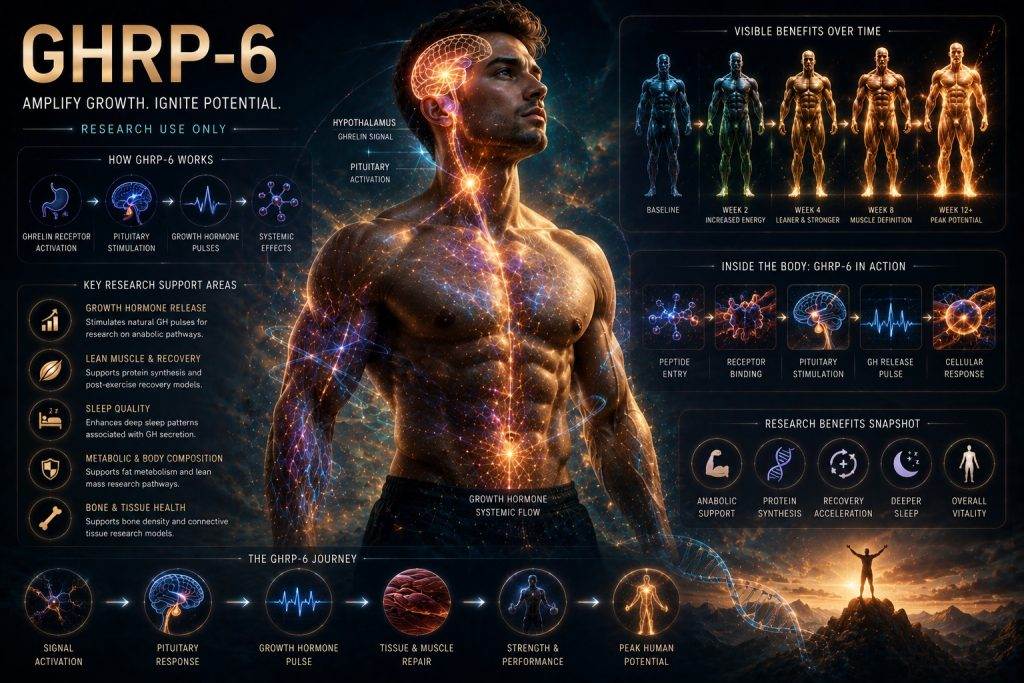
Growth hormone-releasing peptides (GHRPs) have become increasingly popular among athletes, bodybuilders, and longevity enthusiasts because they offer a way to stimulate the body’s natural growth hormone production without relying on exogenous human growth hormone (HGH).
Among the most widely discussed options are GHRP-6 and GHRP-2. Both peptides work by activating the Growth Hormone Secretagogue Receptor (GHS-R1a), triggering natural growth hormone pulses that support muscle growth, recovery, fat metabolism, and tissue repair.
While they share a similar foundation, there are several important differences between them—particularly regarding appetite stimulation, growth hormone output, recovery benefits, and body composition outcomes.
In this guide, we’ll explore:
What GHRP-6 is
What GHRP-2 is
How each peptide works
Benefits for muscle growth and recovery
Fat-loss potential
Side effects and safety considerations
Stacking strategies
Dosing recommendations
Post-cycle considerations
Legal status and regulations
What Is GHRP-6?
Discovery and Development
GHRP-6 (Growth Hormone-Releasing Peptide-6) is a synthetic hexapeptide developed during research efforts aimed at stimulating natural growth hormone production through the hypothalamic-pituitary axis.
A major breakthrough occurred when researchers identified the Growth Hormone Secretagogue Receptor (GHS-R1a), which was later recognized as the receptor for ghrelin, commonly referred to as the body’s hunger hormone.
This discovery led to the development of compounds capable of enhancing natural growth hormone pulses rather than creating the constant hormone elevations associated with exogenous HGH administration.
GHRP-6 quickly became one of the most researched growth hormone secretagogues due to its ability to stimulate growth hormone release while simultaneously increasing appetite.
How GHRP-6 Works
After administration, GHRP-6 binds to GHS-R1a receptors located in the pituitary gland and hypothalamus.
This interaction helps:
Increase growth hormone pulse frequency
Increase growth hormone pulse amplitude
Enhance nighttime growth hormone secretion
Support IGF-1 production
Improve recovery and tissue regeneration
One of GHRP-6’s most distinctive characteristics is its strong activation of ghrelin pathways, which often leads to significant hunger increases shortly after administration.
For individuals attempting to gain size or recover from injury, this appetite stimulation can be a major advantage.
What Is GHRP-2?
Discovery and Development
GHRP-2 was developed after GHRP-6 as a second-generation growth hormone secretagogue.
Researchers designed it to:
Produce stronger growth hormone release
Reduce appetite stimulation
Improve receptor selectivity
Minimize unwanted side effects
Like GHRP-6, GHRP-2 activates the GHS-R1a receptor and promotes natural growth hormone secretion.
However, its enhanced receptor affinity often results in greater growth hormone output while causing considerably less hunger.
This profile has made GHRP-2 particularly popular among athletes focused on lean muscle gains, fat loss, and body recomposition.
How GHRP-2 Works
GHRP-2 binds to the same ghrelin receptor system as GHRP-6.
Potential effects include:
Rapid growth hormone release
Increased IGF-1 production
Improved recovery capacity
Enhanced tissue repair
Better body composition outcomes
Unlike GHRP-6, appetite stimulation tends to be mild, making it easier to maintain dietary control during cutting phases.
Benefits of GHRP-6
Muscle Growth Support
One of the primary reasons individuals use GHRP-6 is its ability to increase natural growth hormone and IGF-1 production.
Potential benefits include:
Enhanced muscle protein synthesis
Greater muscle fiber development
Improved lean mass retention
Better anabolic support during training
These effects may be particularly valuable for older athletes or individuals recovering from periods of inactivity.
Recovery and Tissue Repair
Growth hormone plays a critical role in tissue regeneration.
Potential recovery benefits include:
Improved tendon healing
Enhanced ligament repair
Increased collagen synthesis
Faster recovery between training sessions
Many users combine GHRP-6 with recovery-focused peptides to further support connective tissue healing.
Fat-Loss Support
Although commonly associated with bulking, GHRP-6 may also support fat metabolism through growth hormone-induced lipolysis.
Potential benefits include:
Increased fat oxidation
Improved body composition
Reduction in visceral fat
Better lean-mass-to-fat ratio
However, appetite stimulation can make maintaining a calorie deficit more challenging.
Appetite Enhancement
The strongest distinguishing feature of GHRP-6 is its ability to stimulate appetite.
Potential advantages include:
Easier calorie consumption
Improved bulking efficiency
Better recovery nutrition
Support during periods of poor appetite
For hard gainers, this effect is often considered one of GHRP-6’s biggest strengths.
Benefits of GHRP-2
Muscle Growth
GHRP-2 is widely regarded as one of the most potent growth hormone-releasing peptides available.
Potential benefits include:
Strong growth hormone release
Increased IGF-1 production
Enhanced muscle hypertrophy
Improved training performance
Better recovery capacity
Many athletes favor GHRP-2 because it combines powerful anabolic support with improved appetite control.
Recovery and Healing
Like GHRP-6, GHRP-2 may support:
Tendon repair
Ligament recovery
Joint health
Collagen production
Soft-tissue regeneration
The stronger growth hormone response may further enhance these benefits in some individuals.
Fat Loss and Recomposition
GHRP-2 is often preferred during:
Cutting phases
Contest preparation
Body recomposition programs
Potential benefits include:
Increased fat mobilization
Improved insulin sensitivity
Better body composition
Lean mass preservation
Because appetite stimulation is relatively mild, maintaining nutritional discipline is often easier than with GHRP-6.
Better Appetite Control
Compared to GHRP-6, GHRP-2 generally causes:
Less hunger
Better dietary adherence
Improved cutting outcomes
For physique athletes, this often represents a major advantage.
GHRP-6 vs GHRP-2 Side Effects
Although both peptides are generally well tolerated, users should understand their differing side-effect profiles.
Appetite Stimulation
GHRP-6
Strong appetite increase
Intense hunger after administration
May complicate fat-loss efforts
GHRP-2
Mild appetite increase
Easier calorie control
Better suited for cutting phases
Water Retention
Both compounds may contribute to:
Mild bloating
Temporary water retention
Slight increases in scale weight
These effects are usually temporary and dose dependent.
Prolactin Elevation
GHRP-6
Potentially higher risk of:
Elevated prolactin
Mood changes
Reduced libido in sensitive individuals
GHRP-2
Generally associated with:
Lower prolactin impact
Better overall tolerability
Blood Sugar Considerations
Both peptides can temporarily influence glucose metabolism through growth hormone elevation.
Individuals with:
Prediabetes
Metabolic syndrome
Insulin resistance
should monitor blood glucose carefully when using growth hormone secretagogues.
Stacking Strategies
Both peptides are frequently combined with complementary compounds.
CJC-1295
One of the most common combinations.
Potential benefits include:
Increased growth hormone pulses
Greater IGF-1 production
Enhanced recovery
Improved body composition
GHRP peptides stimulate the ghrelin receptor, while CJC-1295 enhances growth hormone-releasing hormone signaling.
Ipamorelin
Ipamorelin is another growth hormone secretagogue known for:
Minimal appetite stimulation
Reduced prolactin impact
Selective receptor activity
It is often used in advanced growth hormone protocols.
HGH
Some users combine growth hormone secretagogues with HGH.
Potential goals include:
Maintaining natural GH pulsatility
Increasing IGF-1 production
Enhancing recovery
This approach should only be undertaken under medical supervision.
MK-677 (Ibutamoren)
MK-677 is an oral growth hormone secretagogue frequently discussed alongside GHRP peptides.
Potential benefits include:
Elevated growth hormone levels
Increased IGF-1
Improved recovery
Enhanced muscle growth
However, side effects such as water retention may become more pronounced.
Recovery Peptides
Many users pair GHRP-6 or GHRP-2 with:
BPC-157
TB-500
Potential goals include:
Accelerated injury recovery
Joint support
Tendon healing
Soft tissue repair
Dosage and Cycle Recommendations
Typical Dosages
GHRP-6
100–300 mcg per dose
2–3 times daily
GHRP-2
100–300 mcg per dose
2–3 times daily
Common timing includes:
Morning
Pre-workout
Before bed
Typical Cycle Length
Most protocols range from:
8–12 weeks
Some advanced users extend cycles:
16–20 weeks
Longer use is typically followed by:
4–6 weeks off
This may help maintain receptor responsiveness.
Injection Timing Tips
For optimal growth hormone release:
Administer on an empty stomach
Wait at least 2 hours after eating
Avoid eating for 30–45 minutes afterward
Bedtime injections are often favored because they align with natural nighttime growth hormone secretion.
Post-Cycle Considerations
Unlike anabolic steroids, GHRP peptides generally do not suppress testosterone production.
As a result:
Traditional PCT is usually unnecessary
Recovery periods are still recommended
Cycling off helps maintain receptor sensitivity
If combined with anabolic steroids or SARMs, separate post-cycle protocols may be required depending on the compounds used.
Legal Status
Both GHRP-6 and GHRP-2 remain research compounds in many countries.
United States
Not FDA-approved for general use
Often sold for research purposes only
Competitive Sports
Both peptides are prohibited by the World Anti-Doping Agency because of their performance-enhancing potential.
Athletes subject to testing should avoid their use.
Conclusion
Both GHRP-6 and GHRP-2 are highly effective growth hormone-releasing peptides that can support muscle growth, recovery, body composition, and tissue repair.
Choose GHRP-6 If:
You struggle to eat enough calories
You’re focused on bulking
Appetite stimulation is beneficial
Recovery from injury is a priority
Choose GHRP-2 If:
You’re pursuing lean muscle gains
Appetite control matters
You’re in a cutting phase
You want stronger GH release with fewer hunger-related side effects
For many users, the decision comes down to appetite management.
GHRP-6 excels for bulking and recovery, while GHRP-2 is often the preferred choice for lean gains, fat loss, and body recomposition.