When discussing muscle growth, recovery, and body recomposition, two compounds consistently dominate the conversation: Human Growth Hormone (HGH) and IGF-1 LR3. Although both belong to the growth hormone axis, they work through different biological pathways and produce distinct effects on muscle hypertrophy, fat metabolism, tissue repair, and overall performance. Understanding these differences is essential for anyone researching peptide therapy, hormone optimization, or performance enhancement.
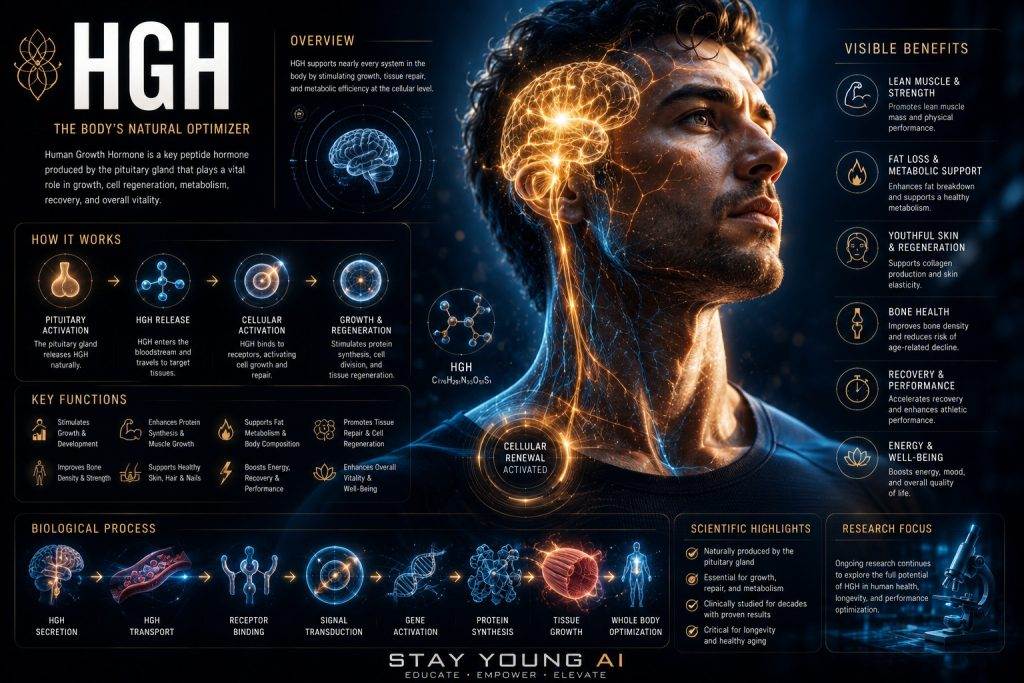
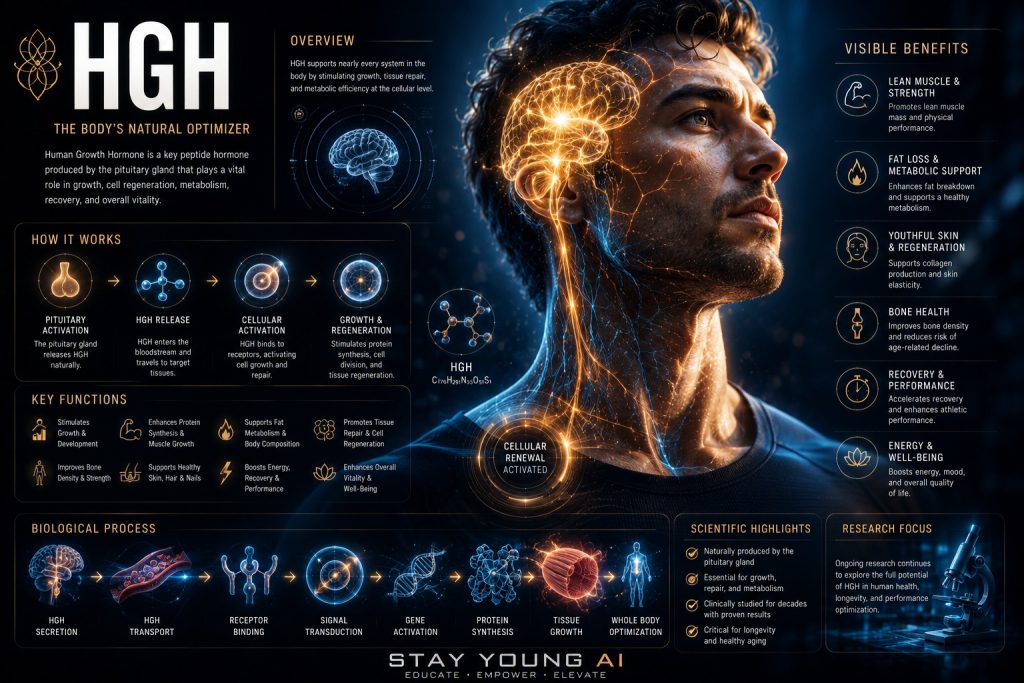
HGH is a naturally occurring peptide hormone produced by the pituitary gland that stimulates the liver to produce insulin-like growth factor-1 (IGF-1), which mediates many of HGH’s anabolic and regenerative effects. IGF-1 LR3, by contrast, is a synthetic, long-acting analogue of IGF-1 engineered with a significantly longer half-life and greater biological availability, allowing it to act directly on muscle tissue without first requiring liver conversion.
In this guide, we’ll compare:
- What HGH is
- What IGF-1 LR3 is
- How each works
- Muscle growth and recovery
- Fat loss
- Side effects
- Safety
- Legal status
- Which may be more appropriate for different goals
What Is Human Growth Hormone (HGH)?
Human Growth Hormone (HGH), also called somatotropin, is a peptide hormone produced by the anterior pituitary gland.
Its primary functions include:
- Growth during childhood
- Muscle maintenance
- Fat metabolism
- Tissue repair
- Bone remodeling
- Cellular regeneration
After secretion, HGH stimulates the liver to produce IGF-1, which is responsible for many of the hormone’s anabolic effects throughout the body.
What Is IGF-1 LR3?
IGF-1 LR3 (Insulin-like Growth Factor-1 Long Arg3) is a synthetic analogue of IGF-1 designed to improve stability and extend biological activity.
Compared with natural IGF-1, LR3 has:
- A much longer half-life
- Reduced binding to IGF-binding proteins
- Greater availability to target tissues
- Direct activation of IGF-1 receptors
Unlike HGH, IGF-1 LR3 does not rely on liver conversion before exerting its anabolic effects.
Mechanism of Action
Although closely related, HGH and IGF-1 LR3 act through different physiological pathways.
HGH
HGH primarily works by:
- Stimulating liver production of IGF-1
- Increasing lipolysis
- Supporting connective tissue repair
- Enhancing collagen synthesis
- Promoting systemic recovery
Its anabolic effects are largely indirect because they depend on downstream IGF-1 production.
IGF-1 LR3
IGF-1 LR3 works directly by binding to IGF-1 receptors on skeletal muscle.
This promotes:
- Satellite cell activation
- Muscle fiber hypertrophy
- Protein synthesis
- Glucose uptake
- Amino acid transport
- Muscle regeneration
Because it bypasses the liver, IGF-1 LR3 delivers a more direct anabolic signal to muscle tissue.
HGH Benefits
Fat Loss
One of HGH’s best-established effects is increased fat utilization.
Potential benefits include:
- Increased lipolysis
- Reduced visceral fat
- Improved body composition
- Enhanced energy availability
These effects make HGH particularly attractive during body recomposition and calorie-restricted phases.
Joint and Connective Tissue Support
HGH promotes:
- Collagen synthesis
- Tendon remodeling
- Ligament repair
- Connective tissue recovery
This regenerative effect has made HGH an area of interest for rehabilitation and aging research.
Muscle Preservation
Although HGH is not considered a highly potent muscle-building hormone by itself, it may help preserve lean body mass during caloric restriction by supporting protein turnover and reducing catabolism.
Recovery
Potential recovery-related benefits include:
- Improved tissue repair
- Enhanced healing
- Better sleep quality
- Reduced recovery time following strenuous exercise
IGF-1 LR3 Benefits
Muscle Hypertrophy
IGF-1 LR3 is widely recognized for its direct effects on skeletal muscle.
Potential effects include:
- Satellite cell activation
- Increased muscle fiber growth
- Enhanced protein synthesis
- Greater lean muscle gains
Its direct action on muscle tissue makes it more anabolic than HGH in terms of localized hypertrophy.
Faster Recovery
IGF-1 LR3 may support:
- Muscle repair
- Tendon healing
- Reduced exercise-induced damage
- Faster recovery between training sessions
These regenerative effects are one reason it has attracted interest in performance settings.
Nutrient Partitioning
IGF-1 LR3 enhances cellular uptake of:
- Glucose
- Amino acids
- Creatine
Improved nutrient delivery may support muscle fullness and post-exercise recovery.
HGH vs IGF-1 LR3 for Muscle Growth
When comparing muscle-building potential:
HGH
Advantages include:
- Supports long-term recovery
- Preserves lean mass
- Improves connective tissue health
- Enhances overall body composition
However, muscle hypertrophy is largely indirect.
IGF-1 LR3
Advantages include:
- Direct muscle stimulation
- Greater satellite cell activation
- More rapid hypertrophy
- Enhanced localized muscle growth
For individuals focused specifically on increasing muscle size, IGF-1 LR3 generally produces stronger anabolic effects than HGH alone.
HGH vs IGF-1 LR3 for Fat Loss
When fat reduction is the primary goal, HGH generally demonstrates stronger metabolic effects.
Potential advantages of HGH include:
- Increased fat oxidation
- Reduced abdominal fat
- Improved body recomposition
- Better preservation of lean tissue
IGF-1 LR3 contributes indirectly through improved nutrient utilization but is not considered primarily a fat-loss peptide.
Recovery Comparison
HGH
Primarily supports:
- Joint health
- Connective tissue
- Skin
- Tendons
- Collagen production
IGF-1 LR3
Primarily supports:
- Skeletal muscle repair
- Muscle regeneration
- Satellite cell activation
- Local tissue recovery
Both compounds influence recovery but emphasize different tissues.
Side Effects
HGH
Potential side effects include:
- Fluid retention
- Swelling
- Joint pain
- Carpal tunnel syndrome
- Insulin resistance
- Elevated blood glucose
Long-term misuse may increase the risk of organ enlargement and other metabolic complications.
IGF-1 LR3
Potential side effects include:
- Hypoglycemia
- Muscle stiffness
- Joint discomfort
- Receptor desensitization with prolonged use
- Theoretical risk of excessive tissue growth
Because IGF-1 LR3 has insulin-like activity, blood glucose monitoring is particularly important in research settings.
Safety Considerations
Both HGH and IGF-1 LR3 influence powerful growth pathways.
Potential concerns include:
- Insulin sensitivity
- Cellular proliferation
- Cardiovascular effects
- Metabolic changes
Long-term use outside medically supervised settings carries significant uncertainty, and both compounds require careful monitoring in clinical research.
Legal Status
HGH
- FDA-approved for specific medical conditions
- Prescription only
- Not approved for bodybuilding or anti-aging
- Prohibited by the World Anti-Doping Agency (WADA)
IGF-1 LR3
- Not FDA-approved for human use
- Generally sold for research purposes only
- Not approved as a therapeutic medication
- Also prohibited by WADA
Both compounds should only be used within approved medical or legitimate research settings.
Which One Is Better?
The answer depends on your primary objective.
HGH may be more appropriate if your goal is:
- Fat loss
- Body recomposition
- Joint support
- Connective tissue recovery
- Long-term regenerative effects
IGF-1 LR3 may be more appropriate if your goal is:
- Muscle hypertrophy
- Satellite cell activation
- Faster muscle recovery
- Enhanced nutrient partitioning
- Lean muscle growth
Because they act through complementary pathways, researchers have also explored their combined use to investigate synergistic effects on muscle growth and recovery. However, such approaches remain experimental and are not approved for performance enhancement.
Conclusion
Although Human Growth Hormone and IGF-1 LR3 are closely linked within the body’s growth hormone axis, they serve different physiological roles. HGH functions as the upstream regulator, stimulating IGF-1 production while supporting fat metabolism, connective tissue repair, and systemic recovery. IGF-1 LR3 bypasses this pathway to act directly on muscle tissue, producing more localized anabolic effects through satellite cell activation and enhanced protein synthesis.
For individuals with medically diagnosed growth hormone deficiency, HGH therapy has well-established clinical applications. IGF-1 LR3, by contrast, remains an investigational compound without approved therapeutic use. While both continue to be studied for their effects on muscle regeneration, metabolism, and recovery, they also carry meaningful risks, particularly when used outside appropriate medical or research settings. Any consideration of growth factor therapies should be guided by qualified healthcare professionals and grounded in evidence-based practice.