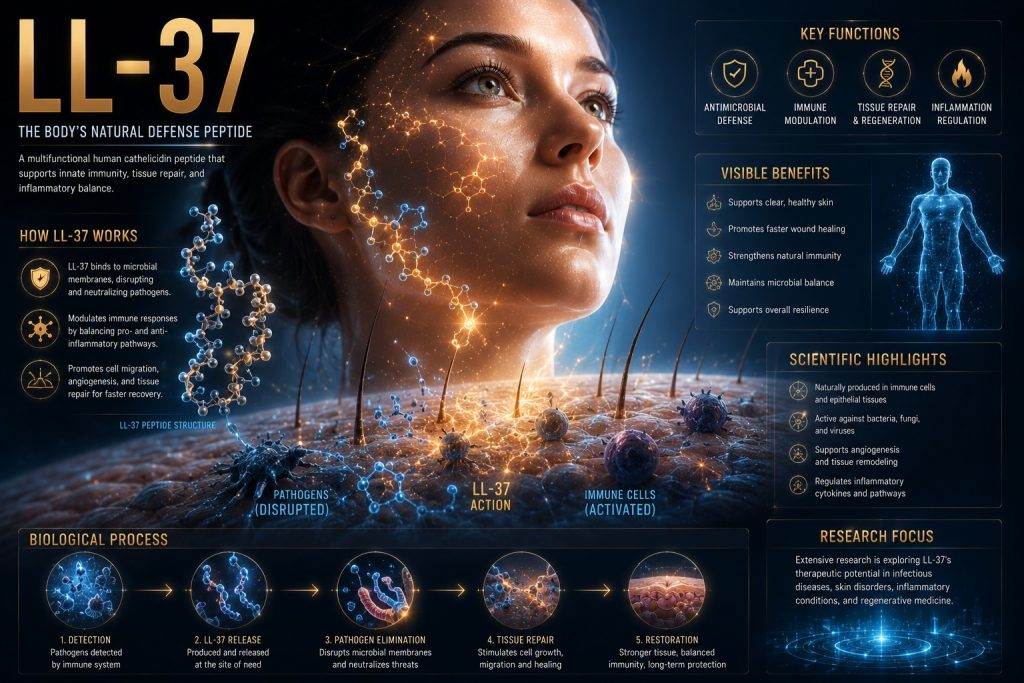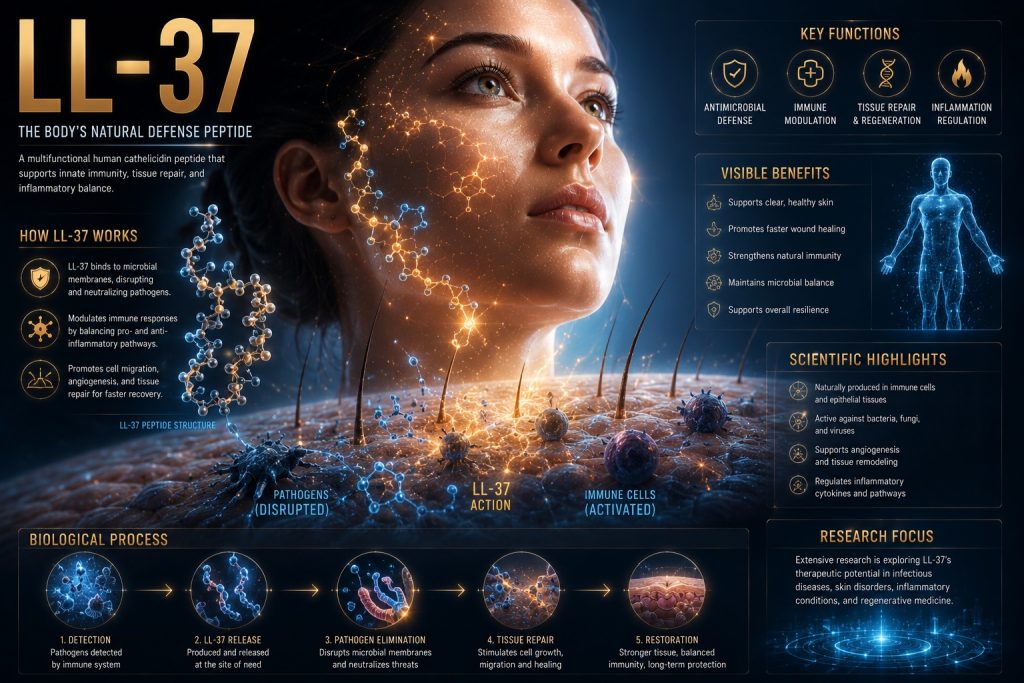
Unlike peptides that focus on growth hormone release or muscle building, LL-37 is best known for its role in the body’s innate immune system. As the only human member of the cathelicidin family of antimicrobial peptides, LL-37 serves as one of the body’s first lines of defense against bacteria, viruses, fungi, and other pathogens. Beyond its antimicrobial activity, researchers have discovered that LL-37 also plays important roles in wound healing, inflammation regulation, tissue regeneration, and maintaining the integrity of the skin and gastrointestinal tract.
Because of these unique properties, LL-37 has attracted growing interest in regenerative medicine and peptide research. Although it is not approved for therapeutic use outside of research settings, scientists continue to investigate its potential applications for chronic wounds, inflammatory disorders, infections, and tissue repair.
In this beginner’s guide, we’ll explore:
- What LL-37 is
- How it works
- Potential health benefits
- Research dosing approaches
- Peptide stacking concepts
- Side effects and safety
- Legal status
- Common beginner mistakes
What Is LL-37?
LL-37 is a naturally occurring cationic antimicrobial peptide (AMP) derived from a precursor protein called hCAP18.
It is the only cathelicidin peptide naturally produced in humans.
LL-37 is synthesized by:
- Neutrophils
- Macrophages
- Epithelial cells
- Skin cells
- Respiratory tissues
- Gastrointestinal tissues
- Bone marrow
Its primary purpose is to help protect the body against invading microorganisms while simultaneously coordinating tissue repair and immune responses.
How LL-37 Works
LL-37 functions through several complementary biological mechanisms.
Direct Antimicrobial Activity
One of LL-37’s most recognized functions is destroying pathogens.
It can disrupt the membranes of:
- Gram-positive bacteria
- Gram-negative bacteria
- Certain viruses
- Fungi
Unlike many antibiotics that target specific metabolic pathways, LL-37 physically disrupts microbial cell membranes, making resistance less likely to develop.
Immune Regulation
LL-37 is more than an antimicrobial peptide.
It also helps coordinate immune responses by:
- Recruiting immune cells
- Regulating cytokine production
- Supporting innate immunity
- Balancing inflammatory responses
Depending on the physiological environment, LL-37 may either stimulate or suppress inflammation to help restore tissue homeostasis.
Tissue Repair
Research suggests LL-37 supports healing by promoting:
- Keratinocyte migration
- Fibroblast activity
- Angiogenesis
- Collagen deposition
- Epithelial regeneration
These effects explain why LL-37 continues to be studied in wound healing and regenerative medicine.
Potential Benefits of LL-37
Although much of the evidence remains preclinical or investigational, researchers have identified several promising therapeutic areas.
Antimicrobial Defense
LL-37 demonstrates broad-spectrum antimicrobial activity against numerous pathogens.
Research has investigated its activity against:
- Staphylococcus aureus
- Escherichia coli
- Pseudomonas aeruginosa
- Candida species
- Certain enveloped viruses
Its broad mechanism makes it an important component of the innate immune system.
Wound Healing
LL-37 may promote healing by supporting:
- Skin regeneration
- Collagen remodeling
- Blood vessel formation
- Re-epithelialization
These properties have generated interest in chronic wound care and dermatologic research.
Gut Health
LL-37 is naturally expressed within the gastrointestinal tract.
Researchers believe it may help:
- Maintain intestinal barrier integrity
- Support mucosal healing
- Regulate gut immune responses
- Defend against pathogenic microbes
Its role in inflammatory bowel diseases and intestinal repair remains an active area of investigation.
Immune Support
By coordinating both antimicrobial activity and immune signaling, LL-37 may help:
- Enhance innate immunity
- Improve host defense
- Regulate inflammatory balance
- Support recovery following infection
These immune-modulating effects distinguish LL-37 from peptides primarily associated with growth or metabolism.
LL-37 Research Protocols
Because LL-37 remains an investigational peptide, there are no standardized or approved dosing guidelines for clinical use.
Published research protocols have varied depending on:
- Disease being studied
- Route of administration
- Experimental design
- Duration of treatment
Researchers often investigate LL-37 in short treatment periods due to its potent immune-modulating activity. Any use outside regulated clinical research should be approached with caution, as safety, efficacy, and optimal dosing have not been established.
Peptides Commonly Studied Alongside LL-37
In research settings, LL-37 is sometimes evaluated alongside other investigational peptides with complementary mechanisms.
Examples include:
BPC-157
Investigated for:
- Gastrointestinal repair
- Tendon healing
- Soft tissue recovery
TB-500
Studied for:
- Connective tissue repair
- Muscle recovery
- Angiogenesis
- Tissue remodeling
Researchers are exploring whether combining immune-modulating peptides with regenerative peptides may provide complementary effects, though clinical evidence remains limited.
Side Effects and Safety
Human safety data remain limited.
Reported or theoretical side effects include:
- Injection site irritation
- Redness
- Burning sensation
- Mild fatigue
- Temporary flu-like symptoms
- Local inflammation
Because LL-37 actively modulates immune signaling, excessive immune activation is considered a theoretical concern, particularly in individuals with autoimmune disorders.
Who Should Exercise Extra Caution?
Because LL-37 influences immune activity, additional caution is warranted in individuals with:
- Autoimmune diseases
- Active inflammatory disorders
- Pregnancy or breastfeeding
- Serious chronic illnesses
Clinical evaluation is essential before considering any investigational immune-modulating therapy.
Common Beginner Mistakes
Researchers and clinicians frequently caution against several common misconceptions.
Expecting Muscle Growth
LL-37 is not an anabolic peptide.
Unlike:
- CJC-1295
- Ipamorelin
- IGF-1 LR3
LL-37 does not stimulate growth hormone release or directly increase muscle mass.
Using Long Continuous Cycles
Because of its immune-modulating properties, prolonged continuous exposure has not been adequately studied.
Most experimental protocols investigate relatively short treatment durations.
Ignoring Injection Reactions
Localized irritation is among the most commonly reported adverse effects.
Proper sterile technique and rotation of injection sites are important considerations in research settings.
Legal Status
LL-37 currently remains an investigational research peptide.
Current regulatory status generally includes:
- Not FDA-approved for therapeutic use
- Not approved as a dietary supplement
- Commonly sold as a research chemical
- Intended for laboratory research only
Regulations vary by country, and products marketed for research purposes should not be interpreted as approved medications.
Current Research
Scientists continue investigating LL-37 across numerous fields, including:
- Chronic wound healing
- Skin regeneration
- Antimicrobial resistance
- Gastrointestinal disease
- Inflammatory bowel disease
- Respiratory infections
- Biomaterials and regenerative medicine
Its ability to combine antimicrobial activity with immune regulation makes LL-37 one of the more distinctive peptides currently under investigation.
Conclusion
LL-37 represents a unique category of peptide because its primary function is not hormone regulation or muscle growth, but protection and repair. As the body’s only naturally occurring cathelicidin peptide, it serves as a critical component of innate immunity while also supporting tissue regeneration, wound healing, and balanced inflammatory responses. These diverse biological functions have made LL-37 an important focus of research in infectious disease, dermatology, gastroenterology, and regenerative medicine.
Although the early findings are promising, LL-37 remains an investigational compound with limited human clinical data. Questions surrounding optimal dosing, long-term safety, and therapeutic applications have yet to be fully answered. For now, LL-37 should be viewed as an exciting area of scientific research rather than an established clinical therapy, and any consideration of its use should occur within appropriate research or medically supervised settings.