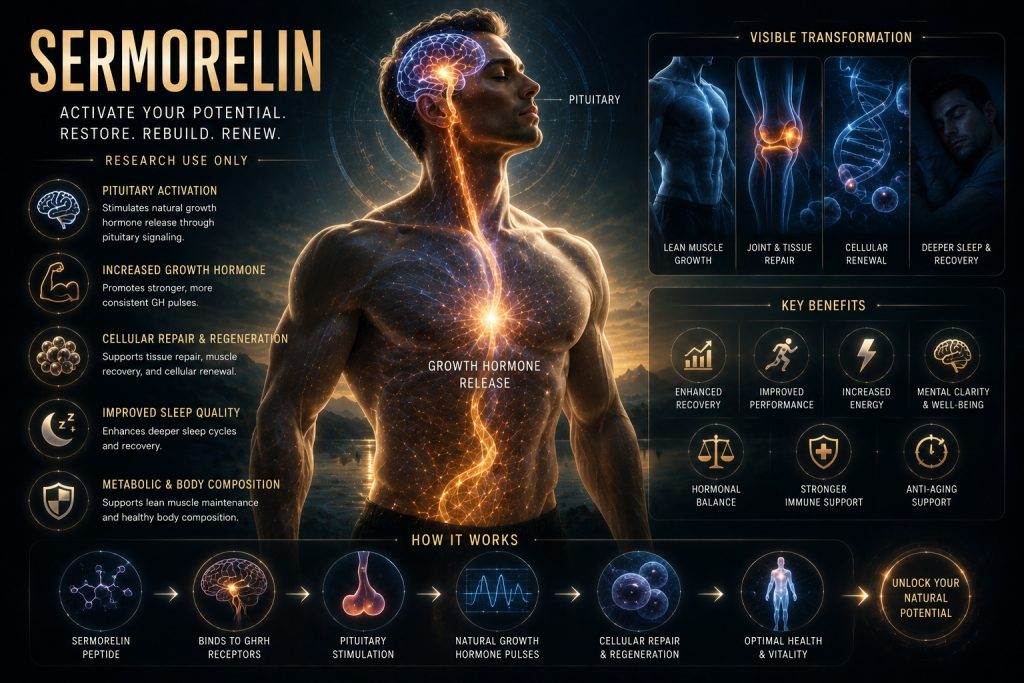
Sermorelin has become one of the most popular growth hormone optimization peptides for individuals seeking improved recovery, fat loss, lean muscle preservation, and healthy aging without relying on synthetic Human Growth Hormone (HGH). As a Growth Hormone-Releasing Hormone (GHRH) analog, Sermorelin stimulates your pituitary gland to release growth hormone naturally, helping maintain a more physiologic hormone profile while supporting long-term wellness goals.
As Sermorelin therapy has grown in popularity, so have the delivery options. While injectable Sermorelin remains the traditional and most widely prescribed form, newer tablet, sublingual, and buccal formulations have emerged as convenient alternatives.
This raises an important question:
Do Sermorelin tablets work as well as injections?
In this guide, we’ll compare:
How each form works
Bioavailability differences
Effectiveness for GH and IGF-1 production
Advantages and disadvantages
Side effects
Which option is best for your goals
Understanding How Sermorelin Works
Before comparing delivery methods, it’s important to understand how Sermorelin functions.
Sermorelin is a synthetic version of GHRH 1-29, the active portion of the natural hormone responsible for stimulating growth hormone release from the pituitary gland.
When Sermorelin binds to GHRH receptors, it triggers:
Natural growth hormone secretion
Increased IGF-1 production
Enhanced recovery
Improved fat metabolism
Support for lean muscle maintenance
Cellular repair processes
Unlike synthetic HGH, Sermorelin encourages your body to produce growth hormone in a natural pulsatile pattern while preserving hormonal feedback mechanisms.
Why Delivery Method Matters
Sermorelin is a peptide composed of amino acids.
Like most peptides, it faces one major challenge:
Digestive enzymes break it down rapidly.
This means the route of administration directly influences:
Absorption
Bioavailability
Growth hormone response
Overall effectiveness
The more Sermorelin that reaches circulation intact, the stronger its potential effects.
Sermorelin Injections
Injectable Sermorelin is the most studied and clinically validated delivery method.
Typically administered:
Subcutaneously (under the skin)
Occasionally intramuscularly
Because injections bypass the digestive tract entirely, they allow the peptide to enter circulation with minimal degradation.
Bioavailability
Injectable Sermorelin typically achieves:
Approximately 90–95% bioavailability
Growth hormone release generally begins:
Within 15–30 minutes
Peak GH levels typically occur:
Within 1–2 hours after administration
Benefits of Injections
Maximum Effectiveness
Injections produce the strongest and most reliable GH response.
Potential benefits include:
Higher IGF-1 production
Better recovery
Enhanced body composition
Improved sleep quality
Greater fat metabolism
Precise Dosing
Injectable protocols allow:
Accurate dosing
Consistent delivery
Reliable blood concentration levels
This makes it easier to optimize therapy under medical supervision.
Strong Clinical Support
Most research involving Sermorelin has been conducted using injectable protocols.
As a result, injections remain the preferred option among:
Hormone replacement clinics
Anti-aging practitioners
Performance-focused patients
Drawbacks of Injections
Potential disadvantages include:
Needle use
Reconstitution requirements
Refrigeration
Injection-site irritation
Less convenience when traveling
For some individuals, these factors create adherence challenges.
Sermorelin Tablets
Several companies now offer Sermorelin in:
Oral tablets
Sublingual tablets
Buccal tablets
While these options eliminate injections, absorption becomes the primary concern.
Oral Tablets (Swallowed)
Traditional oral tablets must pass through:
The stomach
Digestive enzymes
The liver
Because Sermorelin is a peptide, most of it is destroyed before reaching circulation.
Estimated bioavailability:
Less than 5%
This significantly limits growth hormone stimulation.
Sublingual and Buccal Tablets
Sublingual tablets:
Dissolve under the tongue
Buccal tablets:
Dissolve between the cheek and gum
These approaches bypass much of the digestive system by allowing absorption through the oral mucosa.
Potential bioavailability:
Approximately 15–30%
However, absorption remains highly variable between individuals.
Comparing Effectiveness
Growth Hormone Response
Injections
Potential outcomes:
Strong GH pulse
Reliable IGF-1 elevation
Consistent results
Tablets
Potential outcomes:
Mild GH stimulation
Variable absorption
Inconsistent results
For users seeking measurable hormone optimization, injections consistently outperform tablet formulations.
Bioavailability Comparison
Delivery Method Approximate Bioavailability Expected GH Response
Injectable Sermorelin 90–95% Strong
Buccal/Sublingual 15–30% Moderate
Oral Tablet <5% Minimal
Which Form Is Better for Fat Loss?
If your goal is:
Body recomposition
Lean muscle retention
Fat loss
Injectable Sermorelin is generally the superior option because it produces greater growth hormone and IGF-1 stimulation.
Potential benefits include:
Enhanced lipolysis
Improved recovery
Better training adaptation
Tablet formulations may offer some support but generally produce less dramatic outcomes.
Which Form Is Better for Anti-Aging?
For individuals focused primarily on:
General wellness
Healthy aging
Convenience
Buccal or sublingual tablets may provide a practical alternative.
Benefits include:
No needles
Easier travel
Simpler administration
However, users should understand that convenience comes with reduced potency.
Side Effects: Tablets vs Injections
Both forms are generally well tolerated because Sermorelin stimulates natural growth hormone production rather than supplying exogenous HGH.
Injection Side Effects
Potential effects include:
Injection-site redness
Mild swelling
Bruising
Headache
Temporary flushing
Most side effects are mild and short-lived.
Tablet Side Effects
Potential effects include:
Mild gastrointestinal discomfort
Oral irritation
Metallic taste
Variable energy levels due to inconsistent absorption
Systemic side effects are relatively uncommon because absorption is lower.
Cost and Accessibility
Injections
Advantages:
Strongest results
Most research support
Disadvantages:
Higher cost
Prescription requirements
Additional supplies
Tablets
Advantages:
More convenient
Often lower cost
Easier administration
Disadvantages:
Lower effectiveness
Limited clinical data
Who Should Choose Injections?
Injectable Sermorelin is generally best for individuals who want:
Maximum GH stimulation
Improved body composition
Better recovery
Enhanced sleep quality
Athletic performance support
Clinically optimized hormone therapy
For these goals, injections remain the gold standard.
Who Should Consider Tablets?
Tablets may be appropriate for individuals who:
Dislike needles
Prioritize convenience
Travel frequently
Want mild wellness support
Are seeking introductory peptide therapy
They may also be useful as part of a broader wellness protocol when aggressive hormone optimization is not the primary objective.
Final Verdict
While both forms aim to stimulate natural growth hormone production, the evidence strongly favors injectable Sermorelin for effectiveness, consistency, and measurable results.
Choose Sermorelin Injections If You Want:
Maximum GH release
Improved IGF-1 levels
Better fat loss
Enhanced recovery
Stronger performance benefits
Clinically validated outcomes
Choose Sermorelin Tablets If You Want:
Needle-free administration
Greater convenience
Travel-friendly use
Mild anti-aging support
Simpler daily routines
For serious body composition, recovery, hormone optimization, and performance goals, injections remain the preferred choice. For users focused primarily on convenience and general wellness, tablets may offer a practical entry point, though expectations should be adjusted to reflect their significantly lower bioavailability and overall effectiveness.