Whether you’re:
* An athlete
* Bodybuilder
* Endurance competitor
* Active individual
* High-frequency lifter
recovery is one of the most important factors for:
→ Performance progression
→ Injury prevention
→ Muscle growth
→ Longevity and consistency
The faster the body can repair:
→ Muscle tissue
→ Tendons and ligaments
→ Joints and fascia
→ Connective tissue
the faster recovery and adaptation may occur.
This is why peptides and growth hormone secretagogues have become increasingly popular within:
→ Recovery-focused performance communities
These compounds are often discussed for their ability to support:
→ Tissue regeneration
→ Angiogenesis
→ Sleep quality
→ Collagen synthesis
→ Systemic recovery pathways
Unlike anabolic steroids, many recovery-focused peptides appear to target:
→ Regenerative and healing pathways
rather than:
→ Pure anabolic signaling
This educational guide explores:
* The best peptides for recovery
* How they work
* Recovery and healing benefits
* GH/IGF-1 support
* Joint and connective-tissue repair
* Sleep and systemic recovery
* Stacking strategies
* Side effects and safety considerations
—
How Peptides & Secretagogues Support Recovery
Recovery peptides and GH secretagogues appear to support:
→ Tissue remodeling and regeneration
through multiple biological pathways.
—
1. Collagen Synthesis & Connective-Tissue Repair
Peptides such as:
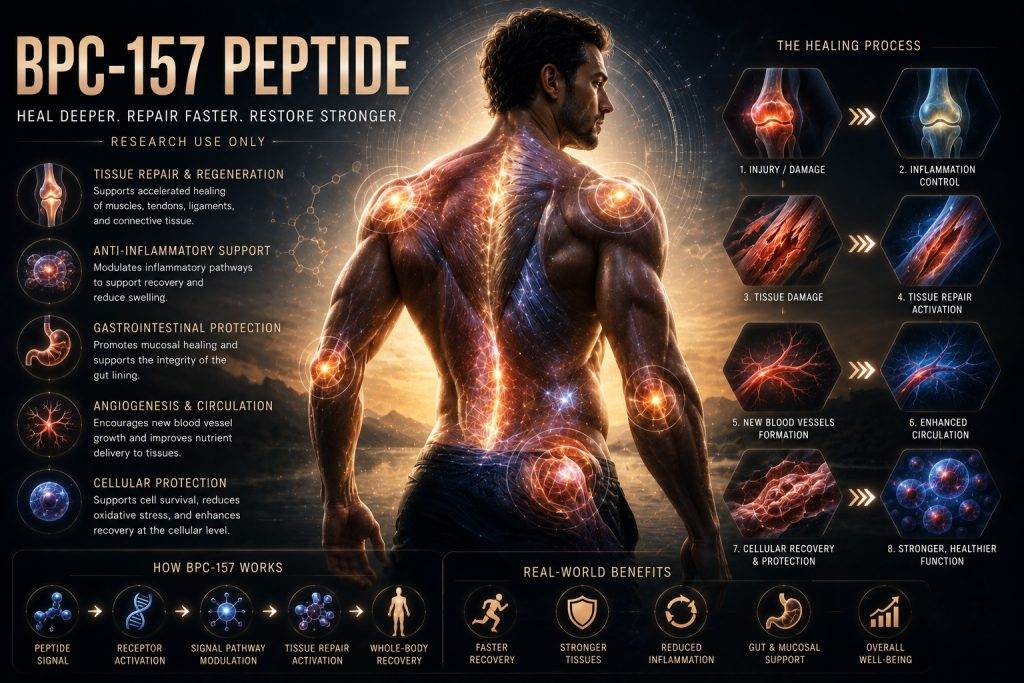
→ BPC-157
→ TB500
appear to support:
→ Collagen production and fibroblast activity
which may help improve:
→ Tendon strength
→ Ligament healing
→ Joint recovery
—
2. Angiogenesis (New Blood Vessel Formation)
Several recovery peptides may help support:
→ Angiogenesis
Potential benefits may include:
→ Improved blood flow
→ Better nutrient delivery
→ Faster tissue oxygenation
→ Enhanced waste removal from damaged tissue
—
3. Satellite Cell Activation & Muscle Repair
Growth hormone secretagogues such as:
→ MK-677
→ CJC-1295
→ Ipamorelin
appear to support:
→ GH and IGF-1 pathways
which may influence:
→ Satellite-cell activity
→ Muscle-fiber regeneration
→ Recovery from training-induced damage
—
4. Anti-Inflammatory & Neuroprotective Effects
Some peptides also appear to influence:
→ Inflammatory signaling pathways
Potential effects may include:
→ Reduced soreness
→ Less swelling
→ Improved tissue resilience
—
5. Sleep Optimization & Systemic Recovery
Recovery is heavily tied to:
→ Deep sleep quality
GH secretagogues such as:
→ MK-677
→ CJC-1295
→ Ipamorelin
→ Sermorelin
→ Tesamorelin
are frequently discussed for:
→ Enhancing slow-wave sleep and recovery capacity
—
Important Disclaimer
This content is provided for educational purposes only.
BPC-157, TB500, MK-677, CJC-1295, Ipamorelin, Sermorelin, and Tesamorelin are:
→ Investigational or research compounds
and are not FDA-approved for:
→ Performance enhancement or cosmetic use
—
BPC-157 (Body Protection Compound-157)
What Is BPC-157?
BPC-157 is a:
→ Synthetic peptide derived from gastric proteins
best known for:
→ Tissue repair and anti-inflammatory support
How BPC-157 Works
Potential mechanisms commonly discussed include:
→ VEGF and FGF upregulation
→ Angiogenesis support
→ Collagen synthesis
→ Fibroblast migration
→ Gut-lining protection
Benefits of BPC-157 For Recovery
Potential benefits may include:
→ Tendon and ligament healing
→ Joint recovery
→ Muscle regeneration
→ Gut-health support
→ Nerve-recovery support
Why Athletes Use It
BPC-157 is especially popular for:
→ Chronic injuries
→ Tendonitis
→ Soft-tissue repair
→ Recovery from overuse
—
TB500 (Thymosin Beta-4 Fragment)
What Is TB500?
TB500 is a:
→ Synthetic version of thymosin beta-4
a peptide heavily involved in:
→ Tissue regeneration and cellular migration
How TB500 Works
Potential mechanisms commonly discussed include:
→ Angiogenesis support
→ Actin polymerization
→ Cell migration
→ Extracellular matrix remodeling
Benefits of TB500 For Recovery
Potential effects may include:
→ Faster soft-tissue healing
→ Improved mobility
→ Better flexibility
→ Reduced fibrosis
→ Muscle and fascia recovery
Why TB500 Is Often Stacked With BPC-157
Potential reasons include:
→ BPC-157 focuses heavily on collagen synthesis and localized repair
while:
→ TB500 supports systemic tissue remodeling and vascular healing
—
MK-677 (Ibutamoren)
What Is MK-677?
MK-677 is an:
→ Oral growth hormone secretagogue
that mimics:
→ Ghrelin signaling
to stimulate:
→ Growth hormone and IGF-1 release
How MK-677 Works
Potential mechanisms may include:
→ GH elevation
→ Increased IGF-1
→ Enhanced sleep quality
→ Improved anabolic recovery environment
Benefits of MK-677 For Recovery
Potential benefits commonly discussed include:
→ Lean-mass retention
→ Better sleep
→ Faster muscle recovery
→ Joint support
→ Improved connective-tissue repair
Why Sleep Matters
One of MK-677’s most discussed effects is:
→ Enhanced deep sleep
which is critical for:
→ Systemic tissue repair and recovery
—
Ipamorelin
What Is Ipamorelin?
Ipamorelin is a:
→ Selective growth hormone–releasing peptide (GHRP)
known for stimulating:
→ Pulsatile GH release
with minimal effects on:
→ Cortisol or prolactin
Benefits of Ipamorelin
Potential effects commonly discussed include:
→ Improved muscle recovery
→ Better sleep quality
→ Joint and tendon support
→ Enhanced systemic recovery
Why Athletes Like Ipamorelin
Compared to some GH secretagogues, Ipamorelin appears:
→ More selective and better tolerated
with:
→ Fewer off-target hormonal effects
—
CJC-1295
What Is CJC-1295?
CJC-1295 is a:
→ Synthetic GHRH analog
designed to support:
→ Natural GH pulsatility
Two Main Versions
CJC-1295 With DAC
→ Longer half-life
→ Weekly dosing
CJC-1295 Without DAC
→ Shorter, more physiological GH pulses
→ Commonly paired with Ipamorelin
Benefits of CJC-1295
Potential benefits may include:
→ Recovery support
→ Improved sleep
→ Better body composition
→ Joint and connective-tissue support
Common Stack: CJC-1295 + Ipamorelin
This combination is widely discussed because:
→ GHRH + GHRP synergy may enhance GH pulsatility
—
Sermorelin
What Is Sermorelin?
Sermorelin is a:
→ Synthetic GHRH analog
designed to stimulate:
→ Physiologic GH release
Benefits of Sermorelin
Potential effects commonly discussed include:
→ Muscle recovery
→ Joint support
→ Better sleep quality
→ Collagen production support
→ Recovery from intense training
Why It’s Popular
Sermorelin is often viewed as:
→ A milder GH-support option
with a relatively:
→ Well-established safety profile
—
Tesamorelin
What Is Tesamorelin?
Tesamorelin is a:
→ Modified GHRH analog
originally developed for:
→ HIV-associated lipodystrophy
Benefits of Tesamorelin For Recovery
Potential benefits may include:
→ Enhanced tissue repair
→ Visceral-fat reduction
→ Increased IGF-1
→ Better muscle recovery
→ Improved collagen synthesis
Why It’s Used In Advanced Recovery Protocols
Tesamorelin is often discussed for:
→ Aggressive recovery and body-composition support
particularly alongside:
→ BPC-157 and TB500
—
Best Recovery Stacks
BPC-157 + TB500
Goal:
→ Comprehensive tendon, ligament, and muscle recovery
MK-677 + BPC-157
Goal:
→ GH/IGF-1 support + localized tissue healing
CJC-1295 + Ipamorelin
Goal:
→ Natural GH pulsatility + improved sleep and recovery
Advanced Recovery Stack
Common Discussion:
→ Tesamorelin + BPC-157 + TB500
Goal:
→ Systemic recovery + connective-tissue repair
—
Best Practices & Safety Considerations
Injection Techniques
Most recovery peptides are commonly administered:
→ Subcutaneously
using:
→ Sterile injection practices
Sourcing Concerns
Potential risks with low-quality peptides may include:
→ Contamination
→ Incorrect dosing
→ Poor sterility
Common Side Effects
Potential issues may include:
→ Water retention
→ Joint stiffness
→ Increased appetite (MK-677)
→ Mild fatigue
→ Injection-site irritation
Cycling Strategies
Potential cycle discussions commonly include:
| Compound Type | Common Duration |
| —————- | ————— |
| BPC-157 / TB500 | 4–6 weeks |
| GH Secretagogues | 8–12 weeks |
—
FAQ: Best Peptides For Recovery
Which peptide is best for tendon healing?
BPC-157 and TB500 are the most commonly discussed peptides for:
→ Tendon and connective-tissue recovery
Which peptide is best for sleep and recovery?
MK-677, Ipamorelin, and CJC-1295 are commonly discussed for:
→ Deep sleep and systemic recovery support
Can recovery peptides be stacked together?
Yes. Many advanced protocols combine:
→ Tissue-healing peptides + GH secretagogues
because they target:
→ Different recovery pathways
Is MK-677 better than Ipamorelin?
It depends on the goal:
→ MK-677 provides oral convenience and long-term GH support
while:
→ Ipamorelin may offer cleaner GH pulses with fewer water-retention concerns
Are these compounds FDA-approved?
No. These compounds remain:
→ Investigational and research-use compounds
with limited long-term human clinical evidence.
—
Conclusion: What Are The Best Peptides For Recovery?
Recovery is one of the most important factors for:
→ Long-term performance and injury prevention
Peptides and GH secretagogues such as:
→ BPC-157
→ TB500
→ MK-677
→ Ipamorelin
→ CJC-1295
→ Sermorelin
→ Tesamorelin
have become increasingly popular because they appear to support:
→ Tissue repair
→ Angiogenesis
→ Collagen synthesis
→ Sleep quality
→ Systemic regeneration
Potential recovery-focused advantages commonly discussed include:
→ Faster healing
→ Reduced inflammation
→ Better joint support
→ Improved muscle regeneration
→ Enhanced recovery capacity
However, despite growing interest, these compounds remain:
→ Experimental
with:
→ Limited human clinical evidence
→ No FDA approval for performance enhancement
→ Ongoing scientific uncertainty
For now, recovery peptides should be viewed as:
→ Investigational tools that may support recovery when combined with:
→ Smart training
→ Proper nutrition
→ Adequate sleep
→ Structured recovery programming.