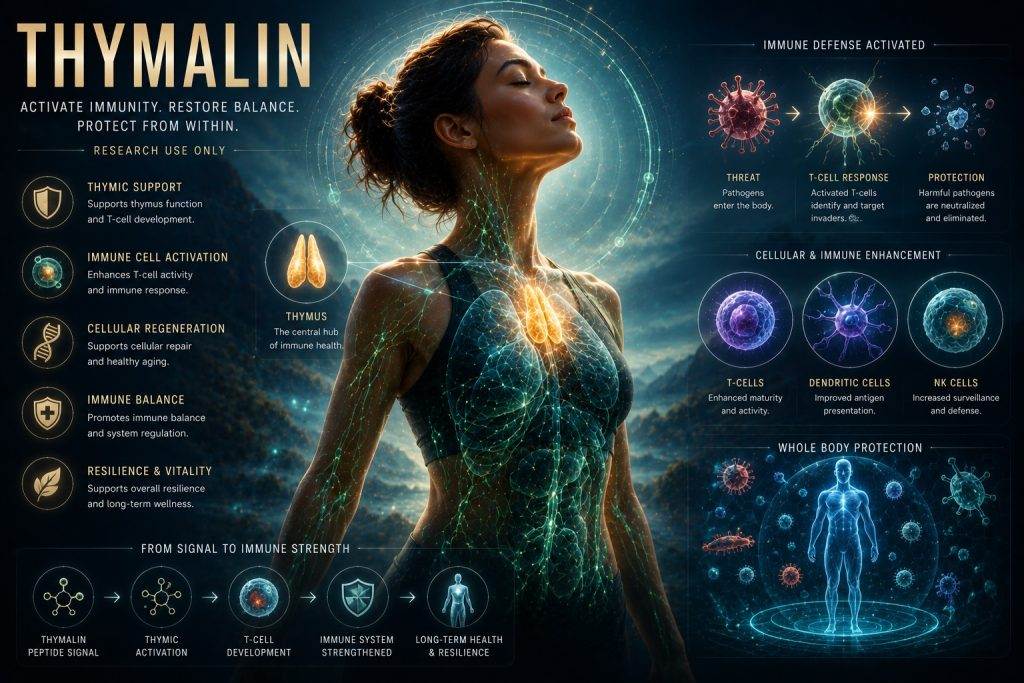
As interest in longevity, immune resilience, and recovery-focused peptides continues to grow, Thymalin has emerged as one of the most respected peptide bioregulators available. Developed in the former Soviet Union and used clinically for decades, Thymalin is known for its ability to support immune function, promote healthy aging, improve recovery, and help restore balance to stressed physiological systems.
Unlike many peptides that target a single pathway, Thymalin acts as a broad-spectrum biological regulator. By influencing immune function, cellular repair mechanisms, inflammation control, and gene expression, it has become popular among athletes, longevity enthusiasts, aging adults, and individuals recovering from illness or chronic stress.
In this beginner’s guide, we’ll cover:
What Thymalin is
How it works
Immune system benefits
Anti-aging and recovery advantages
Dosage recommendations
Stacking strategies
Side effects and safety
Common beginner mistakes
What Is Thymalin?
Thymalin is a natural peptide bioregulator derived from the thymus gland. It belongs to a class of compounds known as cytomedins, which are short peptides capable of influencing cellular function and gene expression.
Originally developed in Russia, Thymalin has been studied extensively for its ability to:
Restore immune function
Improve T-cell activity
Support blood cell production
Reduce inflammation
Enhance tissue regeneration
Promote healthy aging
Unlike more targeted immune peptides, Thymalin contains multiple biologically active peptide fractions that influence several physiological systems simultaneously.
How Thymalin Works
One of Thymalin’s unique characteristics is its ability to regulate biological processes at the genetic level.
Rather than simply stimulating the immune system, Thymalin helps normalize and rebalance cellular activity through several mechanisms.
Supports T-Cell Function
The thymus gland plays a critical role in the development and maturation of T-lymphocytes.
Thymalin may help:
Increase T-cell activity
Improve immune surveillance
Support adaptive immunity
Enhance resistance to infections
These effects are particularly valuable in aging individuals whose thymic function naturally declines over time.
Regulates Gene Expression
Research suggests Thymalin can influence genes involved in:
Inflammation control
DNA repair
Cellular regeneration
Apoptosis regulation
Longevity pathways
This gene-regulatory activity is one reason Thymalin is frequently discussed within anti-aging and longevity communities.
Supports Hematopoiesis
Thymalin has demonstrated the ability to support healthy blood cell production.
Potential benefits include:
Improved white blood cell production
Better immune resilience
Enhanced recovery from illness
Support for red blood cell formation
Reduces Chronic Inflammation
Chronic inflammation is associated with:
Accelerated aging
Poor recovery
Metabolic dysfunction
Autoimmune challenges
Thymalin may help reduce inflammatory signaling and support a healthier immune balance.
Benefits of Thymalin
Immune System Restoration
One of Thymalin’s primary uses is immune support.
Potential benefits include:
Improved immune competence
Enhanced infection resistance
Better recovery following illness
Improved immune surveillance
It has been studied extensively in aging populations and individuals experiencing immune dysfunction.
Healthy Aging and Longevity
Thymalin is often classified as a geroprotective peptide due to its potential anti-aging effects.
Potential benefits include:
Improved biological age markers
Enhanced immune function with age
Better cellular repair
Increased resilience to stress
Many longevity protocols pair Thymalin with other bioregulator peptides to support healthy aging.
Faster Recovery
Athletes and active individuals often use Thymalin to support recovery from:
Intense training blocks
Illness
Surgery
Injury
Chronic fatigue
By supporting immune function and reducing inflammation, Thymalin may help accelerate the recovery process.
Autoimmune and Inflammatory Support
Although research is ongoing, Thymalin may help promote better immune regulation rather than simply increasing immune activity.
Potential benefits include:
Improved immune balance
Reduced inflammatory burden
Better recovery from chronic immune stress
Thymalin Dosage Guide for Beginners
Thymalin is most commonly administered through:
Intramuscular (IM) injection
Subcutaneous (SubQ) injection
Standard Beginner Protocol
Daily Dose
10 mg per day
Duration
5–10 consecutive days
Frequency
1–4 cycles annually
This protocol is commonly used for immune support, anti-aging, and recovery applications.
Best Time to Inject
Thymalin may be administered:
Morning
Afternoon
Early evening
Because it is not a stimulant, timing is generally less critical than consistency.
Immune Support Strategies With Thymalin
Thymalin works best when combined with lifestyle habits that support immune resilience.
Prioritize Sleep
Quality sleep supports:
T-cell activity
Hormonal recovery
Immune regulation
Inflammation control
Many users pair Thymalin with sleep optimization strategies to maximize recovery benefits.
Support Gut Health
A significant portion of the immune system is associated with the gastrointestinal tract.
Strategies include:
Balanced nutrition
Fermented foods
Probiotic supplementation
Adequate fiber intake
These practices may complement Thymalin’s immune-regulating effects.
Control Inflammation
Reducing chronic inflammation can help optimize immune performance.
Helpful strategies include:
Regular exercise
Stress management
Omega-3 fatty acids
Healthy body composition
Thymalin Peptide Stacks
Many users combine Thymalin with other peptides for enhanced benefits.
Thymalin + Thymosin Alpha-1
A popular immune-focused stack.
Potential benefits:
Enhanced immune support
Improved infection defense
Better immune resilience
Thymalin + Epitalon
One of the most well-known longevity combinations.
Potential benefits:
Healthy aging support
Improved sleep regulation
Enhanced cellular repair
Longevity-focused effects
Thymalin + BPC-157
Potential benefits:
Recovery support
Tissue repair
Gut health support
Reduced inflammation
Thymalin + CJC-1295 + Ipamorelin
Potential benefits:
Recovery enhancement
Growth hormone support
Tissue regeneration
Improved resilience
Side Effects and Safety
Thymalin is generally considered one of the safest peptide bioregulators available.
Reported side effects are uncommon and typically mild.
Potential side effects include:
Injection site redness
Mild soreness
Temporary fatigue
Occasional headache
Rare nausea
Clinical experience spanning decades suggests a favorable safety profile when used appropriately.
Who Should Use Caution?
Although generally well tolerated, individuals should consult a healthcare professional before use, particularly if they:
Have active cancer
Use immunosuppressive medications
Are pregnant or breastfeeding
Have significant autoimmune conditions
Common Beginner Mistakes
Expecting Immediate Results
Thymalin works gradually by restoring biological balance.
Benefits often develop over:
Several days
Multiple weeks
Repeated cycles
Poor Recovery Habits
Thymalin cannot compensate for:
Sleep deprivation
Poor nutrition
Excessive stress
Overtraining
Optimizing lifestyle factors helps maximize results.
Inconsistent Usage
Many protocols recommend multiple cycles annually.
Using Thymalin only once may provide benefits, but repeated use is often utilized for long-term immune and longevity support.
Improper Storage
After reconstitution:
Refrigerate immediately
Avoid excessive heat exposure
Follow manufacturer storage recommendations
Proper handling helps preserve peptide integrity.
Legal Status
Thymalin is approved for medical use in several Eastern European countries and Russia but is generally classified as a research peptide in many other regions, including the United States. Availability and regulations may vary depending on local laws and healthcare frameworks.
Conclusion
Thymalin stands out as one of the most versatile immune-support and longevity-focused peptides available. Rather than targeting a single pathway, it works as a biological regulator that helps restore balance across immune, inflammatory, regenerative, and aging-related systems.
Potential benefits include:
Enhanced immune function
Improved recovery
Reduced inflammation
Support for healthy aging
Better resilience to stress
Improved tissue repair
For beginners interested in immune optimization, recovery enhancement, and long-term wellness strategies, Thymalin offers a unique and well-established approach. When combined with proper nutrition, quality sleep, regular exercise, and appropriate medical guidance, it can serve as a valuable component of a comprehensive health and longevity protocol.