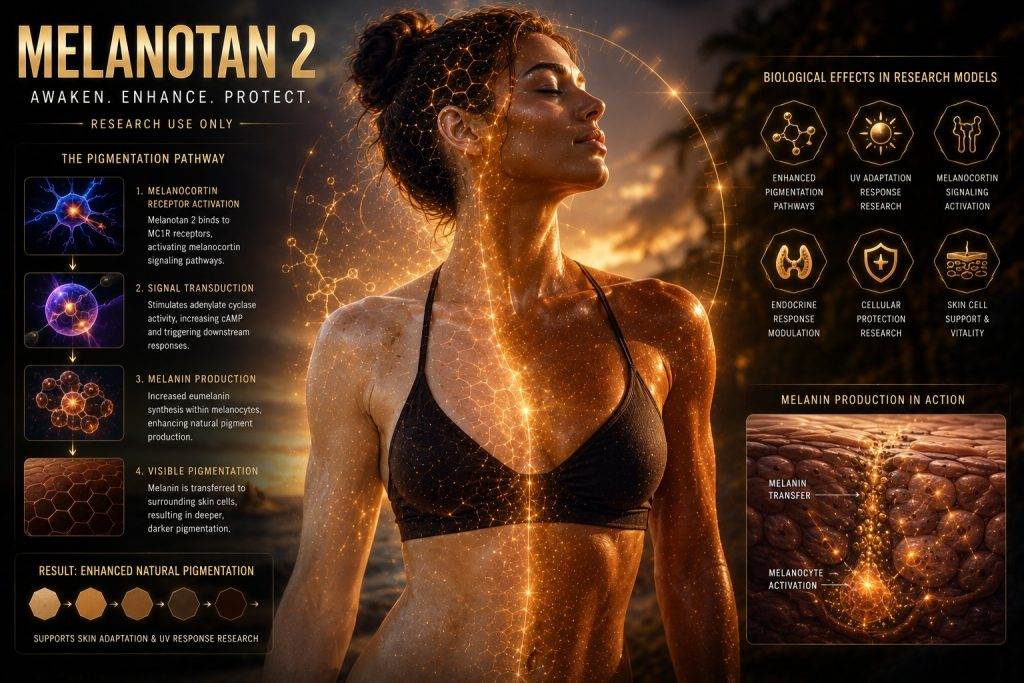
In recent years, Melanotan II has become one of the most talked-about peptides within:
• Biohacking
• Aesthetic enhancement
• Tanning communities
• Longevity circles
• Performance-focused wellness
Originally developed as a synthetic analog of:
→ Alpha-melanocyte-stimulating hormone (α-MSH)
Melanotan II gained popularity because of its potential ability to:
→ Increase skin pigmentation
→ Enhance libido
→ Suppress appetite
For many users, the appeal is obvious:
→ A darker tan with less UV exposure
However, despite its growing popularity online, Melanotan II remains:
→ Unapproved
→ Unregulated
→ Scientifically controversial
This educational guide explores:
• What Melanotan II is
• How it works in the body
• Potential tanning and libido benefits
• Side effects and safety concerns
• Legal status and regulation
• Dosage and administration protocols
• Risks consumers should understand before considering use
—
What Is Melanotan II and How Does It Work?
Melanotan II (MT-II) is classified as a:
→ Synthetic melanocortin peptide
designed to mimic the effects of:
→ Alpha-melanocyte-stimulating hormone (α-MSH)
The Role of α-MSH
Naturally occurring α-MSH plays a role in regulating:
→ Skin pigmentation
→ Appetite
→ Energy balance
→ Sexual signaling
Melanotan II was engineered to stimulate:
→ Melanocortin receptors
throughout the body.
Primary Receptor Targets
Melanotan II primarily affects:
| Receptor | Potential Function |
| ——– | —————————— |
| MC1R | Melanin production and tanning |
| MC3R | Appetite and metabolism |
| MC4R | Libido and sexual signaling |
How Tanning Happens
When Melanotan II activates:
→ MC1R receptors
it stimulates melanocytes to produce:
→ Melanin
the pigment responsible for:
→ Skin coloration and UV protection
This can lead to:
→ Gradual skin darkening with reduced UV exposure
Why Libido Increases
Melanotan II also stimulates:
→ MC4R receptors
which influence:
→ Sexual arousal pathways within the brain
This receptor activity helps explain why some users report:
→ Increased libido and sexual function
—
Benefits of Melanotan II
1. Sunless Tanning
The most popular reason users explore Melanotan II is:
→ Cosmetic tanning enhancement
Potential benefits commonly discussed include:
→ Darker skin pigmentation
→ Reduced tanning-bed exposure
→ Less UV-related skin damage
→ Longer-lasting tan appearance
Why This Appeals to Users
Many individuals with fair skin report difficulty tanning naturally and higher risk of:
→ Sunburn
→ Premature aging
→ UV-related skin damage
Melanotan II is often discussed as a way to:
→ Achieve pigmentation with less sun exposure
2. Enhanced Libido & Sexual Function
Many users also report:
→ Increased sexual arousal
→ Improved libido
→ Heightened sexual sensitivity
This effect is linked to:
→ MC4R activation within the central nervous system
Research Interest
Some research has explored melanocortin peptides involving:
→ Erectile function and sexual arousal pathways
which contributed to later development of:
→ PT-141 (Bremelanotide)
3. Appetite Suppression & Weight Management
Melanotan II also interacts with receptors involved in:
→ Appetite regulation and energy balance
Potential effects commonly discussed include:
→ Reduced hunger
→ Lower caloric intake
→ Mild appetite suppression
Important Limitation
Long-term evidence involving:
→ Weight-loss effectiveness and metabolic safety
remains limited.
—
Potential Risks and Side Effects
Despite the appeal of tanning and libido enhancement, Melanotan II also carries several important:
→ Health risks and safety concerns
1. Gastrointestinal Side Effects
The most commonly reported side effects include:
→ Nausea
→ Vomiting
→ Stomach discomfort
→ Cramping
These effects are often:
→ Dose-dependent
and may become more noticeable during:
→ Early-stage use
2. Hyperpigmentation & Mole Darkening
Because Melanotan II stimulates melanin production broadly, it may cause:
→ Darkening of freckles
→ Mole pigmentation changes
→ Uneven skin coloration
Why This Matters
Dermatologists have raised concerns that excessive pigmentation changes could:
→ Complicate melanoma detection
especially in individuals with:
→ High skin-cancer risk
3. Cardiovascular Concerns
Potential cardiovascular effects commonly discussed include:
→ Elevated blood pressure
→ Increased heart rate
→ Facial flushing
which may pose higher risk for individuals with:
→ Hypertension
→ Cardiovascular disease
4. Product Purity & Contamination Risks
Because Melanotan II is not FDA-approved, it is commonly sold through:
→ Unregulated online peptide vendors
Potential risks may include:
→ Contamination
→ Incorrect dosing
→ Counterfeit peptides
→ Poor sterility standards
—
Melanotan II vs Natural Tanning
Natural UV Tanning
Traditional tanning depends on:
→ UV radiation exposure
to stimulate melanin production.
Risks of UV Exposure
Excessive UV exposure is strongly associated with:
→ Skin aging
→ DNA damage
→ Sunburn
→ Increased skin-cancer risk
WHO Classification
The World Health Organization classifies tanning beds as:
→ Group 1 carcinogens
the same category as:
→ Tobacco products
Why Some Users Prefer Melanotan II
Melanotan II may allow users to achieve pigmentation with:
→ Less UV exposure
though some sunlight is still often needed to fully activate tanning effects.
Important Reality Check
Reducing UV exposure does NOT necessarily make Melanotan II:
→ Risk-free
especially given the lack of:
→ Long-term human safety data
—
Legal Status and Regulation of Melanotan II
United States
Melanotan II is:
→ NOT approved by the FDA
for:
→ Medical or cosmetic use
It is commonly sold online as:
→ A “research chemical”
Europe
Many European health agencies have issued warnings involving:
→ Illegal peptide sales
→ Product contamination
→ Safety concerns
Australia
In Australia, Melanotan II is generally classified as:
→ Prescription-only or restricted-use
under:
→ Therapeutic Goods Administration (TGA) oversight
Why Regulation Matters
Because Melanotan II exists outside normal pharmaceutical oversight, consumers face increased risk involving:
→ Purity
→ Dosing accuracy
→ Product authenticity
—
User Experiences and Testimonials
Positive Experiences Commonly Reported
Some users report:
→ Faster tanning
→ Increased libido
→ Reduced appetite
→ Improved confidence and aesthetics
Negative Experiences Commonly Reported
Others discuss issues involving:
→ Nausea
→ Skin discoloration
→ Elevated heart rate
→ Anxiety
→ Unpredictable product quality
Important Reminder
Anecdotal online reports should NOT replace:
→ Controlled medical research and professional guidance
—
Dosage Guidelines & Administration
Common Administration Method
Melanotan II is most commonly administered through:
→ Subcutaneous (SubQ) injection
Typical Starting Dose
Conservative protocols commonly discuss:
→ 0.25 mg daily initially
followed by gradual titration depending on:
→ Tolerance and skin response
Common Dose Range
Many users commonly discuss:
→ 0.5–1 mg daily
Injection Best Practices
Potential best practices commonly include:
→ Sterile syringes
→ Proper reconstitution
→ Clean injection technique
→ Rotating injection sites
Storage Guidelines
Potential storage recommendations commonly include:
→ Refrigeration after reconstitution
→ Protection from light and heat
→ Sterile vial handling
—
Frequently Asked Questions (FAQ)
What is Melanotan II?
Melanotan II is a synthetic melanocortin peptide commonly discussed for:
→ Tanning enhancement
→ Libido support
→ Appetite suppression
Is Melanotan II FDA-approved?
No. Melanotan II is not FDA-approved for:
→ Human therapeutic or cosmetic use
How long does it take to see tanning effects?
Some users report visible pigmentation changes within:
→ 7–14 days
depending on:
→ Skin type and UV exposure
Does Melanotan II help with weight loss?
Appetite suppression is commonly discussed as a:
→ Secondary effect
though it is not an approved weight-loss treatment.
Can Melanotan II increase libido?
Yes. Many users commonly report:
→ Increased sexual arousal and libido
because of:
→ MC4R receptor activation
Is Melanotan II safe long term?
Long-term human safety remains:
→ Unknown
because controlled human clinical evidence is still limited.
—
Important Disclaimer
This content is provided for educational purposes only and does not constitute medical advice.
Melanotan II remains:
→ An investigational and unapproved peptide compound
with:
→ Limited human clinical evidence
→ No FDA approval
→ Ongoing safety concerns
Always consult a licensed healthcare professional before considering:
→ Experimental peptide-related therapies
especially if you have:
→ Cardiovascular disease
→ Skin-cancer history
→ Hormonal disorders
→ Complex medical conditions
—
Conclusion: Should You Consider Melanotan II?
Melanotan II continues attracting attention because of its potential ability to support:
→ Sunless tanning
→ Libido enhancement
→ Appetite suppression
Potential advantages commonly discussed include:
→ Reduced UV exposure
→ Cosmetic tanning benefits
→ Increased sexual arousal
→ Convenience compared to traditional tanning
However, these potential benefits must be weighed against important concerns involving:
→ Product contamination
→ Cardiovascular strain
→ Hyperpigmentation
→ Mole darkening
→ Unknown long-term safety
Unlike approved medical therapies, Melanotan II remains:
→ Unregulated and experimental
with:
→ Significant scientific uncertainty and legal concerns
For now, Melanotan II should be viewed as:
→ A controversial investigational peptide
rather than:
→ A fully established or medically approved wellness therapy.